LetPot vs AeroGarden vs Click & Grow: Honest 6-Month Test
Last updated: August 5, 2026.
Affiliate disclosure: As an Amazon Associate I earn from qualifying purchases. Links marked “paid link” may earn Fern & Shelf a commission at no extra cost to you. Read our full Affiliate Disclosure.
LetPot vs AeroGarden vs Click & Grow used to be a tidy comparison between three countertop gardens with roughly the same capacity. LetPot has since replaced the 10-pod LPH-Max we tested with a much larger 21-pod Max. That change makes LetPot the most interesting option here, but it also needs an honest footnote.
We ran the older LetPot with 10 sites, the AeroGarden Bounty Basic with nine sites, and the Click & Grow Smart Garden 9 in the same kitchen for six months. The setup times, harvest observations, and noise notes below come from that test. Current prices and specifications come from the manufacturers’ US pages checked on August 5, 2026.
The quick answer: start with LetPot if you want the largest current system, app control, and deep automation. Choose Click & Grow if you want the quietest, least demanding routine. Choose AeroGarden if you want a strong light, open seed choices, and the current clearance price appeals to you.
A note about the LetPot model we tested
Our test unit was the 10-pod LetPot sold as LPH-Max when we bought it. The current LPH-Max is not a small revision. It has 21 standard planting sites, a second tray for two large plants, a 7.5-liter tank, a 36-watt light, automatic water refilling, automatic nutrient dosing, a 4.6-inch screen, and app control. Its official US price was $251.99 when we checked.
We have not relabeled the old test as a test of that new machine. When I discuss measured setup or growing results, I mean our 10-pod unit. When I discuss the current 21-pod Max, I stick to the official specification. It is a less dramatic way to write the comparison, but it is the only fair one.
What we grew
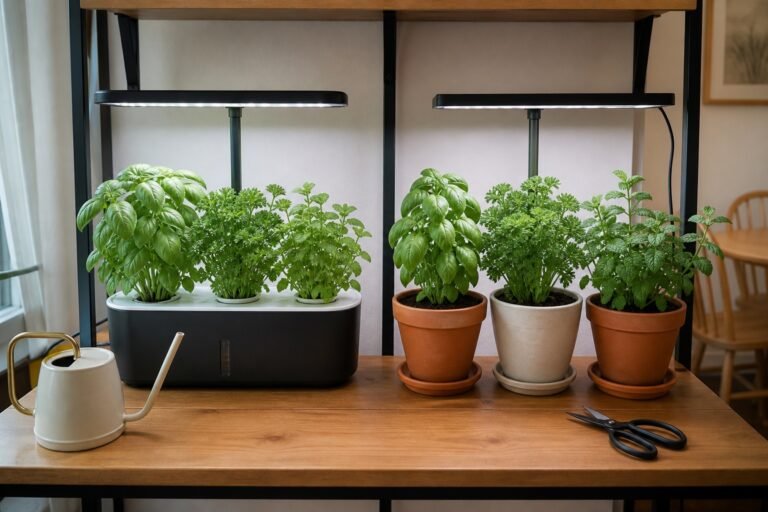
Each test garden started with basil, lettuce, parsley, mint, and cherry tomato. We kept them in the same kitchen and followed the care routine supplied with each system. Where a brand offered its own pod or sponge, we used it for the first cycle.
We tracked germination, time to the first harvest, and harvest weight during the first 90 days, then kept using all three for six months. A small kitchen test cannot settle every crop or every home. It can tell you which annoyances keep showing up after the novelty wears off.
Why LetPot stands apart
LetPot’s appeal was never just one more pod hole. The older unit gave us app-controlled light schedules, a quiet pump, and a seed system that did not lock us into pre-seeded capsules. It felt more configurable than Click & Grow and more polished on the software side than the Bounty Basic.
The current Max pushes much further in that direction. Its app and touchscreen control the light, watering, nutrient dosing, and cycling. The automatic refill connection is useful for travel, while the two-plant tray gives tomatoes and peppers space that a crowded 21-hole deck would not.
There is a cost to that ambition. The new Max is physically and functionally in a different class from the two nine-pod gardens. If you only want basil and lettuce on a narrow counter, much of its automation may be wasted. If you enjoy settings and want to grow more, it is the clear place to start this three-way decision.
The six-month test results
Setup
Click & Grow was ready in about eight minutes. LetPot took 12 minutes, including app pairing. AeroGarden took 22 minutes because it had more parts, more instructions, and an onboard setup sequence.
Those times were not a deal breaker for any of them. They did predict the daily feel. Click & Grow kept decisions to a minimum. LetPot invited adjustment through the app. AeroGarden sat in the middle, with useful controls on the unit and more routine hydroponic maintenance.
Seed freedom and refills
The tested LetPot used reusable inserts with replaceable sponges, so we could plant any seed and keep refill costs low. AeroGarden was almost as flexible. Its reusable baskets work with the brand’s Grow Anything kit, and many owners use replacement sponges.
Click & Grow was the tidiest but the most tied to its own medium. The correction older comparisons miss is that you can use your own seeds. Click & Grow sells official seedless Grow Anything pods. You still buy the brand’s growing medium, but you are not restricted to its pre-seeded plant catalog.
Growing performance
AeroGarden produced the largest plants and the heaviest total harvest in our test. Its basil was roughly 30 percent larger than the same variety in the other two units, and the cherry tomato matured first there.
Click & Grow produced the most even crop. Every supplied pod germinated, and every plant stayed healthy. The harvest was smaller, but we did less to get it.
Our 10-pod LetPot matched AeroGarden closely on leafy greens and fell a little behind on tomato. Adjusting the light schedule in the app improved our results over the default program. That observation belongs to the tested unit. I would not assign the same yield to the current 21-pod Max until we run it through the same cycle.
Noise and daily use
Click & Grow was silent because it uses passive watering. Our LetPot ran nearly silently. The Bounty Basic pump was audible from across a quiet room, although normal kitchen noise covered it.
LetPot offers hardware control from its app. Click & Grow’s companion app supplies care tips and harvest reminders, but the Smart Garden 9 does not depend on it. AeroGarden’s current app page lists Bounty Basic among its compatible gardens, while an older Bounty Basic specification says the model has no WiFi or app support. Compatibility may depend on the model year and firmware, so verify the exact unit before making app control part of the decision.
Current models and prices in 2026
This table uses current manufacturer specifications and US prices checked on August 5, 2026. LetPot’s test result still refers to our older unit with 10 sites, and the AeroGarden figure includes a clearance discount.
| Feature | LetPot LPH-Max | AeroGarden Bounty Basic | Click & Grow Smart Garden 9 |
|---|---|---|---|
| Official price at check | $251.99 | $107.97 clearance ($179.95 regular) | $249.95 |
| Current plant sites | 21, plus a two-plant tray | 9 | 9 |
| Light | 36W | 30W | 13W |
| Water capacity | 7.5 L | Large countertop bowl | 4 L |
| Maximum light height | 30 inches | 24 inches | Two extension arms |
| Controls | 4.6-inch screen and app | Onboard display; app compatibility may vary by model year and firmware | Built-in timer |
| Automatic refill | Yes | No | No |
| Automatic nutrient dosing | Yes | No | Contained in Plant Pods |
| Own-seed route | Sponge system | Grow Anything kit | Grow Anything Plant Pods |
For the current model row, I used LetPot’s official LPH-Max page and AeroGarden’s Bounty Basic listing. AeroGarden’s current app compatibility page supplies the compatibility caveat. Click & Grow’s Smart Garden 9 page supplied the other specifications, while its Grow Anything page confirms the option for using your own seeds. These are manufacturer references for the dated specs and prices, not our buying links.
Amazon prices change often, and older model names can remain in search results. Check the pod count and model description before ordering:
- Check the Click & Grow Smart Garden 9 on Amazon (paid link)
- Check the AeroGarden Bounty Basic on Amazon (paid link)
- Check listings for the tested LetPot LPH-Max 10 on Amazon (paid link)
Which garden fits which buyer?
LetPot makes sense if you want one system to handle a larger planting, you like app controls, or travel makes automatic refilling attractive. The current Max has the most automation here. It also takes more counter space and asks you to learn more settings.
AeroGarden fits the person who values harvest performance and seed flexibility more than silence. The Bounty Basic won our yield test and has room for taller crops. It also had the lowest official price at our August 5 check, though that figure was a clearance offer rather than a stable list price.
Click & Grow is the calm option. It is clean, quiet, and hard to misuse. It delivered the most consistent germination in our test. You pay more for branded growing medium and get less control in return, which some beginners will see as a relief.
If your shortlist has narrowed to the two nine-pod systems, read our focused AeroGarden vs Click & Grow comparison. That page covers their pairwise differences without pulling LetPot into every answer.
What the refills cost
LetPot and AeroGarden make sense for people willing to buy seeds, replace sponges, and manage nutrients. The exact yearly bill depends on what you grow and how often you restart the garden. It can be low, but calling the pods “free” ignores seeds, sponges, and plant food.
Click & Grow is easier to price. On the date of our check, standard nine-packs cost $29.95 and 30-packs cost $59.95 on the official US store. That works out to about $3.33 or $2 per pod. Official Grow Anything pods use the same pricing structure and let you add your own seeds.
Do not choose from a one-year total unless the comparison shows its assumptions. A basil pod may stay productive for months, while lettuce gets replaced much sooner. Four full replantings and twelve full replantings produce very different numbers.
Frequently asked questions
Did you test the current 21-pod LetPot Max?
No. We tested the earlier 10-pod LPH-Max for six months. The current specifications and price come from LetPot’s official product page, but we do not present the older harvest results as a test of the new model.
Which system is the quietest?
Click & Grow is silent. Our older LetPot was close enough that we rarely noticed it. The AeroGarden pump was the easiest to hear in a quiet room.
Can all three use my own seeds?
Yes, with different levels of convenience. LetPot uses a sponge format, AeroGarden sells a Grow Anything kit, and Click & Grow sells seedless Grow Anything Plant Pods.
Which one is best for a complete beginner?
Click & Grow asks the fewest questions and was the most consistent in our test. LetPot makes sense for a beginner who enjoys apps and wants room to experiment. AeroGarden is still approachable, but its nutrients, pump, and controls add a little more routine.
LetPot vs AeroGarden vs Click & Grow: the bottom line
LetPot leads this comparison because its current Max offers the broadest automation and far more capacity than the other two. Our six-month experience with the older 10-pod version also gives us a reason to take the brand seriously: the app was useful, the pump stayed quiet, and greens grew close to AeroGarden’s pace.
AeroGarden remains the performance pick from the units we tested. Click & Grow remains the easy one. The current LetPot Max is the ambitious choice, with one caveat worth repeating: its 21-pod hardware is different enough that our old yield numbers do not belong to it.
Still unsure whether any countertop appliance is worth the money? Compare the category with a simple grow light and pots in our guide to whether smart indoor gardens are worth it, or start with the broader beginner hydroponic systems guide.