
Microgreens Scaling Equipment: 7 Upgrades for Real Bottlenecks
Last updated: July 22, 2026.
Affiliate disclosure: As an Amazon Associate I earn from qualifying purchases. Links marked “paid link” may earn Fern & Shelf a commission at no extra cost to you. Read our full Affiliate Disclosure.
Start here: For a complete overview, see our How to Grow Herbs Indoors Without Sunlight.
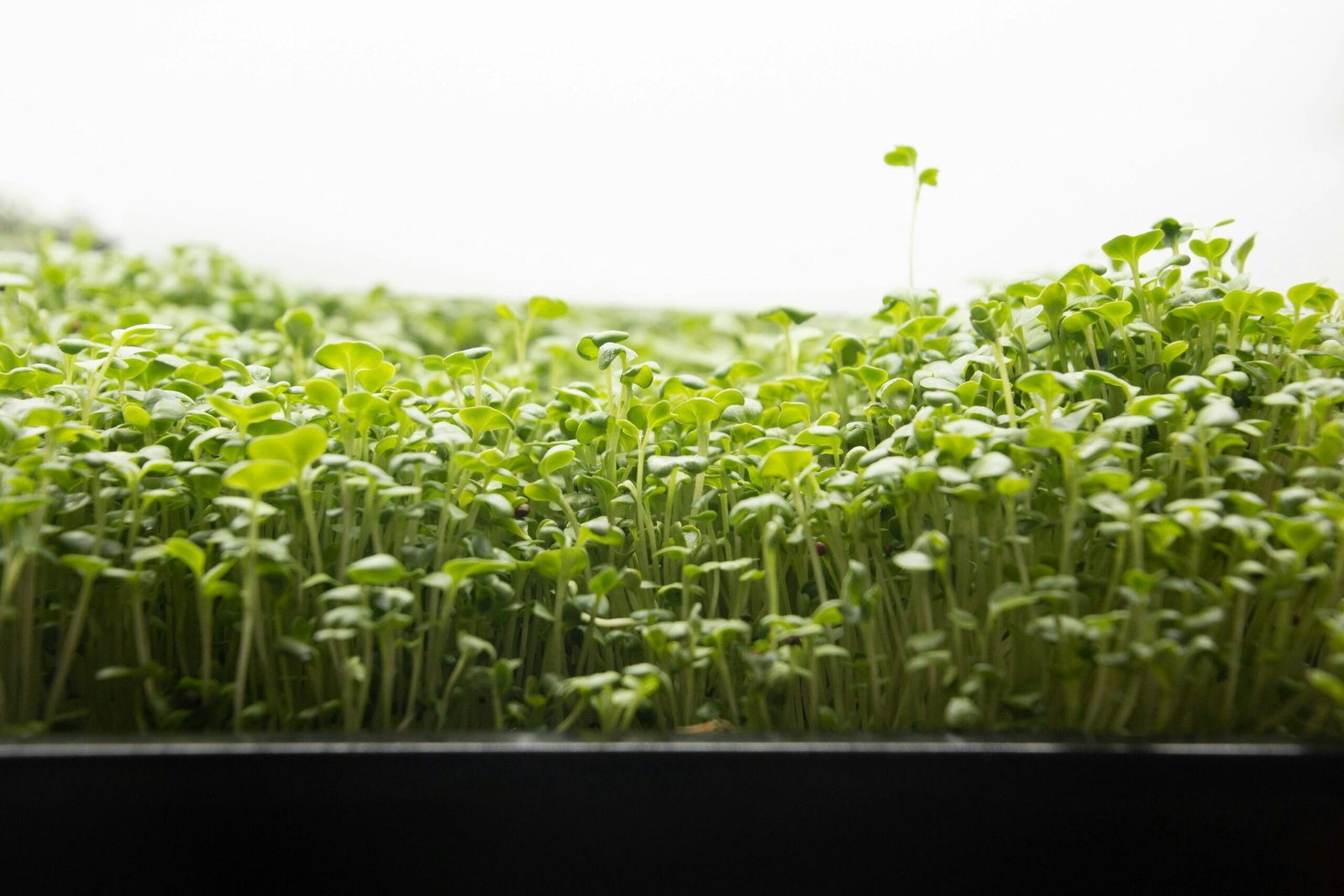
Microgreens scaling equipment should solve a measured bottleneck. It should not be a reward for one busy market or a shortcut to a weekly revenue number.
Matching equipment tiers to weekly sales targets looks neat on paper. In practice, microgreens scaling depends on order mix, price, crop cycle, usable yield, loss, delivery time, food-safety controls, and the number of trays that sell. A rack doesn’t create demand. A humidifier doesn’t fix weak sanitation. A heat sealer doesn’t prove shelf life.
A safer scaling plan starts with records and moves through seven upgrade gates. The numbers come from your operation, not a national income promise.
Microgreens scaling starts with four normal weeks of records
Choose four weeks that do not include a one-off festival or holiday order. For each crop, record:
- trays seeded, harvested, rejected, sampled, donated, and sold;
- usable package weight or count from each tray;
- seed, medium, packaging, card fees, and other variable costs;
- minutes spent seeding, watering, cleaning, harvesting, packing, selling, and delivering;
- orders requested, orders filled, late orders, substitutions, and unsold inventory;
- temperature or humidity observations that connect to a real crop problem.
These records show whether the current constraint is space, light, watering time, harvest labor, cold holding, delivery, or sales. If half the crop remains unsold, more rack capacity will magnify the wrong number.
The economics gate: contribution is not profit
The SBA break-even guide defines contribution margin from selling price and variable cost. For a crop, start with collected sales revenue and subtract the costs that rise with that sale, such as seed, medium, packaging, payment fees, expected crop loss, and variable delivery cost.
That remainder is not net profit. It still has to cover labor, insurance, licenses, utilities, rent, equipment wear, marketing, taxes, and financing. If an equipment purchase saves labor, give the saved minutes a realistic hourly value. If it adds cleaning or maintenance, count that too.
A simple purchase test is:
- What exact bottleneck does this solve?
- How many paid, repeat orders are currently constrained by it?
- What labor or loss changes after the purchase?
- What extra cleaning, utility, repair, and compliance cost appears?
- Can the same result be tested by renting, borrowing, or changing the schedule?
Microgreens scaling upgrade 1: trays and rack capacity
Add tray pairs only when normal recurring orders are bumping against safe capacity. Count germination trays, blackout or weight trays, bottom-watering trays, and the trays temporarily out of service for cleaning or damage. A plan that counts only planted trays will run short.
Heavy trays may reduce replacement and handling problems, but no universal cycle life or three-month payback applies. Track your own cracks, warping, leaks, and replacement dates before assuming a premium tray is cheaper.
Search Amazon for heavy-duty 1020 trays (paid link)
A second rack helps only if the room can safely support it. Measure floor area, door clearance, shelf depth, electrical access, airflow, cleaning access, and the weight of wet trays. Leave enough room to remove a tray without brushing it against the crop above.
Search Amazon for a heavy-duty wire rack (paid link)
Upgrade 2: one repeatable light layout per active tier
Scaling a rack means scaling the light pattern. One panel above a multi-tier rack cannot illuminate the opaque shelves beneath it. Each active tier needs a fixture arrangement that covers the tray surface evenly and can be mounted without unsafe cords or wet connections.
Before buying more of the same fixture, map the current shelf. Compare center and edge growth, crop color, stem strength, heat, and harvest consistency. If the corners lag, adding trays to the same footprint compounds the problem.
Do not buy a large board light merely because its wattage looks impressive. Its shape may suit one open canopy better than several narrow rack shelves. Match fixture dimensions and mounting distance to the shelf, then duplicate a layout that has already produced a consistent crop.
Microgreens scaling upgrade 3: a cleaner watering route
At small scale, a measured pitcher and bottom-watering trays are easy to understand and clean. At larger scale, the first improvement may be a fill cart, a hose that reaches a dedicated wash area, or a written watering route. It is not automatically overhead misting.
Any irrigation upgrade should deliver a known amount, avoid cross-contamination between trays, drain completely, and be accessible for cleaning. An automated system that saves ten minutes but leaves standing water or difficult-to-clean tubing is not an upgrade.
A hygrometer can help document room conditions. It should not be used as an instruction to raise humidity without diagnosing the crop and reviewing condensation, airflow, and sanitation.
Search Amazon for a digital hygrometer and thermometer (paid link)
Microgreens scaling upgrade 4: cleaning and records
This is often the least photogenic and most useful microgreens scaling equipment. A dedicated wash area, drying rack, clearly separated clean and dirty zones, labeled tools, written cleaning steps, and lot records can matter more than another growing shelf.
FDA guidance distinguishes microgreens from sprouts for the sprout-specific rule, but microgreens can still be covered produce unless an exclusion or exemption applies. The FDA Produce Safety Rule overview covers agricultural water, worker health and hygiene, and equipment, tools, and sanitation for covered operations. Confirm which requirements apply to your farm and keep the records needed to support any exemption.
If a rack expansion outpaces the ability to clean trays, dry equipment, trace seed lots, and separate finished product, stop adding crop capacity.
Upgrade 5: packaging and cold holding
Choose packaging after testing it with your crop, your label, your delivery route, and your buyer’s refrigerator. A heat seal can provide tamper evidence or change the presentation. It does not automatically add two or three days of shelf life. Shelf life has to be validated under the actual harvest, handling, temperature, and package conditions.
The USDA Agricultural Research Service notes that harvested microgreens deteriorate quickly and that postharvest quality and food safety remain practical challenges. Read the USDA ARS microgreens review record, then build a cold-holding and delivery procedure around your own crop.
Use insulated transport only as part of a measured temperature-control plan. A cooler full of warm product is storage, not cooling.
Search Amazon for insulated delivery containers (paid link)
Upgrade 6: weighing, labeling, and order control
A production scale can improve crop records and package consistency. Selling by declared net weight may require an approved and inspected device under state or local weights and measures rules. Ask the responsible office before buying a scale advertised as “commercial.”
For packaged food, review the FDA Food Labeling Guide and state requirements. Product identity, net quantity, business name and address, ingredients for mixes, and allergen information when applicable are among the items that may matter. Do not order thousands of labels until the authority and market manager have reviewed the format.
At this point, a simple order sheet can save more time than new machinery. Record customer, crop, pack size, quantity, promised date, lot, delivery status, and payment status in one place.
Upgrade 7: space, permits, and insurance
A dedicated production room changes the business. Check lease terms, zoning, water and drainage, electrical load, washable surfaces, pest control, waste, storage, access, and whether food production is allowed there. A spare bedroom is not automatically an approved food facility.
The SBA permits guide says requirements vary by activity and location. The SBA insurance guide also identifies product liability and home-based business coverage as policies to discuss. There is no universal revenue threshold at which an LLC suddenly becomes required or liability disappears.
Rules and official guidance in this article were checked on July 22, 2026. State, county, city, and market rules can be stricter or simply different, so confirm them before expansion.
A practical microgreens scaling decision table
| Your records show | First response to test | What not to assume |
|---|---|---|
| Repeat paid orders exceed safe tray capacity | Add a small number of tray pairs or one proven shelf | Every inquiry will become a recurring order |
| Uneven crops across a shelf | Correct coverage and mounting before adding capacity | More wattage alone fixes geometry |
| Watering consumes too much time | Standardize volume and route, then test simple delivery aids | Overhead misting is the only solution |
| Cleaning creates a queue | Improve wash, separation, and drying capacity | Another rack is the priority |
| Quality falls during delivery | Measure harvest, cooling, package, and transport conditions | A sealer proves longer shelf life |
| Orders or lots are being mixed up | Use a simple order and traceability system | Software can repair a weak process by itself |
| Home space is no longer suitable | Price and approve a compliant location before moving | Rent is the only new cost |
Equipment I would still postpone
- Industrial humidification: Not until measured conditions, crop response, condensation, cleaning, and room design show a need.
- Vacuum sealers and freezers for pesto or powders: These products introduce processing, recipe, labeling, and facility questions beyond fresh microgreens.
- Huge seed contracts: Wait until crop mix, storage conditions, lot performance, and recurring demand are stable.
- Equipment bought for resale value: Used prices are uncertain. Buy for a documented job, not an assumed recovery percentage.
Frequently asked questions
When should I buy a second microgreens rack?
When several normal weeks of paid repeat orders exceed the safe capacity of your current rack, and sales, cleaning, lighting, cold holding, and delivery can absorb the extra crop. One unusually busy week is not enough evidence.
Do I need automated irrigation?
Not at a universal tray count. Measure watering labor and errors first. A simple fill and bottom-watering routine may scale farther than expected, while a poorly designed automated system can add standing water and cleaning work.
How fast should scaling equipment pay for itself?
There is no honest universal answer. Use the purchase cost, additional operating cost, labor change, avoided loss, and contribution from orders that are already constrained. Run a conservative case with slower sales and repairs before deciding.
Should I form an LLC before scaling?
Choose a business structure with qualified legal and tax advice for your state. Revenue alone does not create a single national threshold, and an LLC does not replace permits, food-safety controls, contracts, or insurance.
The bottom line
Good microgreens scaling equipment makes an existing process safer, steadier, or less labor-intensive. Microgreens scaling still begins with an order, not a sales forecast.
Keep four weeks of plain records, identify the narrowest bottleneck, and make one controlled upgrade. If the next four weeks improve, you have evidence. If they do not, a larger shopping list was never the answer.