PPFD and DLI for Indoor Plants: Free 5-Point Worksheet
Last updated: July 23, 2026.
PPFD and DLI for indoor plants answer two practical questions. How much usable light reaches the leaves, and how much arrives over the full day?
The abbreviations look harder than the math. PPFD is an instant reading at the canopy. DLI combines that reading with the hours your light runs. The catch is coverage: one bright reading in the center can hide dim corners.
This guide gives you starting ranges, a conversion chart, and a five-point worksheet you can print or copy into a notes app. Every worksheet example uses invented readings. It shows the calculation without pretending we measured your shelf.
The 30-second answer
- PPFD is the intensity of 400 to 700 nm PAR photons at the leaf surface. It is measured in micromoles per square meter per second, written as
µmol/m²/s. - DLI is the total of those photons delivered across one day. It is measured in moles per square meter per day, written as
mol/m²/day. - With a steady electric grow light, calculate DLI using: DLI = PPFD × hours × 0.0036.
- A plant under 100 PPFD for 14 hours receives a DLI of about 5.0. The same plant under 250 PPFD for 14 hours receives a DLI of 12.6.
If you are still deciding whether your plants need a grow light at all, start there. If you already have a light and want to know whether it is doing enough, PPFD and DLI are the numbers that help.
PAR, PPF, PPFD, and DLI in plain English
These terms are related, but they do not describe the same thing.
| Term | What it means | Unit | What it tells you |
|---|---|---|---|
| PAR | Photosynthetically active radiation, traditionally the 400 to 700 nm waveband | Not one measurement by itself | Which part of the light spectrum is being discussed |
| PPF | Photosynthetic photon flux | µmol/s | How much PAR-range light a fixture produces in total |
| PPFD | Photosynthetic photon flux density | µmol/m²/s | How much of that light reaches a square meter at the plant canopy right now |
| DLI | Daily light integral | mol/m²/day | How much PAR-range light reaches that area over the entire day |
This guide uses the conventional 400 to 700 nm definition. Some newer research and meters use extended PAR, or ePAR, which includes 700 to 750 nm photons too. An ePPFD reading is therefore not directly interchangeable with a conventional PPFD reading unless the wavelength range is stated. Michigan State University explains the distinction here.
Think of a shower. PPF is the total water leaving the showerhead. PPFD is how hard the water hits one spot. DLI is how much water has collected in the tub by the end of the shower.
This distinction matters when you shop for lights. Watts tell you how much electricity a fixture uses. Lumens describe brightness as human eyes perceive it. Neither tells you how many conventional PAR-range photons reach a leaf. Iowa State University Extension identifies PPFD as the more useful intensity measurement for indoor plant lighting.
PPFD is also not a single permanent score for a lamp. The reading changes with hanging height, angle, optics, coverage, and the position of the plant. A bright number directly under the center of a fixture can hide weak edges.
How much PPFD and DLI do indoor plants need?
There is no single ideal PPFD for houseplants, seedlings, and food crops. A pothos maintained on a shelf, a tray of seedlings, and basil grown for regular harvest do not have the same goal.
The following broad bands come from Iowa State University Extension. Treat them as starting ranges, not hard biological limits for every species or cultivar.
| Light group | Starting DLI | Approximate PPFD for a 14-hour day | Typical uses listed by Iowa State |
|---|---|---|---|
| Low light | 3 to 6 mol/m²/day | 60 to 119 µmol/m²/s | Foliage houseplants |
| Medium light | 6 to 10 mol/m²/day | 119 to 198 µmol/m²/s | Foliage and flowering houseplants, cuttings, and starting seedlings near the high end |
| High light | 12 to 16 mol/m²/day | 238 to 317 µmol/m²/s | Flowering houseplants, succulents, starting seedlings near the low end, leafy herbs, and vegetables |
| Very high light | 18 to 30 mol/m²/day | 357 to 595 µmol/m²/s | Herbs, fruiting plants, and vegetables with demanding production goals |
The PPFD column is calculated from the DLI range and assumes the light stays at roughly the same intensity for 14 hours. It is not a separate recommendation from Iowa State.
These categories are deliberately broad. The University of Minnesota Extension lists canopy-intensity bands of 50 to 150 for low light, 150 to 250 for medium light, and 250 to 450 for high light. It also notes that a plant may tolerate low light but need more to produce dense foliage or flowers.
Young plants and food crops deserve more specific sources. The 2021 Indoor Lighting Guide, edited by Erik Runkle of Michigan State University and Yujin Park of Arizona State University, gives many young plants a target DLI of 8 to 12. A dedicated Virginia Tech Extension DLI guide lists 9 to 12 as a general microgreens range, while its newer microgreens production overview discusses a broader 9 to 16 range. Both stress that the best level depends on species, yield goals, quality, and energy cost.
Herbs are not one lighting category either. The Virginia Tech DLI guide lists broad references of 10 to 15 for parsley, 15 to 20 for cilantro, and 15 to 25 for basil. If your goal is growing herbs indoors without sunlight, identify the crop before choosing the target.
That is the pattern to remember: use a broad range to get close, then adjust for the actual plant and the result you want. A low-light plant surviving is not the same goal as compact new growth. Keeping basil alive is not the same goal as harvesting it every week.
PPFD-to-DLI chart
For a steady grow light, use this formula:
DLI = PPFD × hours of light × 0.0036
The table below does the math for common home setups.
| PPFD at leaf level | 10 hours | 12 hours | 14 hours | 16 hours |
|---|---|---|---|---|
| 50 µmol/m²/s | 1.8 | 2.2 | 2.5 | 2.9 |
| 100 µmol/m²/s | 3.6 | 4.3 | 5.0 | 5.8 |
| 150 µmol/m²/s | 5.4 | 6.5 | 7.6 | 8.6 |
| 200 µmol/m²/s | 7.2 | 8.6 | 10.1 | 11.5 |
| 250 µmol/m²/s | 9.0 | 10.8 | 12.6 | 14.4 |
| 300 µmol/m²/s | 10.8 | 13.0 | 15.1 | 17.3 |
| 400 µmol/m²/s | 14.4 | 17.3 | 20.2 | 23.0 |
| 500 µmol/m²/s | 18.0 | 21.6 | 25.2 | 28.8 |
All DLI values in the table are in mol/m²/day and rounded to one decimal place.
Hours and intensity work together. A weak light left on longer may deliver the same mathematical DLI as a stronger light used for fewer hours, but that does not make every schedule biologically interchangeable. Day length and uninterrupted darkness affect flowering in some plants. The detailed guide to how long to leave a grow light on covers the scheduling side.
How to measure PPFD at home
A calibrated quantum sensor is the best tool because it measures PPFD directly. Most houseplant owners do not need to buy laboratory equipment, though. A suitable phone app, a manufacturer PPFD map, and careful repeat measurements can give you a useful estimate.
Use this process:
- Measure at leaf level. Put the sensor where the top leaves are, not beside the pot and not next to the lamp.
- Use the real setup. Set the fixture to its normal brightness and height. Turn on any other lights that are normally part of the setup.
- Measure several points. Check the center, four corners, and any visibly shaded area. Record the lowest reading as well as the average.
- Keep the phone or sensor level. Small changes in angle can change the result.
- Calculate DLI from the average PPFD and scheduled hours. Also look at the weakest reading if every plant needs similar growth.
- Measure again after changes. Remeasure when you change fixture height, dimmer setting, shelf layout, or plant height.
Iowa State recommends measuring at foliage level and notes that phone apps can be accurate enough for typical home use when configured for the light source. Treat the result as an estimate, not as proof that your phone has become a calibrated quantum sensor.
If a manufacturer provides a PPFD map, match its stated hanging height. Also check whether the map came from a reflective grow tent. An open shelf beside a white wall may not reproduce the same numbers.
PPFD and DLI for indoor plants: measurement worksheet
This is a home-use worksheet, not a laboratory protocol. Use it with a steady electric light. If a window contributes daylight, take lamp-only readings after dark or block the daylight while you measure. One bright reading at noon cannot represent a full day of changing window light.
The five-point grid is simple on purpose. It catches weak edges without turning one shelf into a surveying project. Iowa State recommends measuring at foliage level and checking several spots across the lit area. The University of New Hampshire Extension worksheet also measures lamp output at crop height in the dark when the goal is to isolate electric light.
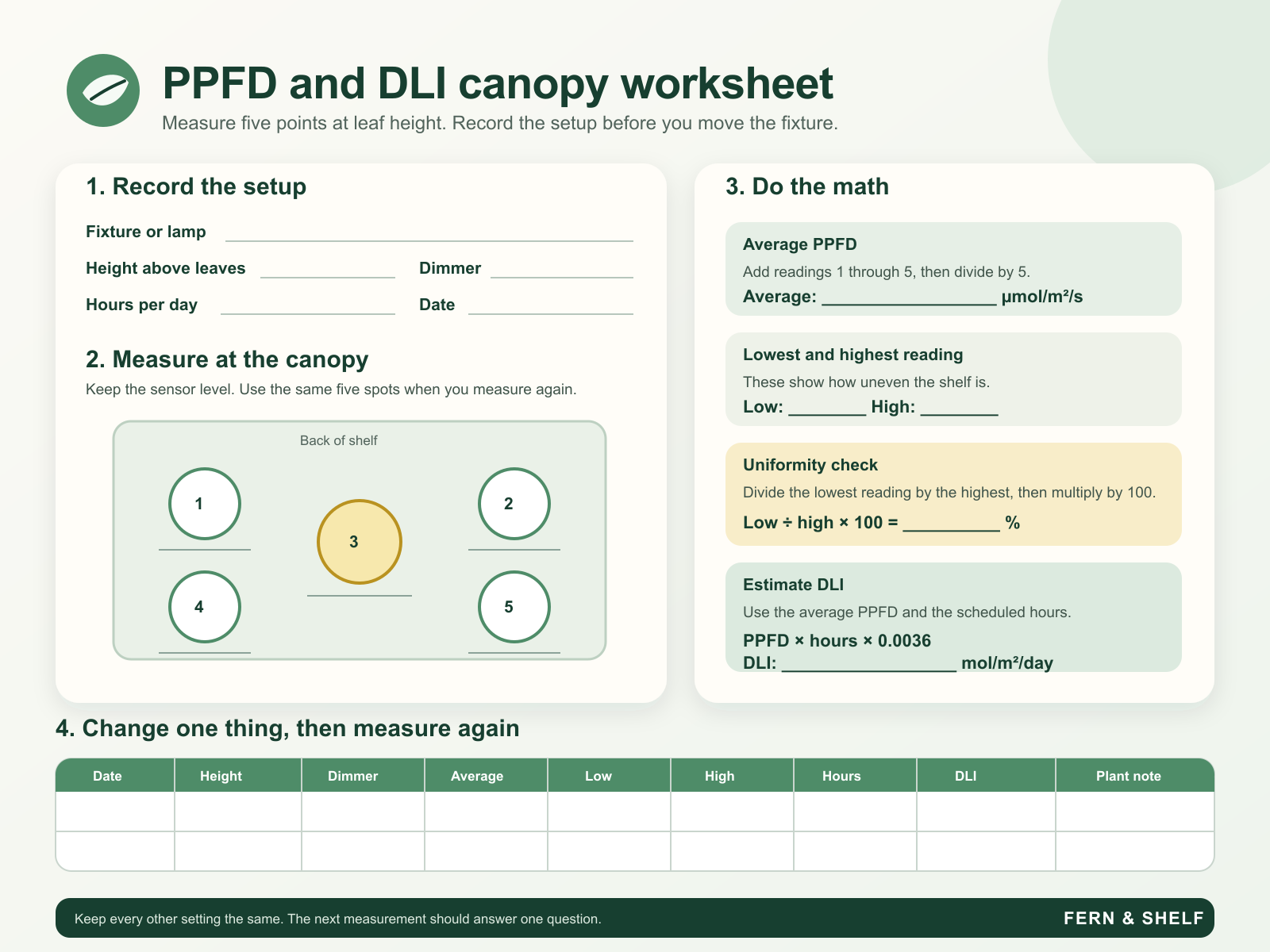
Print this image or keep it open beside the shelf. The numbered positions match the five-reading table below.
Part 1: record the setup
| Field | Your entry |
|---|---|
| Plant or crop | ____________________ |
| Goal: maintenance, flowering, seedlings, or harvest | ____________________ |
| Target DLI and source | ____________________ mol/m²/day |
| Fixture and dimmer setting | ____________________ |
| Fixture-to-canopy distance | ____________________ |
| Meter or phone app and light-source setting | ____________________ |
| Scheduled light hours | ____________________ hours |
| Date | ____________________ |
Part 2: take five canopy readings
Keep the sensor at the height and angle of the upper leaves. Follow the numbered worksheet: back corners, center, then front corners. Do not move the fixture between readings.
| Point | Position | PPFD, µmol/m²/s |
|---|---|---|
| 1 | Back left | ________ |
| 2 | Back right | ________ |
| 3 | Center | ________ |
| 4 | Front left | ________ |
| 5 | Front right | ________ |
| Total of five readings | ________ | |
| Average PPFD: total ÷ 5 | ________ | |
| Lowest reading | ________ | |
Part 3: calculate the daily light
Electric-light DLI = average PPFD × scheduled hours × 0.0036
Target average PPFD = target DLI ÷ (scheduled hours × 0.0036)
Hours needed = target DLI ÷ (average PPFD × 0.0036)
| My electric-light DLI | ________ × ________ × 0.0036 = ________ mol/m²/day |
| Average PPFD needed for my target | ________ ÷ (________ × 0.0036) = ________ µmol/m²/s |
| Hours needed at my measured average | ________ ÷ (________ × 0.0036) = ________ hours |
| Minimum-to-average ratio | lowest reading ________ ÷ average ________ × 100 = ________% |
The minimum-to-average percentage is a coverage note, not a universal pass or fail score. It tells you how far the weakest point sits below your shelf average. If the average looks suitable but one corner is much lower, spreading the light more evenly may make more sense than increasing the dose everywhere.
Example 1: a five-point shelf reading
These are fictional readings: 172, 158, 149, 141, and 130 µmol/m²/s. Their total is 750, so the average is 150.
750 ÷ 5 = 150 µmol/m²/s average PPFD150 × 14 × 0.0036 = 7.56 mol/m²/day130 ÷ 150 × 100 = 86.7% minimum-to-average ratio
The shelf delivers an average electric-light DLI of about 7.6 over 14 hours. Its weakest reading is 13.3% below the average. Those numbers describe the setup; they do not tell you whether it suits a plant until you compare them with a crop-specific starting range.
Example 2: working backward from a target
Suppose an appropriate source gives your crop a target DLI of 9, and you plan a 14-hour schedule. The example target PPFD is:
9 ÷ (14 × 0.0036) = 178.6 µmol/m²/s
If the fictional shelf above averages 150 PPFD, the mathematical runtime for a DLI of 9 would be:
9 ÷ (150 × 0.0036) = 16.7 hours
Raising the average PPFD to about 179 or extending the schedule to about 16.7 hours produces roughly the same DLI on paper. The schedules are not automatically interchangeable for the plant. In this example, 16.7 hours also exceeds Iowa State’s general home guidance of no more than 16 hours. A modest intensity or coverage adjustment is the more sensible trial unless a crop-specific source supports a longer day.
Part 4: log one change
| Date | One change made | New average PPFD | New DLI | Response in new growth |
|---|---|---|---|---|
| ________ | ________________ | ________ | ________ | ________________ |
| ________ | ________________ | ________ | ________ | ________________ |
| ________ | ________________ | ________ | ________ | ________________ |
Change one variable, measure again, and write down what happens to new growth. A higher number is not the goal by itself. The useful result is a plant that grows as expected without bleaching, stretching, or wasting light on empty shelf space.
Why a window makes DLI harder to estimate
The simple formula works best when PPFD stays reasonably constant, as it does under an electric light on a timer. Daylight does not behave that way. A window may provide almost nothing before sunrise, spike around midday, fall under cloud cover, and change again with the season.
Do not take one noon reading and multiply it by the hours between sunrise and sunset. That can badly overstate the daily total.
For a mixed window-and-lamp setup, you have three practical options:
- use a logging sensor that integrates changing light across the day;
- take repeated readings at consistent intervals and treat the result as an estimate;
- calculate the grow light’s contribution separately, then use the plant’s response to fine-tune the combined setup.
This is especially useful in winter, when a window that supported steady growth in summer may contribute far less.
What to change when the number is too low or too high
If DLI is below your starting range:
- increase the fixture’s output if it has a dimmer;
- move the fixture closer or raise the plant, then measure again;
- improve coverage or add a second fixture if the edges are weak;
- increase runtime within a suitable photoperiod;
- reduce shading from shelves, leaves, or nearby objects.
If DLI is above the range or the plant shows light stress:
- dim the fixture;
- move it farther away;
- shorten runtime if that still suits the plant’s photoperiod;
- move a shade-tolerant plant away from the brightest center zone.
Do not change every variable at once. Make one adjustment, remeasure, and watch new growth. The guide to how far to place a grow light covers physical placement in more detail.
Plant symptoms are useful, but they are not a precision meter. Low light can contribute to leggy, stretching growth, pale foliage, and slow growth. Too much light can cause bleaching or scorched patches. The same symptoms can also have other causes, so use the reading and the plant together.
For a symptom based check alongside the meter reading, review seven warning signs of excess grow light before changing the schedule or fixture height.
Common PPFD and DLI mistakes
Trusting watts instead of measuring the canopy
A 40-watt efficient fixture can deliver more useful light than a poorly designed fixture using more electricity. Wattage is a power-consumption number, not a leaf-level light reading.
Measuring only the brightest spot
The center of a small fixture often looks excellent while the corners are weak. A shelf full of plants needs useful coverage, not one impressive number.
Treating lumens or lux as universal PPFD
Lux is weighted to human vision. It can be converted to an approximate PPFD only when you use a conversion factor suited to the light’s spectrum. The same lux reading under two different spectra can represent different photon flux. Direct PPFD measurement is cleaner.
Using hours without intensity
Fourteen hours tells you the schedule, not the dose. Fourteen hours at 50 PPFD produces a DLI of 2.5. Fourteen hours at 300 PPFD produces 15.1. This is why a timer alone cannot tell you whether the setup is adequate.
Running the light 24 hours a day
More hours are not a free substitute for correct intensity. Many indoor plants respond to day length or need an uninterrupted dark period for normal flowering behavior. Use a timer and stay within an appropriate schedule rather than defaulting to nonstop light.
Treating a range as an exact prescription
Species, cultivar, growth stage, spectrum, temperature, and your goal all matter. Start with a sourced range, observe the plant for several weeks, and record what works in your actual setup.
Sources and method notes
The formulas and worksheet method use guidance from Iowa State University Extension and the University of New Hampshire Extension. Starting ranges also draw on University of Minnesota Extension, the 2021 Michigan State University Indoor Lighting Guide, and current Virginia Tech microgreens guidance. All worked readings in this article are hypothetical arithmetic examples, not measurements taken in our home or a laboratory.
Frequently asked questions
Do I need a PPFD meter for ordinary houseplants?
No. Many foliage plants tolerate a fairly wide light range, and you can succeed with a manufacturer map, a carefully configured phone app, and observation. A dedicated quantum sensor becomes more useful for seedling racks, microgreens, valuable collections, or larger shelves where uniformity matters.
Can I convert lux to PPFD?
You can estimate it, but there is no universal conversion factor. The conversion depends on the spectrum of the light. Use a factor supplied for your light type, and treat the result as approximate.
Does sunlight count toward DLI?
Yes. DLI includes useful photons from both sunlight and electric light. The challenge is that window light changes through the day, so one instant reading does not capture its full contribution.
Is a higher DLI always better?
No. More light can support more growth up to a point, but excessive light wastes electricity and can stress plants. Some low-light species need much less than herbs, succulents, or fruiting crops.
How often should I measure again?
Remeasure after changing the lamp, dimmer, distance, or shelf layout. Check again as plants grow toward the fixture and when seasonal window light changes. For a stable lamp-only shelf, you do not need to measure every day.
Related guides and tools
The bottom line
Using PPFD and DLI for indoor plants is a measurement habit, not a hunt for one magic number. For a steadier picture, measure five points at leaf level, calculate the average, and note the weakest spot. Then compare the result with a sourced starting range for what you are growing.
If the number is off, adjust one variable and measure again. If you need a different fixture rather than a different setting, the guide to grow lights for apartment windows covers the product side without turning this measurement guide into a shopping list.