Hygrometer for Houseplants: 7 Mistakes That Skew Readings
Last updated: July 18, 2026.
Affiliate disclosure: As an Amazon Associate I earn from qualifying purchases. Links marked “paid link” may earn Fern & Shelf a commission at no extra cost to you. Read our full Affiliate Disclosure.
Start here: For a complete overview, see our Indoor Gardening for Absolute Beginners.
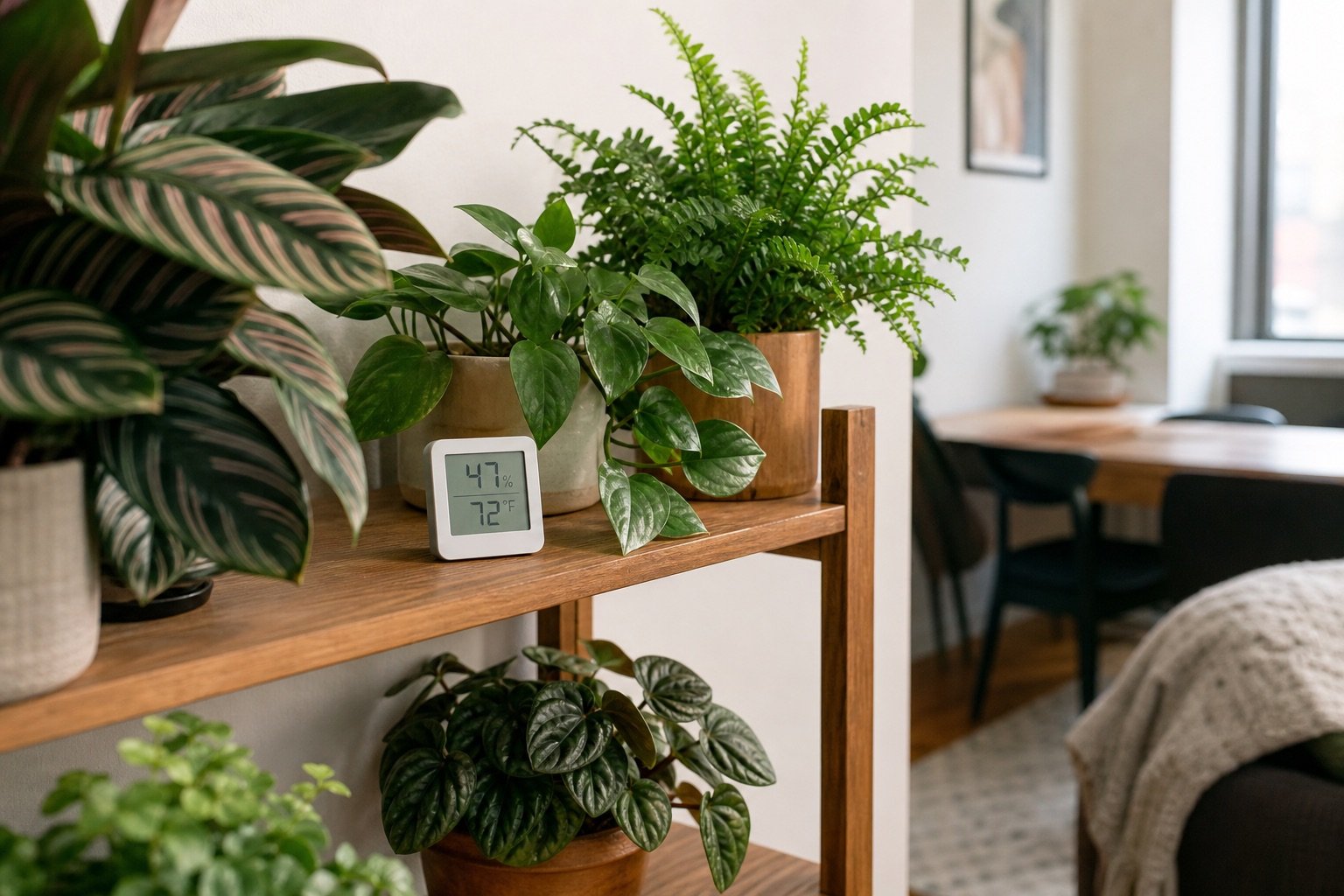
A hygrometer for houseplants is useful only when it measures the air your plants actually experience. Put it beside a cold window, directly above wet soil, or in a humidifier plume. The number can look impressively precise while telling you very little about the rest of the plant corner.
Reading the screen is easy. Finding a spot that tells the truth takes more care. A basic meter can show whether the plant corner stays dry, swings through the day, or gets damp whenever the humidifier runs.
Quick answer: place the sensor around leaf-canopy height, with open air around it. Keep it away from direct sun, grow-light heat, radiators, air-conditioning vents, cold glass, wet potting mix, and direct humidifier mist.
Give the sensor at least 30 minutes after moving it. Then compare humidity with temperature over a full day instead of reacting to one number.
What a hygrometer actually measures
A hygrometer for houseplants measures relative humidity, usually shown as RH%. It does not measure how much water is in the potting mix, and it cannot tell you that a plant needs watering. For that, check the soil and the plant itself. The guide to how often to water indoor plants covers that separate decision.
Relative humidity is also tied to temperature. NOAA explains that RH compares the water vapor currently in the air with the maximum amount the air can hold at its present temperature. Warm and cool parts of the same room can therefore show different RH readings even when the actual amount of moisture has not changed much.
That is why a hygrometer for houseplants should display temperature as well as humidity. The two numbers make more sense together.
How to place a hygrometer for houseplants without fooling yourself
1. Measuring the room instead of the plant zone
A meter on a desk across the room tells you about the desk. It may not describe a group of plants on a shelf, especially if the shelf sits near a window, heater, grow light, or humidifier.
Set the meter near the leaves you care about, roughly at canopy height. Do not bury it inside dense foliage or press it against a wall. It needs ordinary airflow around the sensor opening.
If you have plants in genuinely different spots, treat them as separate zones. A sunny windowsill, a shaded bookcase, and a bathroom can have three different humidity patterns. One reading cannot represent all of them at once.
2. Putting the sensor beside a humidity source
Direct mist is the fastest way to get a reassuring but useless number. A meter sitting six inches from a humidifier might show 70% RH while the far side of the shelf remains much drier.
The same problem appears when the sensor touches damp potting mix, sits above a pebble tray, or gets splashed during watering. These are small, wet microclimates. They are not room conditions.
Keep the device outside the visible mist stream and away from wet surfaces. If you are testing a humidifier, measure once near the plants and again farther into the room. The difference tells you more than either reading alone.
3. Leaving it in direct sun, near a vent, or against cold glass
Sunlight and strong artificial light can warm the sensor case. Heating or cooling vents create short bursts that do not represent the shelf between cycles. A cold winter window can raise local RH and produce condensation even when the center of the room looks normal.
SensorPush gives the same basic placement advice for its own instruments: protect the sensor from direct radiation and water while allowing good airflow. The principle applies to simple display meters too.
Pick a dry, shaded spot with some air around it, a short distance from the obvious heat and moisture sources.
4. Reacting before the reading has settled
Moving a hygrometer from one room to another changes both its temperature and humidity reading. It needs time to adjust.
Thirty minutes is a reasonable minimum for a quick check. A longer side-by-side period in a stable room is better when you are comparing two meters. If you move the sensor and see a low number three minutes later, ignore it for now. It has not settled yet.
For a new plant corner, record the morning, warmest part of the afternoon, and overnight readings for one or two days. That small log exposes the pattern that a single glance misses.
5. Ignoring the temperature beside the RH number
Suppose the shelf reads 48% RH in the morning and 39% in the afternoon. That does not automatically mean the apartment lost a large amount of moisture. The air may simply have warmed.
Read both values. If RH falls as the room gets warmer and rises again overnight, you may be seeing a normal temperature cycle. If the meter stays very dry through every part of the day, the low humidity is more convincing.
This is also why copying a target number from somebody else’s apartment can be misleading. Climate, heating, ventilation, window temperature, plant density, and room size all change the result.
6. Treating two different readings as proof that one meter is broken
Two decent meters can disagree without either one being faulty. If each is rated to plus or minus 3% RH, a gap of a few percentage points may be completely normal.
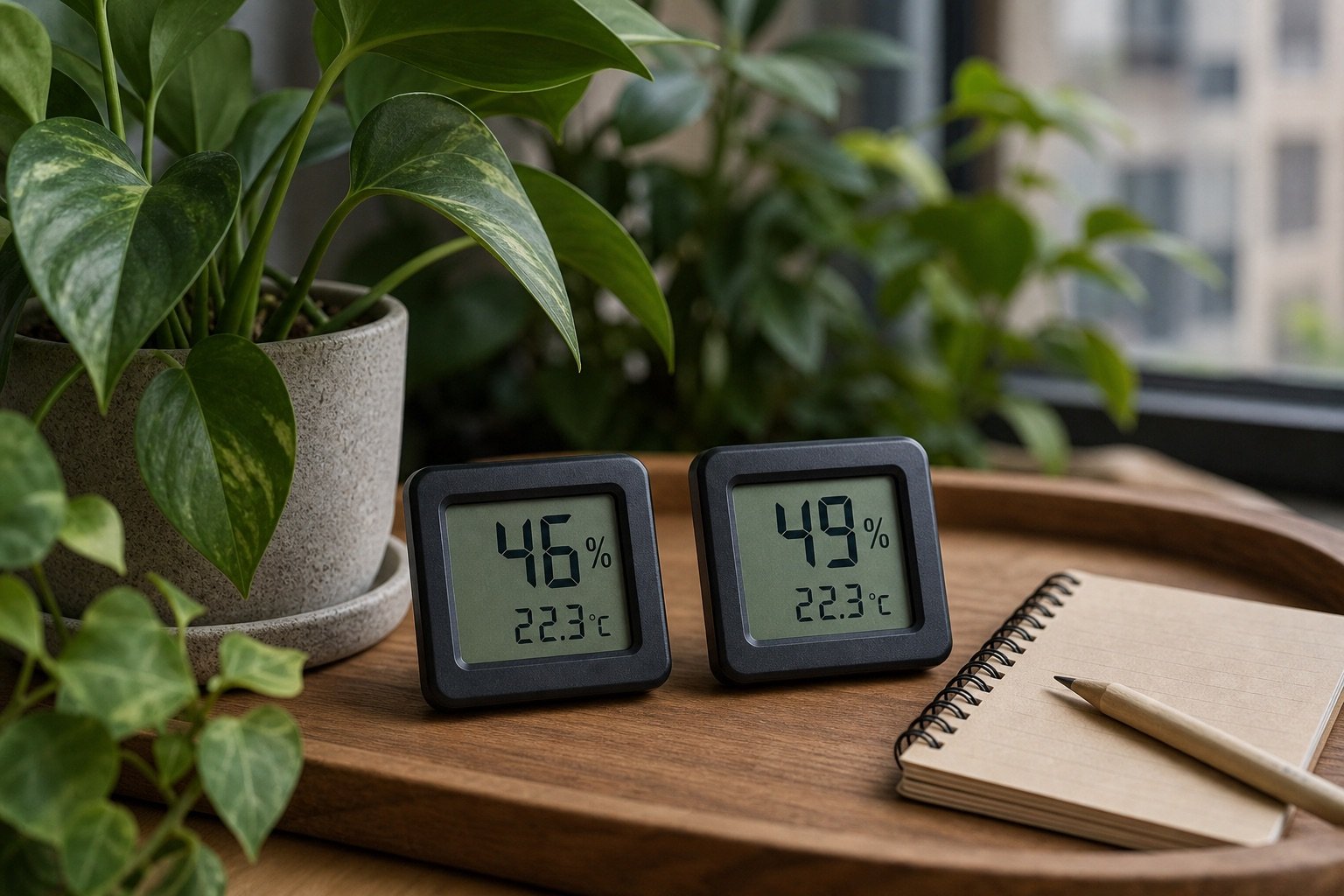
To check them, place both sensors side by side in the same stable location. Keep them out of sun and drafts, wait for them to settle, and compare the result with each manufacturer’s published tolerance. A consistent small difference is useful to know. It does not necessarily justify a return.
Calibration only corrects a sensor against a reference. It cannot turn a cheap meter into laboratory equipment. SensorPush warns that a poor reference can make the result worse. A home salt check can help, but it is easy to spoil through bad preparation, an imperfect seal, or unstable temperature. For a dependable adjustment, use a controlled humidity reference and follow the device maker’s instructions.
7. Chasing plant humidity beyond what the room can safely handle
There is no single perfect RH for every houseplant. Succulents and cacti generally tolerate drier air than many tropical foliage plants. University of New Hampshire Extension says most houseplants, apart from cacti, succulents, and a few others, prefer roughly 40% to 60%. Individual plants and rooms still vary.
The home still matters. The EPA recommends keeping indoor RH below 60%, ideally between 30% and 50%, to reduce condensation and moisture problems. If windows fog, walls feel damp, or textiles stay clammy, do not keep raising whole-room humidity because a tropical plant guide suggested a higher number.
If a plant wants more humidity than the room can safely take, a cabinet or terrarium is usually the cleaner fix. Keep monitoring the enclosure and give it enough ventilation or air movement to prevent persistent condensation.
A practical guide to reading the number
Use this as household guidance, not a universal species chart:
| Observed room RH | What it usually means |
|---|---|
| Below 30% | Dry indoor air. Humidity-sensitive plants may struggle, especially during the heating season. Confirm light and watering before blaming humidity alone. |
| 30% to 40% | A workable household band for many hardy plants and succulents. Some tropical plants may benefit from a localized humid zone. |
| 40% to 50% | A practical shared range for many common houseplants and ordinary living spaces. |
| 50% to 60% | Helpful for some humidity-loving plants, but watch windows, walls, fabrics, airflow, and condensation. |
| Above 60% | Not a better whole-room target. Reduce humidifier output, improve ventilation, or localize the plant environment. |
The hygrometer for houseplants earns its place by showing a pattern. A calathea corner that hits 28% every winter afternoon deserves attention. A brief dip from 47% to 44% does not.
Which hygrometer features are worth paying for?
You do not need a complicated weather station. A hygrometer for houseplants only needs to answer the question you actually have.
- A clear display with daily high and low memory is plenty for one shelf.
- Bluetooth logging helps when the room changes while you are not watching it.
- Multiple sensors make sense when plants occupy genuinely different zones.
- In a cabinet or splash-prone spot, check the documented water resistance. Water-resistant does not mean submersible.
- If you plan to calibrate the meter, confirm that it supports an offset.
- Ignore “high accuracy” badges and read the stated RH tolerance instead.
Fern & Shelf has not tested these three meters side by side. They are included because their documented features suit three common setups. Specifications were checked on July 16, 2026.
A simple screen: TempPro TP50
The TempPro TP50 is the stripped-down option. Its manufacturer page lists a basic LCD, daily high and low records, a 10-second refresh, and stated humidity tolerance of plus or minus 2% from 30% to 80% RH. There is no app to install, which is either a limitation or a relief.
Search Amazon for the TempPro TP50 (paid link)
A screen plus Bluetooth history: Govee H5075
The Govee H5075 adds Bluetooth history and alerts. Its manufacturer page lists an LCD, stored history, data export, and stated humidity accuracy of plus or minus 3%. That history is useful when you want to catch an overnight dip instead of seeing only the number on the screen. The model is not standalone Wi-Fi.
If you want to turn sensor readings into a DIY spoken plant assistant, the OpenAI Plant Talk project shows what that experiment actually does and where its limits are.
Search Amazon for the Govee H5075 (paid link)
A more capable logger: SensorPush HT.w
SensorPush HT.w is the more serious logger. The manufacturer page documents typical accuracy of plus or minus 2% RH from 10% to 90% at 77°F. It also lists one-minute sampling, more than a month of onboard data, VPD and dew-point tracking, and a water-resistant design. Remote internet monitoring still requires the optional G1 gateway. SensorPush warns that prolonged exposure above 80% RH can temporarily shift readings upward by as much as 3%, which matters in very humid cabinets. The HT.w makes sense in a plant cabinet or greenhouse-style zone, but it is excessive if you only want to glance at one shelf.
Search Amazon for the SensorPush HT.w (paid link)
What to do when the reading is low or high
If the number is low, check the sensor position first. Then look at the plant and rule out light or watering problems before blaming dry air. If the dry reading persists, the guide to increasing humidity for houseplants compares the methods that help with the ones that barely move the meter.
If the number is high, look for condensation and stagnant air before celebrating. Turn down the humidifier, move it farther from cold windows, and improve air movement. A damp room is not a healthier plant room.
Brown tips can involve humidity, but they can also come from watering, salts, root stress, or physical damage. Use the full brown-tip diagnostic guide before treating the hygrometer as a diagnosis.
Frequently asked questions
Where should I put a hygrometer for houseplants?
Place it around leaf-canopy height in the plant zone, with open airflow around the sensor. Keep it out of direct sun, grow-light heat, vents, radiator air, cold glass, wet soil, and direct humidifier mist.
Do I need one hygrometer per plant?
No. Buying a hygrometer for houseplants does not mean buying one for every pot. One sensor can cover a group that shares the same shelf or microclimate. Use another when plants sit in meaningfully different rooms or conditions.
Should the hygrometer sit inside the pot?
No. A room hygrometer measures air humidity. Sitting it on damp soil can distort the reading and expose the device to water. Use your finger, a wooden skewer, pot weight, or a soil-moisture method for the potting mix.
How accurate should a hygrometer for houseplants be?
A stated tolerance around plus or minus 2% to 3% RH is adequate for spotting household trends. Read the range where that tolerance applies, and remember that two sensors can differ while both remain within specification.
Is 60% humidity good for houseplants?
Some tropical plants appreciate conditions near that level, but 60% should be treated as an upper boundary for an ordinary room, not a goal to exceed. EPA guidance recommends keeping indoor RH below 60%, and lower if condensation or damp surfaces appear.
How often should I check the reading?
Check morning, the warmest part of the day, and overnight when mapping a new spot. After you understand the pattern, occasional checks or app alerts are usually enough.
Use the meter, do not obey it
The meter’s job is to reveal a pattern. Place it well, let it settle, and check temperature before reacting to RH. A healthier plant corner is not worth damp windows or walls.
The cheapest useful meter is the one you place correctly. The most advanced logger cannot rescue a bad measurement spot.