7 Best Small Indoor Herb Garden Kits (Tested in a 1-Bedroom Apartment)
Last updated: July 22, 2026.
Affiliate disclosure: As an Amazon Associate I earn from qualifying purchases. Links marked “paid link” may earn Fern & Shelf a commission at no extra cost to you. Read our full Affiliate Disclosure.
The best small indoor herb garden kits feel like a tiny luxury until you have basil within arm’s reach of the cutting board. Then a counter garden becomes one of those kitchen conveniences you miss the moment it is gone.
The trouble is that these kits solve very different problems. Some are compact hydroponic gardens with their own lights. Some are ordinary soil planters sold with seeds. One pick on this list is really a microgreens tray, and another is a handsome grow-light planter rather than a self-watering garden. Calling all seven the same thing makes shopping harder than it needs to be.
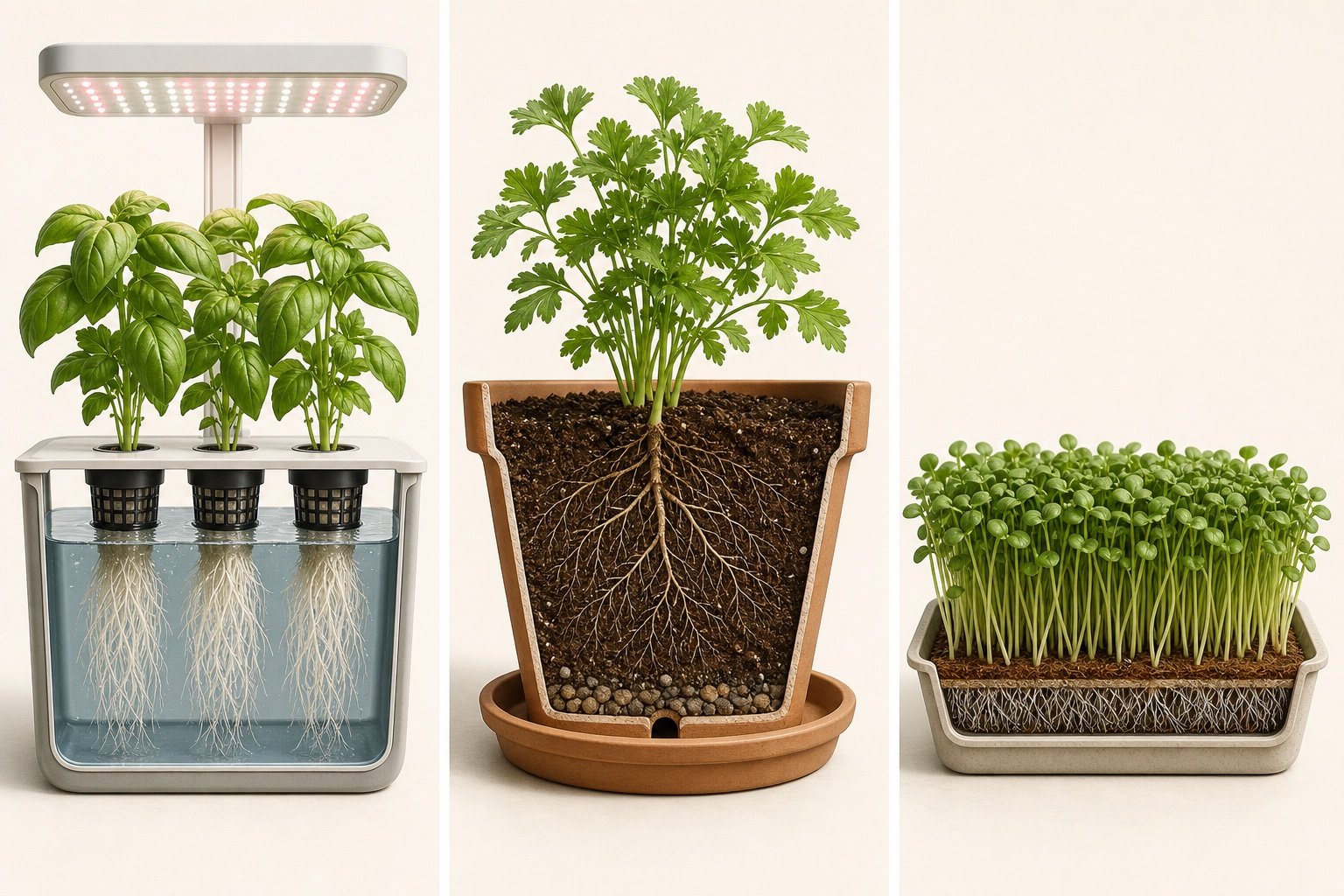
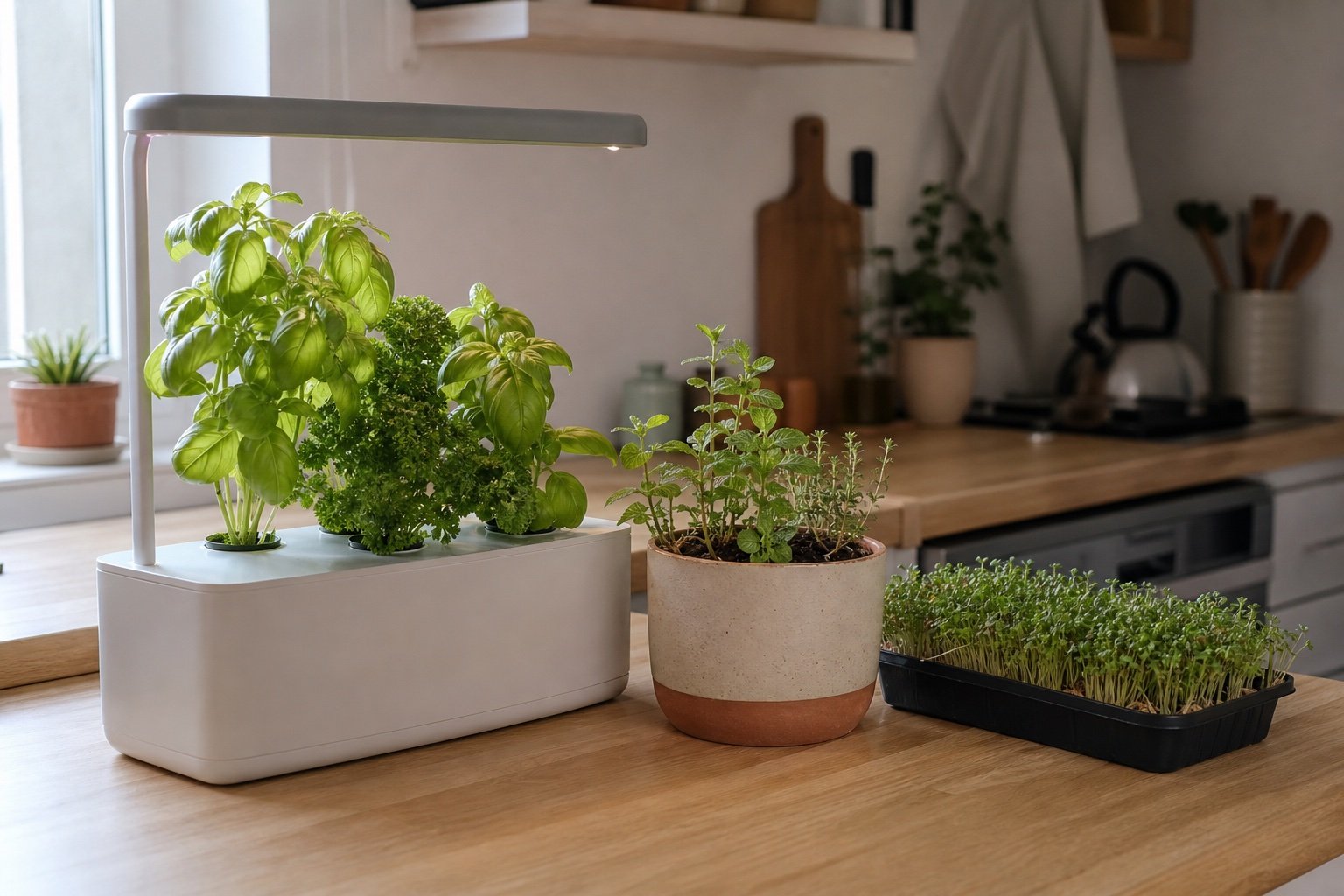
We ran all seven for eight weeks in the same one-bedroom apartment, on the same kitchen counter, with no direct sunlight. We tracked first harvest, overall yield, day-to-day effort, and whether each kit still felt welcome after the novelty wore off. The Click & Grow Smart Garden 3 was the easiest all-round choice. The AeroGarden Sprout gave us more control in nearly the same footprint. For fast edible results on a tighter budget, the Hamama tray made the most sense.
The short version
- Best overall: Click & Grow Smart Garden 3
- Best compact hydroponic kit: AeroGarden Sprout
- Best for more planting spots on a budget: iDOO 7-Pod system
- Best simple soil starter: Window Garden Veggie Kit
- Best-looking grow-light planter: Modern Sprout Smart Growhouse
- Best for quick microgreens: Hamama Microgreens Kit
- Best low-commitment soil kit: Back to the Roots Kitchen Herb Garden
Price note: Manufacturer prices and specifications below were checked on July 22, 2026. Promotions change, and Amazon search results can include older models or third-party bundles. Match the product name and capacity before buying.
Official product sources: Click & Grow Smart Garden 3, AeroGarden Sprout, iDOO’s current hydroponic collection, and Modern Sprout Smart Growhouse. These pages support current product and availability details; they are citations, not affiliate buying links.
We also checked the official Hamama Microgreens Kit and Back to the Roots three-can herb kit pages. Pet guidance refers readers to the ASPCA toxic and non-toxic plant database.
How we tested these small indoor herb garden kits
Each kit stayed in the same kitchen for eight weeks and followed the care routine intended by its maker. That meant topping up reservoirs and adding nutrients for hydroponic units, watering soil kits when they needed it, and following the quilt instructions for Hamama. We did not force identical watering schedules onto products built to work differently.
We paid attention to four things: how soon we could cut something edible, how much useful growth we got, how often the kit demanded attention, and how awkward it felt on a normal counter. This was an apartment-use test, not a controlled laboratory trial. Our harvest notes are comparative observations from that eight-week run, not a promise that every seed, room, or season will behave the same way.
| Kit | Current verified price or status | Light included | Growing style | Best for |
|---|---|---|---|---|
| Click & Grow Smart Garden 3 | $124.95 | Yes | Passive water reservoir and pods | Lowest-effort herbs |
| AeroGarden Sprout | $49.95 | Yes | Hydroponic, 3 pods | Compact hydroponics |
| iDOO 7-Pod | Legacy model, current official price not verified | Yes | Hydroponic, 7 pods | More sites in a small unit |
| Window Garden Veggie Kit | Current official listing not verified | No | Soil | A bright windowsill |
| Modern Sprout Smart Growhouse | $199 sale price when checked | Yes | Grow-light planter for potted plants | Design-conscious kitchens |
| Hamama Microgreens Kit | $35 for the plastic starter kit | No | Microgreens quilts | Fast edible shoots |
| Back to the Roots Kitchen Herb Garden | $24.99 sale price when checked | No | Soil in 3 cans | A simple first try |
1. Click & Grow Smart Garden 3: best overall
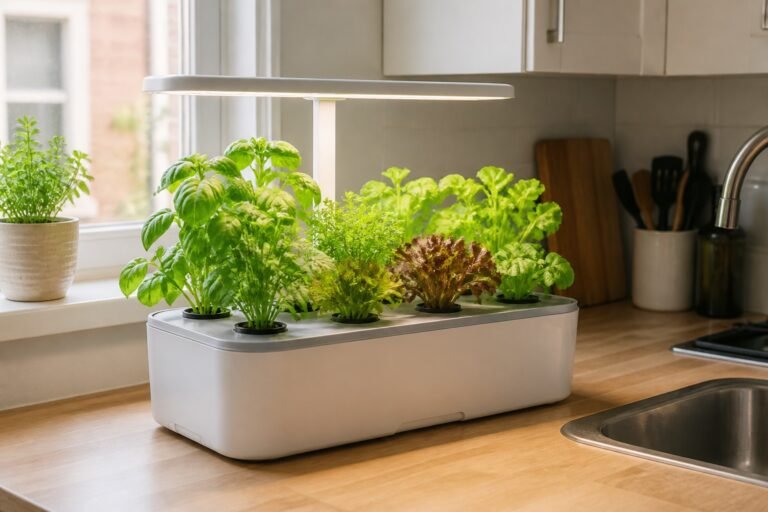
The Smart Garden 3 was the closest thing in our test to setting up a garden and then getting out of its way. You insert three pods, fill the reservoir, plug in the light, and wait. It suited our dark kitchen because the plants were not depending on a window.
The current US model costs $124.95 and includes three basil pods. Click & Grow lists an 8-watt light, a 1.5-liter tank, and monthly energy use of 3.8 kWh. The maker says the reservoir can last up to three weeks, though actual refill timing depends on plant size, temperature, and humidity. Mature basil drinks much more than a row of new seedlings.
We liked the quiet, clean setup and the fact that there was no nutrient measuring. The tradeoff is the pod system. It is convenient, but replacement pods cost more than ordinary seed, and three planting spots limit variety. You can use the company’s experimental pods with your own seed, but this is still a convenience-first garden.
- Good fit: you want the least daily fuss and need a built-in light.
- Think twice if: you want to grow several large herbs at once or dislike proprietary consumables.
Search Amazon for Click & Grow Smart Garden 3 (paid link)
2. AeroGarden Sprout: best compact hydroponic kit
The Sprout also grows three plants under an integrated light, but it feels more like a small hydroponic appliance. It circulates water and reminds you when water or plant food needs attention. The current model has a 10-watt LED and up to 10 inches of grow height. It does not have Wi-Fi or app control.
At $49.95 on the manufacturer’s site when checked, it costs much less than the Smart Garden 3. We found it more hands-on, which can be a virtue if you enjoy watching roots, adjusting care, and choosing from a wider range of seed pods. It also gives faster-growing herbs less headroom than taller AeroGarden models.
- Makes sense for: someone who wants a small hydroponic system and does not mind nutrients and reminders.
- Less suitable for: a home where pump noise bothers you or tall herbs are the priority.
Search Amazon for AeroGarden Sprout (paid link)
3. iDOO 7-Pod: best for more planting spots on a budget
The seven-pod iDOO gave us more room to experiment without taking over the counter. Being able to start several herbs at once was its main advantage over the three-pod gardens. It also required more thinning and pruning once those seedlings began competing for light.
There is an important availability caveat. We tested the 7-Pod model, but iDOO’s current official collection does not list that capacity. Current retail results may be old stock, a marketplace bundle, or a different iDOO generation. We are therefore not attaching a supposedly current list price to it. Check the pod count, light height, included accessories, and seller’s return policy on the exact listing.
- Worth considering when: you find the tested seven-pod version from a seller you trust and want more variety.
- Avoid when: clear manufacturer support and current replacement parts matter more than capacity.
Search Amazon for the iDOO 7-Pod Hydroponic Herb Kit (paid link)
4. Window Garden Veggie Kit: best simple soil starter
This was the familiar version of indoor gardening: potting mix, seed, water, patience. There was no pump to clean and no nutrient schedule to learn. There was also no built-in light to rescue a dim windowsill. In our no-sun kitchen, that difference was obvious.
The version we tested was useful for learning how soil moisture and seedling light affect a small herb crop. We could not verify a current official product page or price on July 22, 2026, so packaging and seed varieties in marketplace listings may differ from our kit. Treat the Amazon link as a search, not a direct endorsement of every result on the page.
- Works best with: a genuinely bright window or a suitable grow light you already own.
- Wrong choice for: a dark kitchen where you need one complete, lighted system.
Search Amazon for the Window Garden Veggie Kit (paid link)
5. Modern Sprout Smart Growhouse: best-looking grow-light planter
The Smart Growhouse is the one most likely to be mistaken for decor, in a good way. Its metal frame, watertight planter, and slim LED fixture look considered rather than gadget-like. The app controls light timing and brightness, which is handy if the garden sits near a bedroom or dining table.
It is not a hydroponic garden, and it is not self-watering. Modern Sprout describes it as a grow-light planter that holds three to four plants in 4-inch nursery pots. The current fixture uses full-spectrum 4000K LEDs, measures 16.5 by 5.5 by 15.8 inches, and carries a three-year warranty. It was listed at $199, reduced from $249, when we checked.
You still have to choose pots, soil, and a watering routine. In return, you are not locked into seed pods, and you can swap in a grocery-store herb or a small houseplant. It is a lighting-and-presentation solution, not an automatic garden.
- Best match: appearance matters and you want to grow your own potted herbs under a good light.
- Main mismatch: you expect a reservoir, pump, or hands-off watering.
Search Amazon for Modern Sprout Smart Growhouse (paid link)
6. Hamama Microgreens Kit: best for quick edible results
Hamama is not a herb garden in the usual sense. It grows a dense tray of microgreens from a pre-seeded quilt. That narrower job is exactly why it works. You add water, set the quilt in the tray, and harvest tender shoots rather than waiting for a mature basil or mint plant.
The plastic starter kit was $35 and included a reusable tray plus three seed quilts when checked. Hamama says most quilts are ready in about 7 to 10 days and can work in low light. Our test confirmed the practical appeal: it produced something edible quickly and asked for very little counter space. The recurring cost of proprietary quilts is the catch.
- Pick it for: fast salad and sandwich greens rather than a long-lived herb plant.
- Skip it when: your goal is repeated cuttings from basil, mint, parsley, or thyme.
Search Amazon for Hamama Microgreens Kit (paid link)
7. Back to the Roots Kitchen Herb Garden: best low-commitment soil kit
This three-can kit is an inexpensive way to find out whether you actually enjoy growing herbs indoors. The current set includes basil, cilantro, and mint in 16-ounce cans with organic soil blend. It was $24.99, reduced from $29.99, on the manufacturer’s site when checked.
The cans have no drainage holes, so the easy mistake is adding more water because the surface looks dry while the lower soil is still wet. They also need useful light. A kit can include seed and soil, but it cannot turn a dark shelf into a sunny windowsill.
- Ideal situation: you want a simple soil project and have a bright spot.
- The drawback: it is unforgiving if you tend to overwater, and it has no integrated grow light.
Search Amazon for the Back to the Roots Indoor Herb Garden Kit (paid link)
How to choose the right kit for your apartment
Start with the light, not the seed list
If the intended spot does not receive several hours of strong daylight, buy a kit with an integrated grow light or budget for a separate one. Moving a weak seedling closer to a normal ceiling bulb will not solve the problem. Our guide to growing herbs indoors without sunlight explains the setup in more detail.
Measure height as well as width
A small base can still become inconvenient when the light rises or basil reaches toward it. Check the full working height against shelves and cabinets. Also leave enough room to remove the reservoir lid, lift the light, and prune without dragging the unit forward every time.
Decide whether convenience is worth recurring supplies
Pods and microgreen quilts simplify setup, but they add a repeat purchase. Soil kits and grow-light planters accept ordinary seed, soil, and nursery pots, though they leave more decisions to you. Neither route is automatically cheaper once lights, nutrients, replacement seed, and failed starts are counted.
Frequently asked questions
Do indoor herb gardens use much electricity?
Small LED gardens use much less power than large vertical systems, but the dollar cost depends on your utility rate. Click & Grow lists 3.8 kWh per month for the Smart Garden 3. To estimate your own cost, multiply a product’s monthly kWh figure by the price per kWh on your electricity bill. Do not rely on a universal monthly dollar estimate.
Are seed pods guaranteed to sprout?
No seed is guaranteed to germinate. A pod controls the growing medium and makes setup consistent, but age, storage, temperature, and the seed itself still matter. Check the maker’s germination or replacement policy if a pod stays empty beyond the stated window.
Are indoor herbs safe around cats and dogs?
Safety depends on the exact plant species, not on the kit. Some common culinary herbs are considered non-toxic, while other edible plants can still cause problems or stomach upset. Confirm every seed or plant in the ASPCA toxic and non-toxic plant database, then keep nutrient solution, fertilizer, cords, and loose plastic away from pets.
Which kit would we buy again?
For a dark apartment kitchen and the least maintenance, the Click & Grow Smart Garden 3. For a less expensive hydroponic start, the AeroGarden Sprout. If the real goal is a quick edible crop rather than keeping herb plants alive for months, we would spend less and choose Hamama.
Related guides and tools
Final verdict
The best small indoor herb garden is the one that fits the light you actually have and the routine you are willing to keep. The Smart Garden 3 won our eight-week apartment test because it made those two variables unusually easy. It is not the cheapest pick, nor the most flexible. It simply removed the most common reasons a counter garden gets abandoned.
Readers who want the reasoning behind that winner can read why the Smart Garden 3 became our single kit recommendation, including who should skip it.
If you enjoy tinkering, the AeroGarden Sprout offers more involvement for less money. If you want something green to harvest next week, Hamama is more honest about the job it performs. Start with your desired crop, available light, and counter space. The logo on the front matters much less.