If I Had to Buy Just One Indoor Herb Garden Kit Today, This Is What I’d Pick
Last updated: 25.05.2026.
Affiliate disclosure: As an Amazon Associate I earn from qualifying purchases. Links marked “paid link” may earn Fern & Shelf a commission at no extra cost to you. Read our full Affiliate Disclosure.
Start here: For a complete overview, see our How to Grow Herbs Indoors Without Sunlight.
The question I get more than any other, from friends and from emails: “Just tell me which one to buy.”
People don’t want a spreadsheet. They want a recommendation. They want me to take responsibility for the choice so they can stop researching and start growing basil.
So here it is. The one indoor herb garden kit I’d buy if I could only buy one, with the honest reasons why — and the situations where I’d tell you to buy something else instead.
The pick: Click & Grow Smart Garden 9
If you walked up to me at a party and asked which indoor herb kit to buy, I’d say “the Smart Garden 9, just get it.” Not the 3. Not the AeroGarden. Not the iDOO. The Smart Garden 9.
Search Amazon for Click & Grow Smart Garden 9 (paid link)
The 9 is Click & Grow’s middle-sized unit. Nine pods, a height-adjustable LED light arm (the smaller 3-pod version doesn’t have this), a reservoir that holds about three weeks of water, and the same dead-simple “drop a pod in and walk away” experience the brand built its reputation on. It costs more than the Smart Garden 3 — around $200 versus $130 — but you get three times the plants and a light arm that actually moves up as the plants grow.
Why this specifically, when there are objectively cheaper options that work fine?
Reason 1: Nine pods is the right number
Three pods is not enough. I learned this with my own Smart Garden 3, which I reviewed at length after nine months. Three plants gets you garnish quantities. By month two you’re wishing you had more pots going at once. Six or nine is the threshold where the kit produces enough fresh herbs to actually change how you cook.
Twelve and twenty-pod systems exist (iDOO sells one, LetPot sells one). But they get larger, louder, less attractive on a counter — and most apartments don’t have the space to commit to twelve pods of herbs. Nine is the sweet spot: enough that you actually use what it grows, small enough that it doesn’t take over the kitchen.
Reason 2: It just works
I’ve now tested seven different indoor herb kits over the past two years. The Smart Garden 9 has the highest success rate of any of them. You drop in a pod. It sprouts. The plant grows. You harvest. Repeat.
The proprietary “smart soil” pods are the reason. They’re a closed system — sterilized soil, optimized nutrient mix, the seed already dropped in at the right depth. There’s almost nothing you can do wrong. Most other systems require you to assemble pieces: net cup, sponge, seed, growing medium, nutrient mix. The variables add up, and so do the failure modes.
For a beginner — or even an intermediate gardener who’s tired of fiddling — that reliability is worth a lot.
Reason 3: It looks like furniture, not a science experiment
This is the part people underrate when they’re researching online. A unit that looks like an appliance ends up shoved in a back corner. A unit that looks like a piece of decor stays on the counter, where you can actually see it, water it, harvest from it.
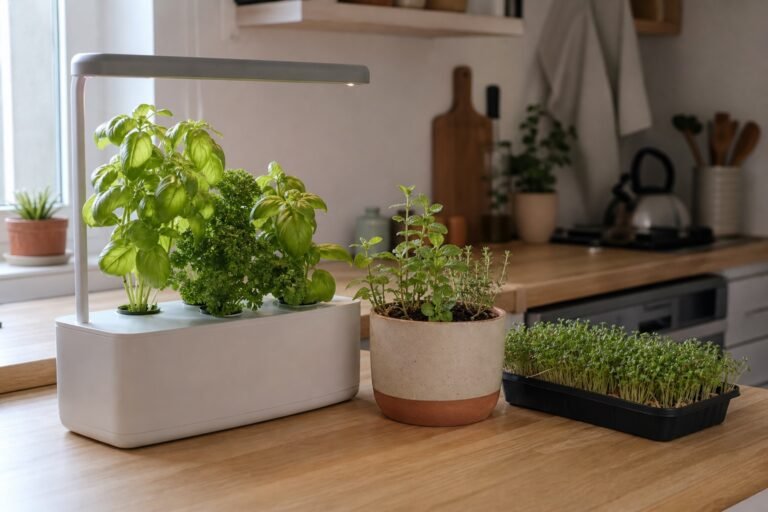
The Smart Garden 9 looks decor-grade. Matte beige finish, soft wood accents, a clean light arm that doesn’t broadcast “GROW LIGHT” to anyone walking by. After nine months mine still gets compliments from guests who don’t immediately register what it is.
The AeroGarden line, by comparison, looks like an appliance. Functional, capable, slightly clinical. Black plastic, branded logos. It works just as well — but it lives in a different corner of the visual hierarchy.
Reason 4: The light height adjusts
This is the practical detail that separates the Smart Garden 9 from the 3. Tall plants — basil, parsley, dill — keep growing upward over the course of their life cycle. With a fixed-height light arm, they eventually brush against the LED and start drooping. The adjustable arm on the 9 means you raise it as needed, and the plants keep growing taller without crowding.
It sounds minor. It isn’t. It’s the reason a Smart Garden 9 produces meaningfully larger plants than a Smart Garden 3 of the same age.
What you’re paying extra for (and why it’s worth it)
The Smart Garden 9 is roughly twice the price of the cheapest hydroponic kits on Amazon. You can buy a 12-pod iDOO system for around $80, and it will sprout most seeds reliably. So why pay double?
Three things, ranked by what actually matters:
The build feels different. The plastic is denser. The pieces fit together precisely. There’s a quiet quality to the materials that doesn’t show up in photos. After nine months of daily use, my Smart Garden 3 still looks essentially new. I’ve seen cheaper units develop algae stains, cracked light arms, loose-fitting reservoirs after a year of use.
The light spectrum is genuinely better. Click & Grow tunes the LED specifically for photosynthesis, and the plants show it — denser foliage, deeper color, slower bolting. iDOO and similar budget systems use generic full-spectrum LEDs that work, but produce slightly leggier, paler plants over time.
Customer support exists. Click & Grow has a real support team that responds to emails. iDOO ships from a generic Amazon warehouse with no real follow-up if something breaks. When a $200 unit fails, you want a real person on the other end.
When I’d tell you to buy something else
Three situations.
You want to grow more than just herbs. If your real goal is leafy greens at meaningful volume — multiple heads of lettuce per week — the Smart Garden 9 is too small. Get a Gardyn Studio or a Tower Garden Flex instead. They cost three to four times as much but produce ten times the food.
You’re on the tightest possible budget. If $80 is the absolute most you can spend, the iDOO 12-Pod will get you started. It’s not as nice. The plants won’t be quite as productive. The unit won’t last as long. But it’ll grow basil, and that’s what matters most. (We’ve reviewed it as the budget pick in our hydroponic systems guide.)
You hate the idea of proprietary pods. Click & Grow’s smart soil pods are convenient but they’re a lock-in. About $2.20 per plant per cycle. If the recurring cost bothers you, get an AeroGarden Harvest — it lets you use generic grow sponges with your own seeds, which drops the per-plant cost to about $0.15.
For everyone else — most apartment dwellers, most beginners, most people who just want fresh basil and don’t want to think about it — the Smart Garden 9 is the right buy.
What you actually need with it
Honestly? Almost nothing. The unit comes with everything: pods, nutrient solution for the first cycle, the light arm, the reservoir. You add water, plug it in.
After the first cycle (about 4–6 weeks for most herbs), you’ll need:
- A refill pack of pods, which you can buy on Amazon or directly from Click & Grow. Around $20 for nine.
- Eventually, a bottle of plant nutrient solution. The starter bottle lasts about 6 months.
That’s it. No grow lights to add, no separate timer, no app, no fertilizer schedule to track.
The thing nobody mentions
It changes how you cook.
The first time you snip basil for pasta water mid-recipe, instead of pulling a sad clamshell from the fridge or skipping it because you don’t have any — you understand why people pay for these. Fresh basil within reach changes the small decisions. You add herbs to things you wouldn’t have. You make pesto without planning. You garnish things that you’d otherwise leave plain.
Nine months in, that’s the part of the Smart Garden experience that I’d find hardest to give up. Not the gadget itself. The way it changes the kitchen.
Search Amazon for Click & Grow Smart Garden 9 (paid link)
The short answer
If you’ve read this far and you’re still deciding: stop deciding. Get the Smart Garden 9. Set it up next to wherever you eat breakfast. In six weeks you’ll be cooking with fresh basil, and in six months you won’t remember what your kitchen was like without it.