PPFD DLI Calculator: 3 Easy Light Checks
Start here: For a complete overview, see our Do You Need a Grow Light for Your Indoor Plants? An Honest Look.
This PPFD DLI calculator joins light intensity and time in one useful number. A grow light can run for 14 hours and still be too weak, or run for 10 hours and deliver plenty of light. The tool also works backward when you know the daily target but need the PPFD or runtime.
PPFD DLI calculator
Use a canopy-level PPFD reading for steady electric light. The plant presets are starting ranges, not hard limits.
What the calculator is doing
PPFD is the light intensity reaching the leaves at a particular moment. DLI is the total plant-usable light received across the day. For a steady electric light, the conversion is:
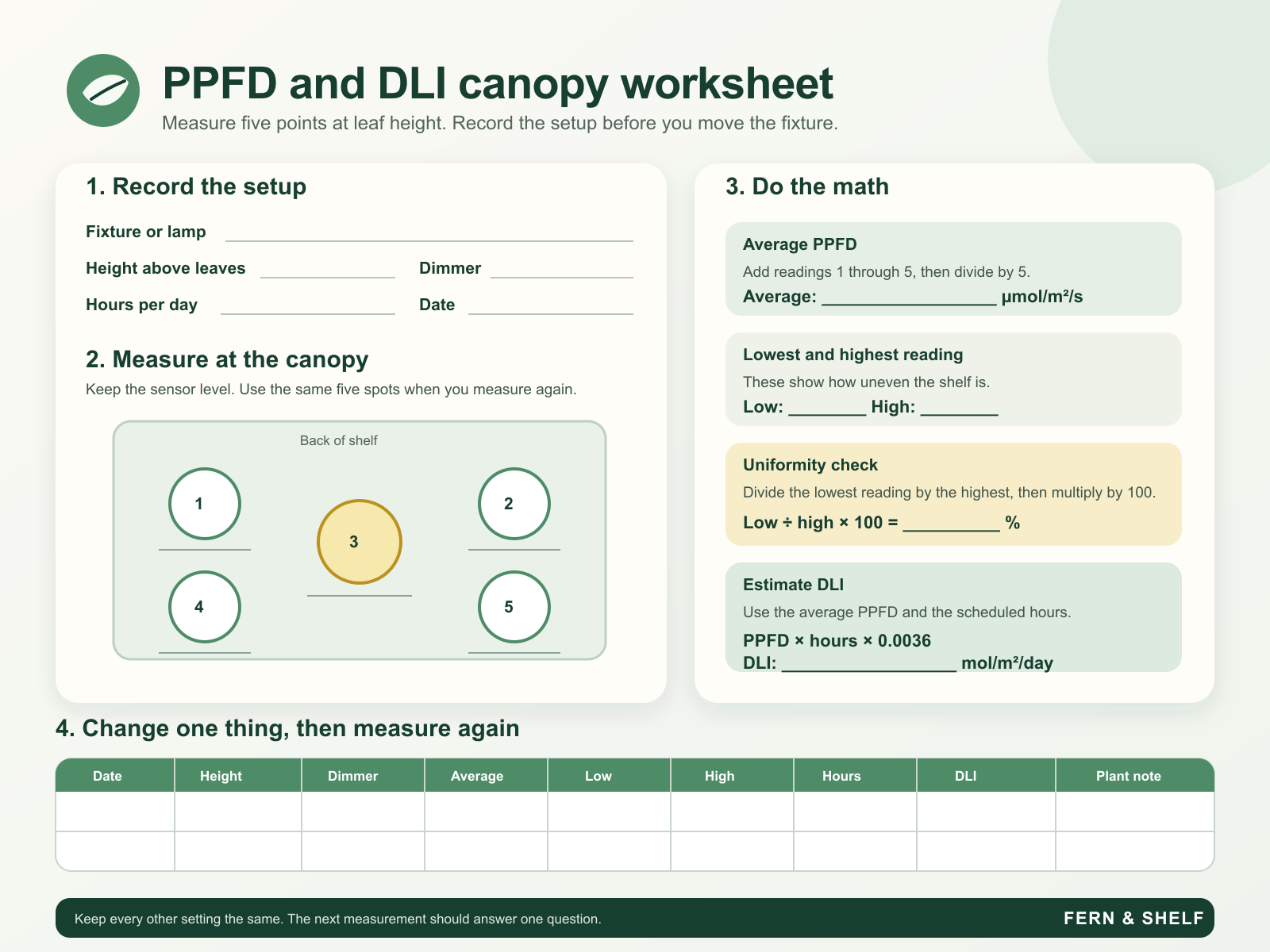
DLI = PPFD × hours × 0.0036
The 0.0036 factor converts hours to seconds and micromoles to moles. If the lamp delivers an average PPFD of 200 for 16 hours, the lamp contributes 11.52 mol/m²/day. The calculator rearranges the same equation when you ask for PPFD or hours.
Measure where the leaves are, not at the lamp. A center reading can hide weak edges, so take readings in the middle and around the growing area. A manufacturer’s PPFD map is useful only at the stated mounting height and footprint. Our full guide to PPFD and DLI for indoor plants covers measuring technique, lux, phone apps, and plant response in more detail.
Reference ranges used in the presets
These ranges give you a sensible place to begin. Species, cultivar, growth stage, temperature, and the result you want can shift the useful target. Acclimate plants gradually and watch the whole canopy rather than chasing an exact decimal.
| Plant group | Starting DLI range | PPFD at 14 hours |
|---|---|---|
| Low-light foliage houseplants | 3 to 6 mol/m²/day | 60 to 119 µmol/m²/s |
| Medium-light houseplants | 6 to 10 mol/m²/day | 119 to 198 µmol/m²/s |
| High-light houseplants and succulents | 12 to 16 mol/m²/day | 238 to 317 µmol/m²/s |
| Seedlings | 5 to 10 mol/m²/day | 99 to 198 µmol/m²/s |
| Microgreens | 9 to 12 mol/m²/day | 179 to 238 µmol/m²/s |
| Lettuce | 12 to 17 mol/m²/day | 238 to 337 µmol/m²/s |
| Basil | 15 to 25 mol/m²/day | 298 to 496 µmol/m²/s |
How to use the result
If the calculated DLI falls below the reference range, first check that you measured at leaf level and sampled the dimmer parts of the canopy. Then change one thing: raise the dimmer setting, move the fixture closer within its safe instructions, add coverage, or lengthen the schedule without erasing the plant’s dark period. Our guides explain grow light distance and daily grow light schedules.
If the result is high and the plant shows bleaching, dry pale patches, curling, or unusual heat at the upper leaves, back off. A high number is not automatically better. Read the symptoms, remeasure after any change, and see our guide to too much grow light.
Frequently asked questions
Can I calculate DLI from one PPFD reading?
Yes for an electric light that holds a fairly steady output. It is much less reliable for window light because PPFD changes with clouds, time of day, season, curtains, and shadows. A single noon reading multiplied by daylight hours can badly overstate the daily total.
Should I use the center or average PPFD?
Use an average of canopy-level readings, then check the weakest useful growing spot too. A bright center does not make up for plants sitting outside the fixture’s effective coverage.
Can I use watts instead of PPFD?
No. Watts tell you how much electricity a fixture uses. They do not tell you how many photosynthetic photons reach a leaf. Fixture efficiency, optics, distance, and coverage all change that outcome.
Is the midpoint of a preset the best target?
It is a convenient planning value, not a promise. Start near the lower end when a plant is moving from dim light, then adjust slowly using plant response and fresh measurements.
Sources
- Iowa State University Extension: supplemental light, DLI formula, and houseplant ranges
- Virginia Cooperative Extension: DLI calculation and crop reference ranges
- University of Missouri Extension: PPFD maps, coverage, and grow light selection
- University of Minnesota Extension: indoor plant light schedules