
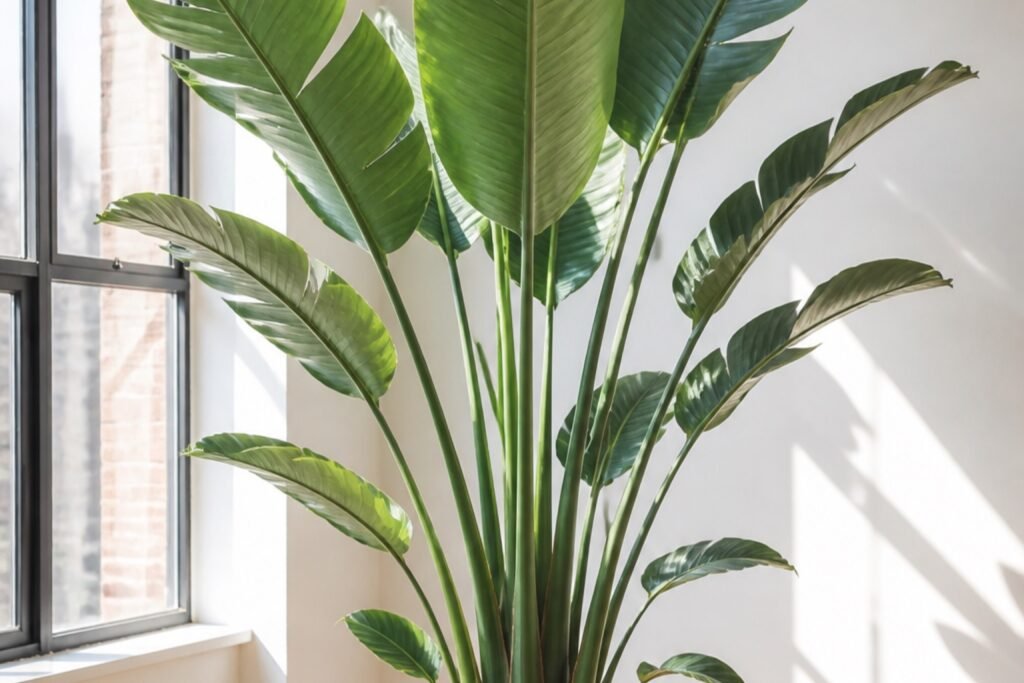
White bird of paradise care indoors begins with an honest look at scale. Strelitzia nicolai is a large clumping tropical plant, not a compact desk plant. Its banana-like blades can reach several feet long, and a healthy specimen eventually needs floor space, strong light, and a pot heavy enough to stay upright.
Giant bird of paradise, Natal wild banana, and wild banana are trade names. It is not a banana, and it is not the orange-flowering Strelitzia reginae usually pictured in cut-flower arrangements. Indoor S. nicolai seldom flowers, so judge it by firm new leaves and roots.
White bird of paradise care indoors snapshot
| Care point | Practical indoor target |
|---|---|
| Light | Very bright light with some acclimated direct sun |
| Water | Soak after the upper 2 to 3 inches dry and the lower pot is no longer wet |
| Soil | Substantial, airy mix that drains freely |
| Humidity | Moderate humidity or better |
| Temperature | Roughly 55 to 85 F |
| Mature indoor size | Often 4 to 10 feet tall |
| Growth rate | Moderate in strong light |
| Pet safety | Exact veterinary status not verified; keep it away from pets |
Find the brightest workable position
Place the plant beside a large east, south, or west window. Several hours of gentle or filtered direct sun support sturdy petioles and broad new leaves. Acclimate a nursery plant before giving it hot afternoon rays through glass.
A darker spot creates long weak petioles, slow drying, and smaller leaves. Moving the pot farther into the room to protect one scorched patch usually trades a visible blemish for chronic low light. Use the guide to whether a grow light is needed if the window is obstructed or winter days are short. For an added lamp, grow-light distance matters because the tall canopy can sit much closer to a fixture than expected.
Rotate the container occasionally, provided its weight makes this safe. The leaves follow the window and a one-sided crown can pull a light pot over.
Water a large root ball in sections
Check the upper 2 to 3 inches, then probe deeper at more than one point. Large decorative pots often stay wet in the center long after the edge dries. Water when the upper zone is dry, the lower zone is no longer wet, and the pot has lost weight.
Apply water slowly across the surface so the whole root ball is reached. Drain the cachepot. A few cups poured near one stem leave dry pockets while the center may remain sour. The approach in how often to water indoor plants is especially useful for pots too heavy to lift easily.
Curling can follow drought, root injury, heat, or very dry air. It is not a command to water. Check the root zone first. Yellowing that spreads while the mix is damp needs a drainage and root inspection.
Accept some splits, but inspect new leaves
Strelitzia leaves split along parallel veins. Wind helps outdoor plants survive storms, and ordinary indoor movement, brushing, and low humidity can open the same seams. A split blade still photosynthesizes.
Focus on how the newest rolled leaf opens. If it sticks and tears while emerging, check root moisture and room humidity. The guide to increasing humidity for houseplants explains which methods change the room and which barely affect it.
Wipe broad blades with plain water and a soft cloth. Removing dust helps inspection. Avoid leaf-shine oil, which makes a naturally matte surface greasy. The leaf-cleaning guide covers safe support for large blades.
Repot for stability, not on a yearly date
Use an airy but substantial mix and a container with an open drainage hole. Repot when roots distort the pot, block drainage, or leave the clump unstable. The plant tolerates a reasonably snug root system, so do not jump to a huge tub.
Divide only a mature clump whose sections have their own roots and shoots. Separation is heavy work and may set the plant back. The houseplant repotting guide helps plan the new pot volume before the root ball is out on the floor.
Feed during active growth as the product label directs. Pause in weak winter light or when roots are stressed. A fast fertilizer schedule cannot replace strong window light.
White bird of paradise problem triage
| Symptom | Likely checks | First sensible move |
|---|---|---|
| Split leaf edges | Normal tearing, traffic, or moving dry air | Judge how the next leaf opens |
| Curling leaves | Dry roots, heat, low humidity, or root stress | Check the full root zone |
| Yellow lower leaf | Age, wet roots, or weak light | Compare old and new growth with soil moisture |
| Brown patch facing glass | Heat or abrupt sun | Review the hottest window hours |
| Sticky specks or webbing | Scale or spider mites | Inspect petioles and leaf undersides |
Scale often resembles a harmless brown bump along petioles. Spider mites leave pale stippling and fine webbing, especially in a dry warm room. The broad leaves make inspection easy if they are cleaned regularly. The spider mite guide explains how to confirm active mites before treatment.
Cut a badly damaged leaf at the base with a clean blade if it has little green tissue left. Do not cut the central emerging spear. That rolled leaf is current growth, not a dead stalk.
Plan for sap and ingestion safety
NC State's horticultural record flags Strelitzia nicolai as a problem for cats and dogs and reports nausea, vomiting, and drowsiness after ingestion, plus possible skin irritation. An exact independent veterinary record for this species was not verified during this review. The database therefore keeps cat and dog status as not verified rather than turning a horticultural warning into a stronger veterinary claim. Keep leaves and any rare fruit out of reach, wear gloves for division, and contact a veterinarian after suspected ingestion.
Do not substitute safety information for S. reginae or a banana plant without checking the name. Similar silhouettes do not make plants interchangeable.
Frequently asked questions
Why are my white bird of paradise leaves splitting?
Some splitting is normal along the parallel veins. Traffic, moving air, and dry conditions make it more noticeable. Watch whether new leaves open cleanly before treating it as a health problem.
Can white bird of paradise live in low light?
It may survive for a time, but it will stretch, grow slowly, and use water poorly. This is a high-light floor plant. A bright window or strong supplemental light is a better match.
Will a white bird of paradise flower indoors?
It can, but flowering is uncommon and requires a mature plant with abundant light and space. Healthy leaves and roots are realistic indoor goals; lack of flowers alone does not mean poor care.