
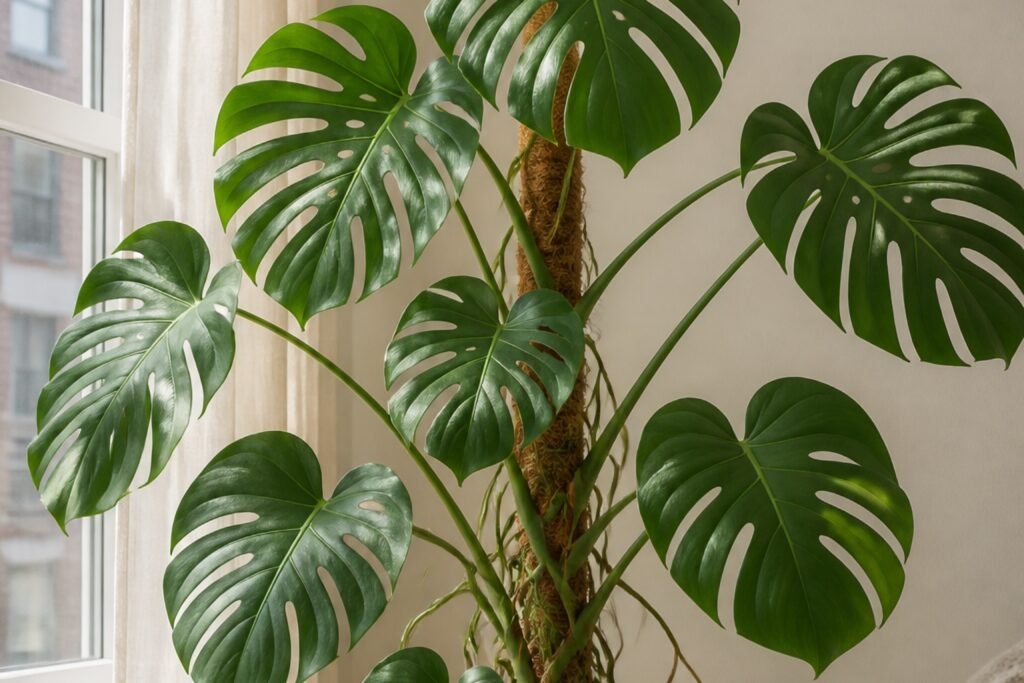
Monstera deliciosa care gets easier once the plant is treated as a large climbing aroid, not a compact floor shrub. Monstera deliciosa comes from Mexico through Central America, where it climbs toward better light with aerial roots. Indoors, the same habit shows up as long stems, heavy leaves, and a determined lean toward the window.
Nurseries also call it Swiss cheese plant or split-leaf philodendron. It is not a philodendron. The smaller Monstera adansonii shares the Swiss cheese nickname, so leaf size and growth habit matter when identifying an unlabeled plant.
Monstera deliciosa care snapshot
| Care point | Practical indoor target |
|---|---|
| Light | Bright indirect light with gentle early sun if acclimated |
| Water | Water when the upper quarter to third of the mix has dried |
| Soil | Chunky, airy indoor mix in a pot with drainage |
| Humidity | Average to moderately high humidity with air movement |
| Temperature | About 60 to 85 F, away from cold drafts |
| Indoor size | Commonly 6 to 8 feet tall with support, often 3 to 6 feet wide |
| Pet safety | Toxic to cats and dogs if chewed |
Give Monstera deliciosa care room to climb
Place the plant close to an unobstructed east window or in bright filtered light near a south or west exposure. A little mild morning sun can be useful after gradual acclimation. Hot afternoon rays through glass can scorch leaves that formed in shade. The plant's shadow should be soft but distinct during the brightest part of the day.
Fenestrations depend partly on maturity, genetics, and support, but poor light often keeps new leaves small and solid. A young leaf without holes is normal. A mature plant that begins making smaller leaves on long bare stretches is asking for more useful light or better climbing support. The grow light distance guide explains why a lamp across the room has little effect even when it looks bright.
Give the main stem a sturdy pole, plank, or trellis before the plant becomes difficult to move. Tie the stem loosely, never the leaf stalks. Aerial roots can be guided toward the support or potting mix. They do not need to be forced into a jar of water, and trimming an inconvenient root does not stop the plant from climbing.
Water the root ball, then let it breathe
Push a finger or skewer several inches into the pot. Water when the upper quarter to third has dried and the container feels lighter, while the deeper mix still has a trace of cool moisture. Soak evenly until water runs out, then empty the saucer or outer pot.
A large Monstera in bright summer light may use water quickly. The same plant in winter can take much longer. That is why a calendar fails. Our houseplant watering guide uses pot weight and moisture instead of a fixed interval.
Yellow lower leaves can follow prolonged wetness, but one old leaf fading is not proof of rot. Look for a pattern. Several yellow leaves, soft dark roots, and a mix that smells stale justify a root inspection. Curling or limp leaves in a dry, light pot point in the other direction. When the clues disagree, check the center of the root ball before pouring.
Build an airy potting mix
The roots need both moisture and oxygen. Use a loose indoor mix with coarse components that resist collapsing, and always use a pot with a drainage hole. The exact ingredients matter less than the finished behavior: water should spread through the pot, drain freely, and leave small air spaces.
Choose a pot only one size larger when repotting. A giant container stays wet around the edge while the root ball occupies the center. The indoor potting soil guide compares commercial options, while the repotting guide covers root inspection and planting depth.
Repot when roots circle densely, emerge through the drainage hole, or make watering difficult. A top-heavy plant may need a heavier outer cachepot, but do not let runoff collect inside it. Install or upgrade the support during the same job so you do not spear roots later.
Feed and prune with a plan
During active growth, apply a complete houseplant fertilizer according to its label. A plant with strong light can use more nutrition than one stalled in a dim corner. Fertilizer will not create fenestrations in weak light, and extra doses can burn roots or leave salts in the mix.
Wipe the broad leaves with a damp cloth and check the undersides for spider mites, thrips, scale, and mealybugs. If fine speckling or webbing appears, use the spider mite guide to confirm the pest before treating the whole collection.
Pruning controls reach but changes the shape. Cut just above a node if you want the remaining vine to branch. A cutting needs at least one viable node; a leaf and petiole without a node may stay green for a time but cannot grow into a full vine. The water propagation guide covers the rooting process without turning this profile into a second procedure page.
Common Monstera deliciosa problems
| Symptom | What to check first | First sensible move |
|---|---|---|
| New leaves stay small and solid | Plant age, light, and climbing support | Improve verified light and attach the stem to a support |
| Several leaves yellow | Moisture deep in the pot and root firmness | Pause watering and inspect if the mix stays wet |
| Brown crisp patches | Hot direct sun and severe dryness | Move back from harsh glass and stabilize watering |
| Black or water-soaked spots | Cold exposure, wet foliage, and roots | Correct the environment and remove badly damaged tissue |
| Fine pale speckling | Leaf undersides for mites or thrips | Isolate and identify the pest closely |
Splits caused while a new leaf unfurls will not knit back together. They are cosmetic. Repeated damage, sticky residue, or distorted growth deserves a closer look through the houseplant problem diagnostic.
Pet and household safety
The ASPCA lists Monstera deliciosa as toxic to cats and dogs. Insoluble calcium oxalates can cause mouth pain, drooling, vomiting, and difficulty swallowing if the plant is chewed. Sap can also irritate sensitive skin. Keep the pot, trailing stem, cuttings, and pruned leaves out of reach. Contact a veterinarian or animal poison service promptly after a suspected exposure with symptoms.
Frequently asked questions
Why does my Monstera have no holes?
Juvenile leaves are naturally solid. As the plant matures, brighter indirect light and a stable climbing support encourage larger adult leaves. A sudden lack of holes on an older plant often follows weaker light or loss of support.
Should I put Monstera aerial roots in water?
No. Guide them toward a support or the potting mix, leave them alone, or trim an inconvenient one with clean shears. Keeping aerial roots in separate jars adds clutter and does not replace watering the root ball.
How often should I rotate a Monstera?
Rotate a little every week or two only if you want more even growth. A plant trained flat against a support may look better kept in one orientation. Avoid a complete sudden turn that moves shade-grown leaves into hot direct sun.