
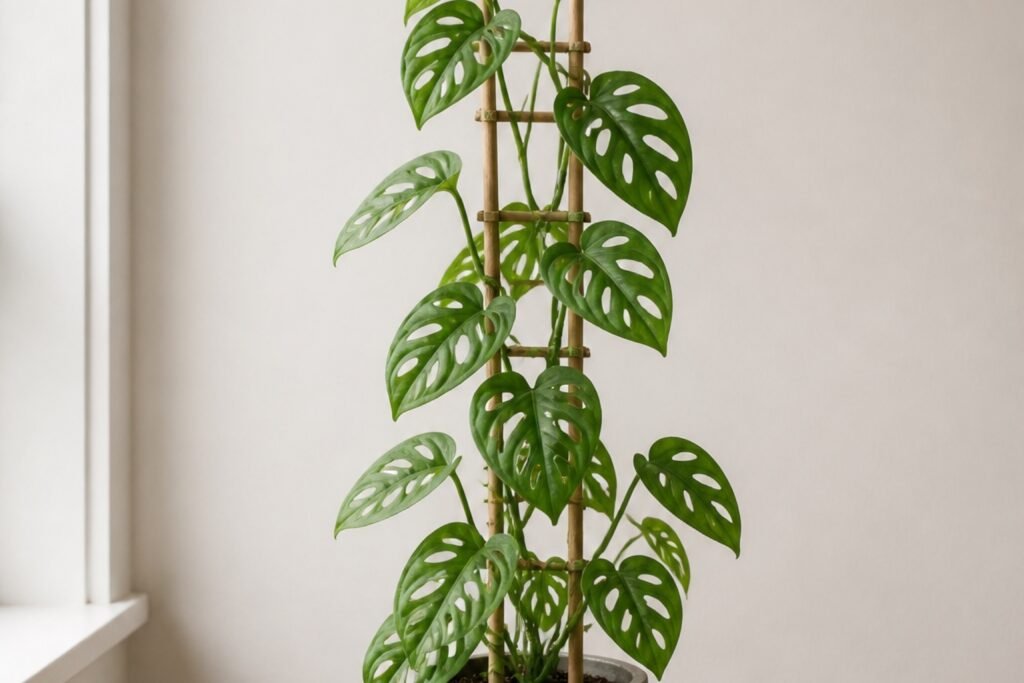
Monstera adansonii care should produce a flexible vine with thin, perforated leaves, not a miniature copy of Monstera deliciosa. Monstera adansonii has several common names, including Swiss cheese vine, five holes plant, and Adanson's monstera. The shared Swiss cheese name causes plenty of label mix-ups. Adansonii usually has smaller leaves with enclosed oval holes and a faster, lighter climbing habit.
The plant comes from tropical regions of the Americas and belongs to Araceae. It can trail from a shelf, but support usually produces larger leaves and a tidier vine. The stems are slimmer than those of deliciosa, so they also dry and damage more quickly when the root zone is neglected.
Monstera adansonii care snapshot
| Care point | Practical indoor target |
|---|---|
| Light | Bright indirect light, protected from hot direct sun |
| Water | Water when the upper inch or two has dried and the pot feels lighter |
| Soil | Airy, well drained indoor mix |
| Humidity | Moderately high humidity with gentle air movement |
| Temperature | About 65 to 80 F; avoid temperatures below 50 F |
| Indoor size | Often 3 to 8 feet long, with leaves larger on support |
| Pet safety | Toxic to cats and dogs if chewed |
Use light to keep the vine compact
Set the plant near an east window, beside a bright north window, or back from a stronger south or west exposure. Direct afternoon sun can bleach the thin leaves or leave tan patches. Move a shade-grown plant gradually if the new location receives even gentle sun.
Long gaps between leaves, tiny new growth, and a vine reaching hard toward one side usually point to weak light. More fertilizer will not tighten those internodes. Improve the light and prune the bare section once the plant is growing again. If natural light is limited, the grow light timing guide explains why both intensity and duration matter.
Adansonii can hang, but climbing changes its appearance. Fasten the stem loosely to a narrow plank, trellis, or textured pole. Do not tie the leaf stalks. Aerial roots can rest against the support or be guided toward the mix. Give the vine a route before it tangles around furniture.
Check moisture below the surface
Water when the upper inch or two of mix has dried and the pot is lighter than it was after the last soak. Apply water slowly across the surface until it drains from the bottom, then empty the saucer. If water rushes down one channel while the center stays dry, loosen or replace the old mix rather than repeating small sips.
Thin adansonii leaves may curl when the plant is very dry, but curling also appears with root damage, heat, or pests. Put a finger or skewer into the root zone before deciding. The indoor watering guide explains how pot weight and root condition narrow the cause.
Constant moisture without air can rot the roots and lower stem. Several yellow leaves, a soft node near the soil, and a pot that stays wet are a reason to stop watering and inspect. One yellow old leaf is less alarming. Read the pattern, not a single spot of color.
Keep the mix open and the pot modest
Use a loose mix that drains freely but holds a little moisture between its coarse pieces. A drainage hole is mandatory. Adansonii grows quickly in good conditions, yet moving it into a pot several sizes too large creates a wet buffer around a small root system.
Repot when roots pack the container, water passes unevenly, or the plant dries far faster than its light and temperature would suggest. Move up one modest size. Keep healthy roots intact and reset the vine at the same depth. The houseplant repotting guide covers the mechanics, and our potting soil guide helps compare ready-made mixes.
Increase humidity with a room humidifier if leaf edges crisp during a dry heating season. A pebble tray has a small, local effect and should never leave the pot standing in water. Do not crowd the plant into still, wet air, since leaf spots are more troublesome where foliage stays damp.
Feed, prune, and propagate the vine
Use a complete houseplant fertilizer during active growth at the product label rate. Reduce or pause feeding when light is weak and growth has slowed. A white crust on the mix or pot rim suggests salts are building up; flush with plain water before adding another dose.
Prune above a node to control length or encourage a new side shoot. For propagation, cut a healthy section that includes at least one node. A leaf without a node cannot become a complete vine. Rooting in water makes development easy to see, while a moist propagation medium avoids the later move from water to mix. The detailed steps belong to our water propagation guide.
Inspect new growth and leaf undersides for spider mites, thrips, scale, and mealybugs. Adansonii's holes and veins give small insects places to hide. Quarantine an incoming plant using the new houseplant checklist before it joins the shelf.
Common Monstera adansonii problems
| Symptom | What to check first | First sensible move |
|---|---|---|
| Long bare spaces on the vine | Light and distance from the window | Improve light, then prune during active growth |
| Leaves curl inward | Root-zone moisture, heat, and pests | Confirm the cause before watering |
| Yellow leaves and soft stem | Wet mix and root firmness | Pause watering and inspect roots and nodes |
| Crisp brown edges | Severe dryness, hot sun, and dry air | Stabilize watering and move away from harsh glass |
| Silvery scars or black specks | Young leaves and leaf undersides | Isolate and inspect closely for thrips |
For damage that does not fit one clear pattern, use the houseplant problem diagnostic and resist changing every variable in the same week.
Pet and household safety
North Carolina Extension lists Monstera adansonii as toxic to humans and pets if ingested and notes calcium oxalate crystals. Chewing can irritate the mouth and digestive tract; sap may irritate skin. Train trailing stems away from pet routes, collect every pruning piece, and wash exposed skin. Contact a veterinarian or animal poison service if a pet chews the plant or develops drooling, vomiting, swelling, or trouble swallowing.
Frequently asked questions
Should Monstera adansonii climb or trail?
Either habit can work. Trailing keeps it simple for a shelf or hanging pot. A climbing vine generally develops larger leaves and needs less frequent untangling. Choose one structure early and prune for that shape.
Why are new leaves missing holes?
Young leaves may be solid, and individual leaves vary. If an established plant also makes smaller leaves on long stems, check light and support. Do not cut holes or add extra fertilizer to force fenestration.
What is the difference between adansonii and deliciosa?
Adansonii has a slimmer vine and usually smaller, thinner leaves with enclosed oval openings. Deliciosa becomes much larger and develops both internal holes and deep cuts toward the edge as it matures.