
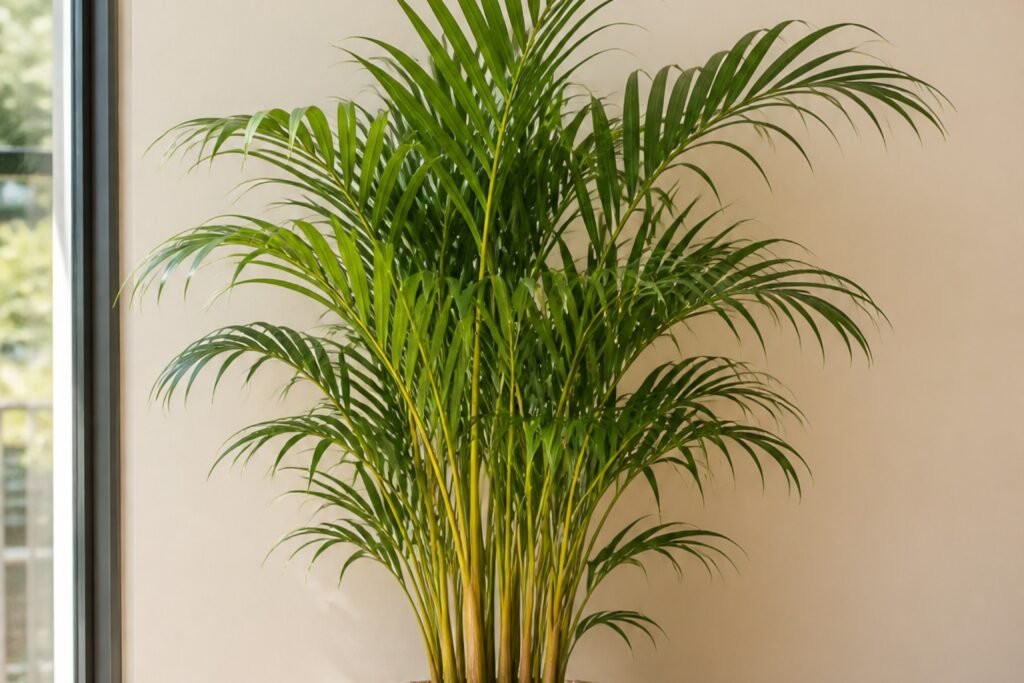
Areca palm care needs more room and light than parlor palm care. The many yellow-green canes and arching fronds make an impressive floor plant, but the pot can become heavy, thirsty, and crowded. It is a sensible choice for a bright room. It is a frustrating choice for a dark hallway.
Kew Plants of the World Online accepts Chrysalidocarpus lutescens. Dypsis lutescens is a homotypic synonym still used by many shops and by the ASPCA. Both names refer to the areca palm covered here. Butterfly palm, golden cane palm, and yellow palm are other common names. The species is native to eastern Madagascar and belongs to Arecaceae.
Areca palm care snapshot
| Care point | Practical indoor target |
|---|---|
| Light | Bright indirect light, with gentle morning sun if acclimated |
| Water | Water after the upper layer begins to dry; do not let the root ball stay soggy |
| Soil | Rich, well drained indoor mix in a stable container |
| Humidity | Moderate to high humidity |
| Temperature | About 65 to 80 F, protected from cold drafts |
| Mature indoor size | Commonly 5 to 8 feet indoors with enough room |
| Growth rate | Moderate |
| Pet safety | ASPCA lists it as non-toxic to cats and dogs |
Areca palm appears in our pet safe indoor plant guide, but it is not one of the site's low light recommendations. Its large canopy needs useful light and open space around the fronds.
Use a bright room and acclimate to sun
Place the palm near a large east window or a filtered south or west exposure. Gentle morning sun can be useful once the plant has adjusted. Strong midday sun through glass may bleach the leaflets, particularly on a plant that came from a shaded retail floor.
Turn the pot every week or two so the canes do not lean in one direction. Avoid squeezing the fronds against a wall. Constant rubbing creates brown tears that look like a care problem but are simple physical damage.
If a bright room still produces long, sparse new fronds, measure the light at leaf level. The article on whether indoor plants need a grow light explains how distance from a window changes the useful amount.
Keep moisture steady, then drain the excess
Areca palm uses more water than a parlor palm when it has a large canopy and bright light. Check the top inch or two. Water when that layer begins to dry, soaking the root ball evenly and letting excess escape.
Do not leave the heavy container sitting in runoff. Roots need moisture and air. A pot that remains saturated can develop a sour smell, yellow lower fronds, and root decline. A pot that repeatedly dries hard may produce crisp tips and shed leaflets.
The method in how often to water indoor plants is useful because large floor plants can be deceptive. Test the mix in more than one spot and learn the difference between the wet and dry pot weight.
Water quality and fertilizer salts can contribute to brown tips. If a pale crust forms, flush the pot with plain water when drainage is working. Do not use softened water that contains added sodium.
Give the canopy more humidity, not more mist
Areca palm prefers higher humidity than many apartments provide in winter. A humidifier gives a stable result. Grouping plants can help, but leave enough air space for inspection. A pebble tray under a large palm has limited reach.
Misting the fronds does not keep room humidity elevated and may leave spots on the leaves. Our humidity guide compares methods. Keep the palm away from hot vents even if a hygrometer elsewhere in the room shows a reasonable number.
Use a stable pot with fresh drainage
A tall areca palm can become top-heavy. Choose a sturdy container with a drainage hole and a rich, porous indoor mix. Do not jump to a huge pot for stability. Use a heavy outer cachepot or plant stand while keeping the root ball in a sensibly sized draining container.
Repot when roots crowd the pot, water no longer enters the mix evenly, or the plant becomes unstable. Move up one size and keep the bases of the canes at their former depth. The houseplant repotting guide covers root checks and drainage.
Feed with a complete fertilizer labeled for indoor palms or houseplants during active growth. Follow the rate. Excess fertilizer can brown tips and damage roots, while a truly deficient palm needs more than a random dose. Check light, moisture, roots, and the age of the mix first.
Do not take stem cuttings
Areca palms do not root from cut canes. The species is propagated by seed or by carefully dividing a multi-stemmed clump with its own roots. Division can set both sections back, so it is best reserved for a healthy, crowded plant rather than a declining one.
Do not cut a green cane halfway and expect it to branch. Remove a dead cane near the soil line with clean tools. Protect the healthy growing points.
Common areca palm problems
| Symptom | Likely checks | First sensible move |
|---|---|---|
| Brown tips across many fronds | Dry air, salts, dry spells, hot vents | Review humidity, water quality, and pot moisture |
| Yellow lower fronds in wet mix | Root stress or poor drainage | Drain the pot and inspect roots if decline continues |
| Pale bleached patches | Sudden direct sun | Filter the light and acclimate gradually |
| Fine webbing or stippling | Spider mites | Isolate and inspect the undersides |
| Sticky leaves or fixed bumps | Scale or whiteflies | Confirm the pest before choosing a treatment |
Our guide to brown tips on houseplant leaves helps separate pest evidence from moisture and light stress. Large palms are awkward to treat, so early inspection saves a lot of work.
Pet safety and name confusion
ASPCA lists the synonym Dypsis lutescens as non-toxic to cats and dogs. NC State separately warns that the heart-of-palm contains cyanogenic compounds and should not be eaten. Do not extend the ASPCA safety result to sago palm, which is not a true palm and is dangerous to pets. An animal can still develop stomach upset after chewing a non-toxic plant or swallowing potting mix.
Frequently asked questions
Is areca palm a good low light plant?
No. It may hold on in medium light, but it grows best in a bright room with filtered light. A dark corner usually produces weak growth and slow drying soil.
Why are my areca palm tips brown?
Dry air, uneven watering, salt buildup, softened water, and hot drafts are common checks. Inspect the root zone before deciding the palm simply needs more water.
Can I cut an areca palm cane and root it?
No. A cut cane will not make a new rooted palm. Propagation is by seed or by dividing a rooted clump, and division can be stressful for a mature indoor plant.