
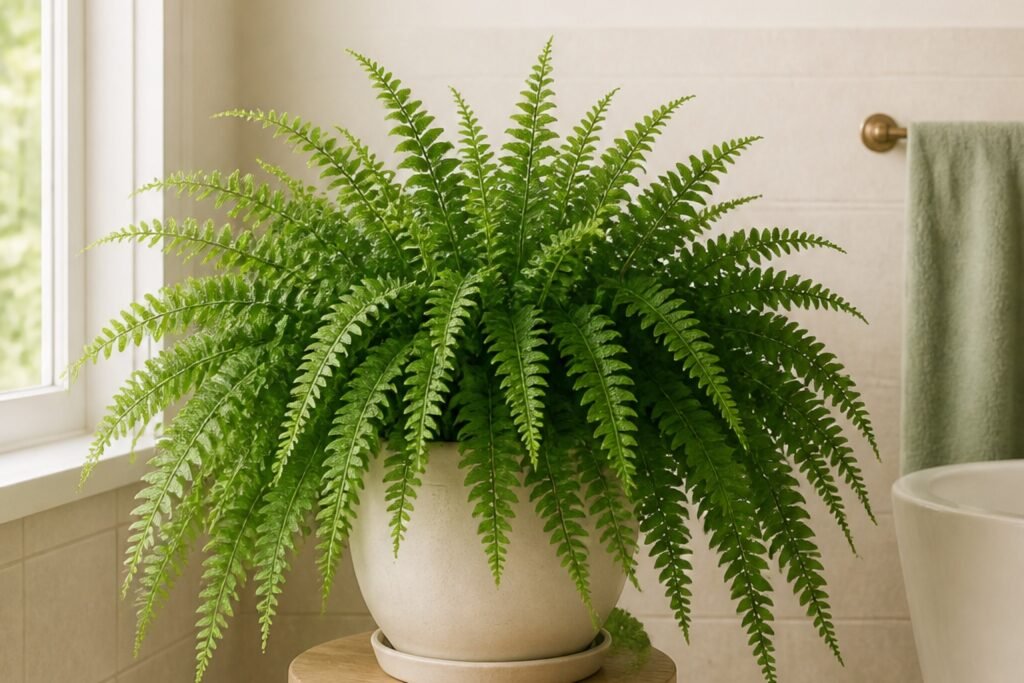
Boston fern care is not difficult in the sense of being mysterious. It is demanding because the plant notices missed moisture and dry air quickly. When the root ball dries hard, the fronds shed leaflets across the floor. When the pot stays swampy, roots decline. The useful target sits between those two extremes.
Boston fern is a cultivated form of Nephrolepis exaltata, a tropical and subtropical American fern. It grows as a terrestrial or epiphytic plant in nature and forms arching fronds from a central crown. Unlike flowering houseplants, it reproduces with spores and runners rather than seeds from flowers.
Boston fern care snapshot
| Care point | Practical indoor target |
|---|---|
| Light | Bright indirect light with no hot afternoon sun |
| Water | Keep evenly moist, but let excess water drain |
| Soil | Porous, organic fern mix that holds moisture without staying airless |
| Humidity | Higher than average, around 50 percent or more if practical |
| Temperature | About 60 to 70 F is comfortable |
| Mature indoor size | Roughly 2 to 3 feet tall and wide |
| Growth rate | Moderate in steady conditions |
| Pet safety | ASPCA lists Boston fern as non-toxic to cats and dogs |
The Boston fern appears in our guides to bathroom houseplants and pet safe indoor plants. A bathroom works only if it also provides useful light. Steam after a shower cannot compensate for a room with no window.
Give the fronds bright filtered light
Set the fern close to an east or bright north window. A sheer curtain can soften stronger exposures. Harsh sun bleaches and crisps fronds, while deep shade produces sparse growth and a thin crown. Rotate the pot so one side does not keep reaching toward the window.
A fern bought from a shaded greenhouse may burn after a sudden move to a bright sill. Acclimate it over a week or two. Old scorch will not turn green again, but new fronds should emerge without the same pale patches.
During winter, move the plant closer to daylight rather than assuming it needs less light because growth has slowed. Keep it away from cold glass, exterior doors, and hot vents.
Keep moisture steady without drowning the crown
Feel the surface often. Water when it begins to lose moisture, before the entire root ball dries. Apply water evenly until excess drains, then empty the saucer. A hanging basket can dry rapidly because air moves around every side, so its schedule may differ from a fern inside a cachepot.
The advice in how often to water indoor plants still applies: check the mix, pot weight, light, and season. Boston fern simply reaches the dry limit sooner than a ZZ plant or cast iron plant.
If the pot has dried hard and water races down the sides, soak it slowly in a shallow basin until the root ball accepts moisture, then lift it out and drain it. Do not leave it sitting in water for the rest of the day.
Raise humidity in a way that lasts
Dry heated air turns leaflet tips brown and makes spider mites more comfortable. A room humidifier is the most dependable fix. Grouping plants can help locally. A pebble tray has a modest effect and must keep the pot above the water line.
Misting gives only a brief humidity change and leaves foliage wet. Iowa State Extension notes that misting does not raise room humidity in a practical way. Use a hygrometer if you want to measure the room rather than guess. Our article about increasing humidity for houseplants compares the methods.
Use a porous mix and repot carefully
Choose an organic fern or indoor mix that holds moisture yet drains freely. A pot with drainage is required. Peat-heavy mix can become hard to rewet if it dries completely, while a dense, decomposed mix can stay airless.
Repot when roots fill the container, the mix has collapsed, or water no longer moves through evenly. Move up one size. Do not bury the crown, since water held around the center can encourage rot. The houseplant repotting guide covers root inspection and pot sizing.
Feed during active growth with a complete houseplant fertilizer used at the label rate. A fern in low winter light needs little or none. Brown tips after feeding may indicate salt buildup, especially when the potting mix has not been flushed.
Divide a healthy plant instead of chasing spores
Division is the practical indoor propagation method. Remove a crowded fern, identify rooted crowns, and separate a few substantial sections. Pot each at its previous depth and keep moisture steady while new roots establish.
Runners may also form rooted plantlets. Spores can produce new ferns, but they require careful sterile culture and a long juvenile stage. That is an interesting project, not the quickest way to fill another basket.
Common Boston fern problems
| Symptom | Likely checks | First sensible move |
|---|---|---|
| Crisp tips and falling leaflets | Dry root ball, low humidity, hot draft | Check moisture and move away from the vent |
| Yellow fronds in wet mix | Poor drainage or root stress | Drain the pot and inspect roots if decline continues |
| Pale bleached areas | Direct sun | Shift to filtered light and judge new fronds |
| Fine stippling or webbing | Spider mites | Isolate and inspect the undersides closely |
| Brown rows under mature fronds | Normal sori containing spores | Compare the regular pattern before treating |
That last line saves many healthy ferns from unnecessary pesticide. Sori form in orderly rows or patches on the underside of mature fronds. Random insects, sticky residue, and distorted new growth are different evidence. Our guide to brown leaf tips can help with uncertain damage.
Pet safety
ASPCA lists Boston fern as non-toxic to cats and dogs. Make sure the plant is really a Nephrolepis fern. Asparagus fern is not a true fern and has a different safety profile. Even a non-toxic plant may cause stomach upset if a pet eats a large amount, and a heavy hanging basket needs a secure hook.
Frequently asked questions
Why is my Boston fern dropping leaves everywhere?
Check for a dry root ball, low humidity, hot airflow, or a recent move. Some old fronds shed naturally, but widespread crisp shedding usually points to moisture or air conditions.
Can a Boston fern live in a bathroom?
Yes, if the room has bright filtered light and comfortable temperatures. A windowless bathroom needs a grow light. Humidity alone will not support the plant.
Should I cut brown Boston fern fronds?
Remove a fully brown frond at the base with clean scissors. Keep partly green fronds unless they are diseased, since the living sections still support the plant.