
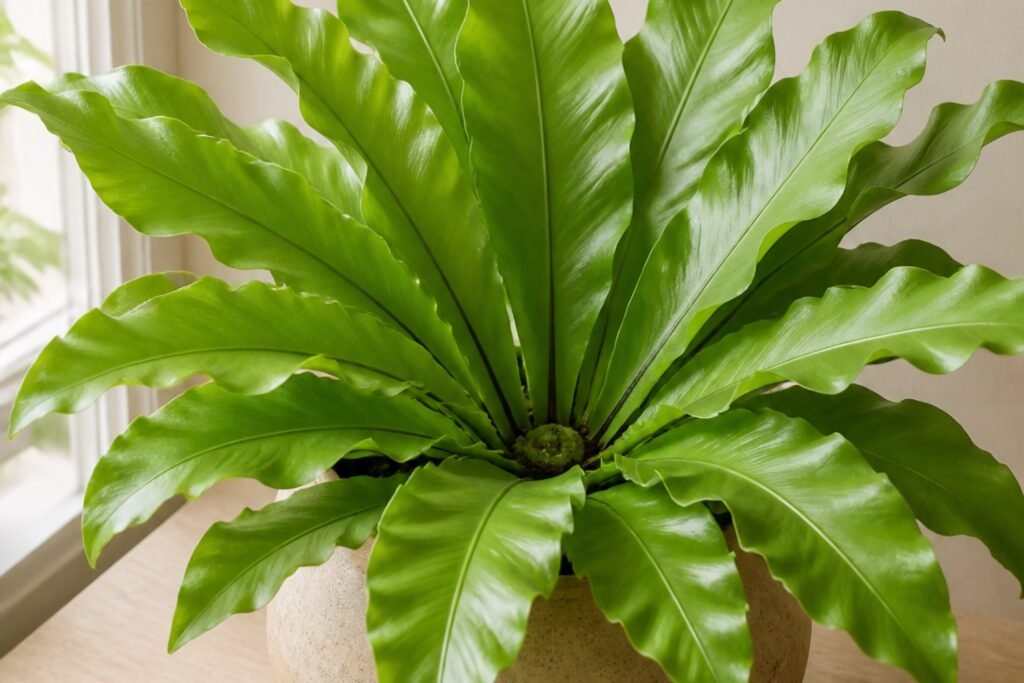
Bird's nest fern care feels different from the care of a feathery Boston fern. Asplenium nidus makes broad, undivided fronds in a tight rosette. The center looks like a cup, but it should not be treated like one. Water and debris held in that crown can damage the tender growing point.
Nest fern is another common name. In tropical forests across parts of Southeast Asia, Polynesia, Australia, and Madagascar, the plant often grows as an epiphyte on trunks and branches. Its rosette catches organic litter in nature. In a pot, a porous mix and careful watering replace that forest arrangement.
Bird's nest fern care snapshot
| Care point | Practical indoor target |
|---|---|
| Light | Bright filtered or dappled light |
| Water | Keep the mix evenly moist and water around, not into, the crown |
| Soil | Rich, porous fern mix with reliable drainage |
| Humidity | Moderate to high humidity |
| Temperature | About 65 to 80 F, protected from cold drafts |
| Mature indoor size | Often 2 to 3 feet across; larger outdoors in the tropics |
| Growth rate | Slow to moderate |
| Pet safety | No exact ASPCA listing was found for this species; prevent chewing and retain the botanical label |
Bird's nest fern appears in our guide to houseplants for bathroom humidity. It suits a bright bathroom, yet a windowless one still needs a suitable grow light. New fronds emerge from the center, so overhead fixtures should not heat or bleach that point.
Choose soft, useful light
An east window with gentle morning sun or a bright north exposure is often comfortable. Filter stronger southern and western light. Direct sun can bleach the broad fronds and leave tan patches, while deep shade produces narrow, weak growth.
Some cultivars have wavy edges, such as plants sold as 'Crispy Wave'. The rippling is normal. Compare both sides of the plant and inspect new growth before deciding that a natural shape is damage.
Move the fern gradually when light changes. A plant from a shaded store bench may scorch on a bright sill even if the final location would have been suitable after acclimation.
Water the mix and leave the crown alone
Feel the surface regularly. Water when it begins to dry, before the root ball becomes hard and light. Pour slowly around the pot's edge and let excess drain. Avoid directing a stream into the rosette, especially in cool conditions when water evaporates slowly.
Consistent moisture does not mean standing water. A sealed cachepot or compacted mix can suffocate roots. Yellowing from the base, a sour smell, or a soft center calls for a close look at drainage and the crown.
The general guide to watering indoor plants helps with the checks. A broad fern in bright summer light may use water quickly. The same plant in winter can remain moist for much longer.
Humidity helps new fronds open cleanly
Dry air can leave edges brown and may cause a new frond to emerge distorted. A room humidifier creates a measurable change. Grouping plants may help locally. Misting is brief and can leave water in the crown, so it is a poor substitute.
Aim for stable moderate or high humidity rather than a daily spike after a shower. Our article about increasing houseplant humidity compares humidifiers, grouping, and pebble trays. Keep the fern away from heating vents even if the room's average reading looks acceptable.
Use a light, organic root zone
Choose a porous fern mix with organic matter. The plant is an epiphyte in much of its native range, so a heavy mineral soil is a bad match. The pot needs drainage and should be only a little larger than the root mass.
Repot when roots crowd the container or the mix has collapsed. Keep the crown above the surface. Burying the center or packing mix between the young fronds can lead to decay. The repotting guide covers root inspection and safe pot sizing.
Feed lightly during active growth with a complete houseplant fertilizer according to the label. Apply it to moist mix rather than pouring concentrated solution into the crown. Too much fertilizer can burn roots and brown the margins.
Propagation is a specialist project
Unlike a Boston fern, a bird's nest fern does not usually offer obvious divisions or plantlets. It grows from spores that form in straight brown lines on the underside of mature fronds. Those sori are normal and should not be scraped off as pests.
Spore propagation requires clean equipment, a sterile medium, continuous moisture, and patience through the fern's early stages. Most home growers will find it simpler to buy a second plant. Do not split the single crown. Cutting the central growing point can kill the fern.
Common bird's nest fern problems
| Symptom | Likely checks | First sensible move |
|---|---|---|
| Brown crisp margins | Dry air, dry mix, fertilizer salts | Stabilize moisture and check humidity |
| Soft or black center | Water trapped in crown, cold, rot | Stop crown watering and isolate the plant |
| Pale tan areas | Direct sun | Move to filtered light and watch new fronds |
| Narrow, stretched fronds | Light too low | Increase indirect light gradually |
| Straight brown lines under fronds | Normal sori | Leave them alone after confirming the regular pattern |
Irregular spots, sticky residue, or distorted new leaves deserve a closer inspection. Compare simple edge damage with the guide to brown leaf tips before treating a normal spore pattern as an insect outbreak.
Pet safety and plant names
An exact ASPCA entry for Asplenium nidus was not located during this review, and NC State Extension does not flag the species as poisonous. That is not the same as a veterinary guarantee. Prevent chewing and contact a veterinarian after an exposure that causes symptoms. Keep the botanical name because asparagus fern, which is not a true fern, has a different safety profile. Our pet safe plant guide explains why "fern" alone is not a reliable identification.
Frequently asked questions
Should I water inside a bird's nest fern?
No. Water the potting mix around the crown. Water held in the center can damage the growing point, particularly in cool or low light conditions.
What are the brown lines under the leaves?
Regular brown lines on mature fronds are usually sori, the structures that contain spores. Random bumps, insects, or sticky residue are different and need inspection.
Can I divide a bird's nest fern?
Do not split a plant with one central crown. This species is normally propagated from spores, which is a slow and exacting home project.