
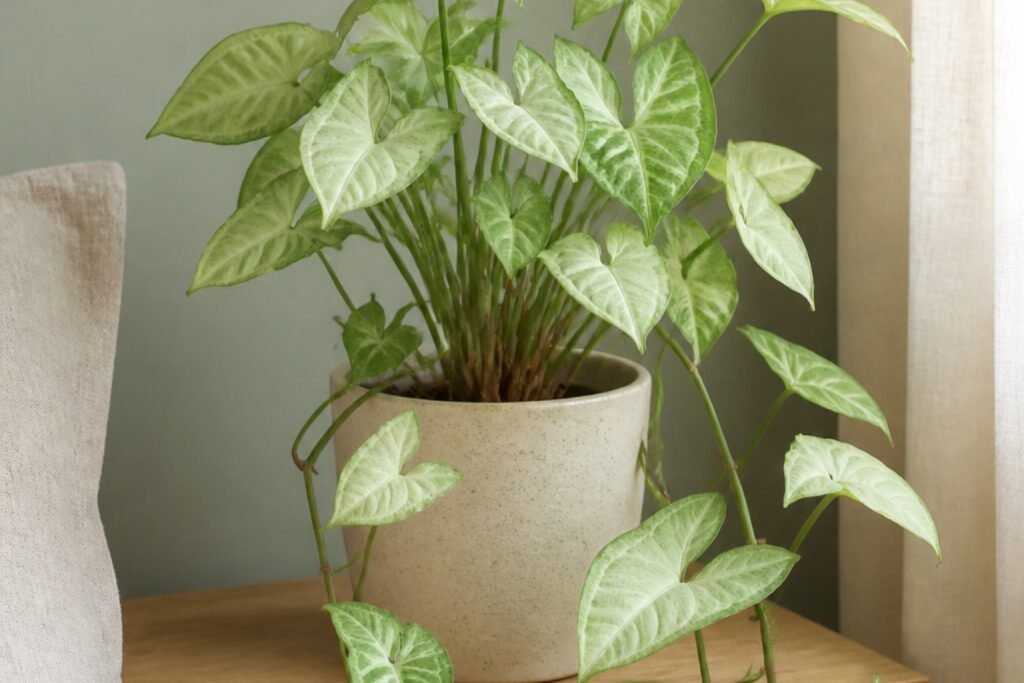
Arrowhead plant care changes as the plant grows up. A young Syngonium podophyllum makes compact arrow-shaped leaves. An older stem wants to climb or trail, and leaves may gain lobes as it matures. A vine running over the pot edge is not a different plant or a failure of care.
Arrowhead vine, American evergreen, and trileaf wonder are useful common names. "Nephthytis" still appears in shops, although true Nephthytis is a different African genus. The trade label persists, so the accepted botanical name is the safest reference.
Arrowhead plant care snapshot
| Care point | Practical indoor target |
|---|---|
| Light | Bright indirect light, protected from hot midday sun |
| Water | Water after the upper 1 to 2 inches dry and the pot gets lighter |
| Soil | Airy aroid mix with modest moisture retention |
| Humidity | Moderate humidity or better |
| Temperature | Roughly 60 to 85 F |
| Mature indoor form | Compact juvenile growth followed by trailing or climbing stems |
| Growth rate | Fast in warmth and good light |
| Pet safety | Toxic to cats and dogs |
Match light to the leaf color
Green cultivars tolerate medium indirect light, but the plant stays fuller in brighter filtered light. Pale, cream, or pink-variegated leaves need enough light to hold their pattern. Hot direct sun can leave bleached patches, especially on thin new foliage.
Long gaps between leaves usually mean the vine is reaching. Move it closer to a bright window in stages. Cutting the stem may hide the symptom for a month, but it will stretch again if light stays weak. The guide to why a plant becomes leggy helps separate low light from normal climbing growth.
A small trellis or moss pole encourages larger mature foliage. A hanging basket keeps the juvenile-looking cascade but requires occasional pruning. Neither form is more correct.
Variegated cultivars can also revert on one stem. If a new shoot stays plain after several leaves, prune that shoot back to the last node showing the pattern you want. First confirm that the plant has adequate light; cutting repeatedly in a dark site only trades one weak stem for another.
Before removing a reverted stem, follow it down to its point of origin. If it emerges from below the patterned section, cutting only its tip lets plain growth return. Use clean pruners and leave a small stub above the chosen node. New leaves need time to color fully, so judge the branch only after two or three leaves have hardened. Cream sections contain less chlorophyll and may grow more slowly than green tissue. That difference is normal, provided the whole plant still produces firm leaves.
Check moisture below the decorative surface
Push a finger or wooden stick 1 to 2 inches into the mix and lift the pot. Water when that upper zone is dry and the container is lighter. Soak all of the root ball, drain, and remove runoff from the cachepot.
Syngonium wilts when dry, but repeated collapse weakens fine roots. Constant moisture brings soft stems and yellow leaves. The plant uses much less water in lower light or cooler weather, so a weekly date has no real authority. Use the cues in how often to water indoor plants instead.
Yellowing limited to one old lower leaf may be ordinary turnover. Several yellow leaves over wet soil need a root check. A dark soft vine should be cut back to firm tissue and the damp setup corrected.
Prune above a node and propagate below it
Cut a long stem just above a node on the parent plant. New growth can develop from a node below the cut. For propagation, keep at least one node on the cutting, because roots and shoots develop from that joint.
A cutting may root in water, sphagnum, or an airy mix. Move a water-rooted cutting before roots become a tangled mass, and keep the new pot evenly but lightly moist while it adjusts. The water-propagation guide covers vessel hygiene and the move to potting mix.
Layering is even gentler. Pin a node against moist mix while it remains attached to the parent, then separate it after roots form. A leaf with its petiole but no node cannot grow a new vine.
Repot when roots crowd the container or water bypasses the center. Use a pot only one size larger. Feed lightly during active growth and stop when the plant is stressed.
Arrowhead plant problem triage
| Symptom | Likely checks | First sensible move |
|---|---|---|
| Yellow lower leaves | Wet roots, old foliage, or weak light | Check root moisture and whether damage spreads |
| Long gaps between leaves | Light too weak | Move closer to filtered light before pruning |
| Crisp brown edges | Dry roots, hot sun, or dry air | Compare pot weight with window conditions |
| Soft dark stem | Rot from wet mix or cold | Cut to firm tissue and inspect roots |
| Cottony clusters | Mealybugs | Inspect nodes, petioles, and roots |
Mealybugs hide in the sheathing leaf bases and at nodes. Isolate the plant and use the mealybug guide to confirm the pest and repeat treatment for hatchlings.
Brown edges on one sun-facing leaf are different from brown tips across the whole plant. Map where damage appears. Local damage often points to hot glass or a dry draft; widespread decline brings the roots back into the investigation.
Keep every part away from chewing pets
ASPCA lists Syngonium podophyllum as toxic to cats and dogs. Insoluble calcium oxalate crystals can cause intense oral pain, swelling, drooling, vomiting, and difficulty swallowing. Wear gloves if sap irritates your skin and wash pruning tools.
Trailing stems quickly reach lower shelves and floors. Train or trim them before they enter a pet's reach. The plant should not be treated as a safe substitute from a pet-friendly plant list.
Frequently asked questions
Why did my arrowhead plant start trailing?
Trailing is normal mature behavior. Syngonium podophyllum is a vine. Prune it for a compact pot, let it hang, or give it a support to climb.
Can arrowhead plant grow from a single leaf?
No, not without a stem node. A node carries the bud that can produce a new shoot. Take a short stem section with at least one healthy node.
Why are new Syngonium leaves less variegated?
Check whether mature new leaves receive enough filtered light. Very weak light can reduce visible variegation, but cultivar genetics and leaf age also affect color. Do not expose pale leaves abruptly to hot sun.