
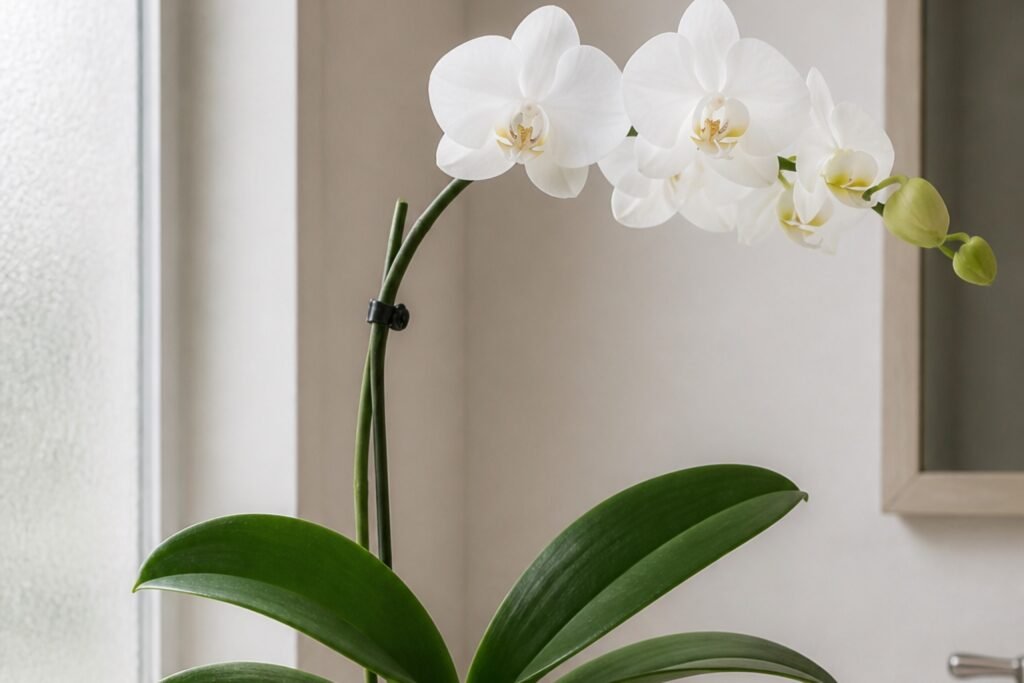
Phalaenopsis orchid care gets simpler when the roots are allowed to be visible. A healthy moth orchid has a short central stem, a fan of broad leathery leaves, and thick roots that turn green when wet and silvery as they dry. Those roots give a more useful watering signal than a printed day of the week.
Most store plants are complex Phalaenopsis hybrids, not a named wild species. Moth orchid and moon orchid are common names. "Doritaenopsis" still appears on old labels, but former Doritis hybrids now sit within Phalaenopsis. Care varies a little among hybrids, so plant condition outranks a rigid recipe.
Phalaenopsis orchid care snapshot
| Care point | Practical indoor target |
|---|---|
| Light | Bright filtered light, often at an east window |
| Water | Water when bark is nearly dry, the pot is light, and exposed roots turn silvery |
| Medium | Fresh coarse orchid bark in a ventilated draining pot |
| Humidity | Moderate to high humidity with air movement |
| Temperature | Roughly 60 to 85 F for common hybrids |
| Mature indoor size | Usually under 2 feet including leaves |
| Growth rate | Moderate during active leaf and root growth |
| Pet safety | ASPCA lists Phalaenopsis as non-toxic to cats and dogs |
Read the leaves for light, not the flowers
Place the orchid at an east window or in bright shade at a south or west exposure. Leaves should be medium green, firm, and warm only briefly in gentle sun. Yellow-green leaves with bleached patches suggest too much light; very dark floppy leaves and no growth may point to too little.
An old flowering display can continue in weak light because the spike was produced under greenhouse conditions. Watch the next leaf and root tips. If the room is dim, use the grow-light decision guide rather than moving the orchid into harsh direct rays.
Do not rotate or relocate a plant repeatedly while buds are forming. A sudden change in light or temperature can trigger bud blast.
Water the bark, then let it breathe
Lift the clear pot and look at exposed roots. Water when bark is nearly dry, the pot feels light, and most visible roots have shifted from green toward silvery gray. Run tepid water through the pot, soak the bark evenly, and drain completely.
Keep water out of the crown overnight. Blot standing water from the leaf center, especially in a cool room. Never leave the inner pot sitting in a decorative cachepot full of runoff.
Wrinkled leaves do not prove the plant is dry. Rotten roots cannot deliver water, so a wet orchid with damaged roots can look dehydrated. Remove the pot and inspect before increasing frequency. The physical method in how often to water indoor plants applies here, with root color and bark condition added to the check.
Replace stale medium, not every aerial root
Fresh orchid bark leaves large air spaces. As it decomposes, particles become smaller, stay wet longer, and reduce oxygen. Repot after flowering when bark has broken down, roots crowd the pot, or drying becomes uneven.
Firm green, white, or silver roots are alive. Brown hollow or mushy roots can be trimmed with a clean blade. Aerial roots outside the pot are normal and do not need to be forced into bark. The houseplant repotting guide provides a general root inspection sequence; keep the specialized orchid pot ventilated.
Feed weakly during active root and leaf growth as an orchid fertilizer label directs. Flush with plain water periodically so salts do not collect on bark and root tips.
Treat the flower spike as optional
After the last flower fades, a green spike may branch from a node, or it may slowly brown. Cutting above a node can produce a smaller side display on some hybrids. Cutting a spent spike near its base lets the plant invest in roots and leaves. Both choices are reasonable when the plant is healthy.
A mature hybrid often needs a modest drop in night temperature to initiate a new spike, but dwarf and warm-growing ancestry changes the response. Strong leaves and roots come first. Do not chill a weak wet orchid to force a bloom.
Propagation at home is limited. A plantlet, called a keiki, may form on a spike. Wait for several roots before separating it. A leaf cannot root into a new Phalaenopsis, and commercial seed propagation requires sterile laboratory methods.
Phalaenopsis problem triage
| Symptom | Likely checks | First sensible move |
|---|---|---|
| Wrinkled limp leaves | Dry bark or damaged roots | Inspect roots before adding water |
| Brown mushy roots | Stale wet medium or standing water | Remove the pot and assess every root |
| Bud blast | Temperature, moisture, humidity, or location changed | Review recent environmental changes |
| No new flower spike | Weak light, weak plant, or missing temperature cue | Prioritize roots and new leaves |
| Sticky cottony pests | Mealybugs or scale | Inspect leaf joints, spike nodes, and roots |
Mealybugs hide where leaves meet and beneath pot rims. Scale can cling to spikes and leaf undersides. Isolate the orchid and use the mealybug guide when white cottony insects are present.
Humid air helps, but a closed wet space invites disease. A nearby humidifier with gentle air movement is more useful than soaking flowers with a mister. The humidity guide explains workable room-level options.
Keep pet safety tied to Phalaenopsis
ASPCA lists Phalaenopsis species as non-toxic to cats and dogs. The designation does not cover every orchid genus, dyed flower treatment, pesticide residue, fertilizer, or decorative moss in the cachepot. Keep those materials out of reach.
A pet that chews a large amount of any plant may still develop digestive upset. If symptoms appear or the plant identity is uncertain, contact a veterinarian. Correct identification is the basis of any pet-safe indoor plant list.
Frequently asked questions
Should Phalaenopsis roots be outside the pot?
Yes. Aerial roots are normal for an epiphytic orchid. Leave firm roots alone and do not force them into dense medium simply to make the pot look tidy.
Why are orchid leaves wrinkled when the bark is wet?
The roots may be damaged and unable to take up water. Unpot the orchid, inspect for mushy or hollow roots, and replace decomposed bark before watering more often.
Will a Phalaenopsis bloom again on the same spike?
A green spike may branch from a node, while a brown spike will not. Some growers keep a healthy green spike; others cut it so the plant can focus on roots and leaves. Either choice can work.