
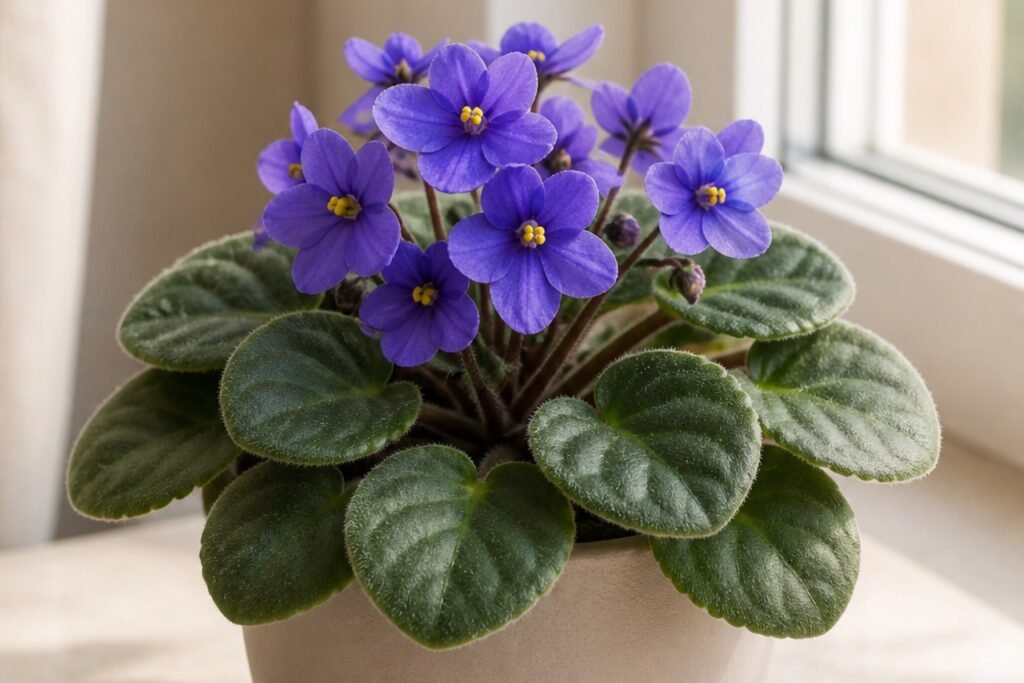
African violet care is easiest when the small root system gets steady moisture, bright filtered light, and a pot that is not much larger than the rosette. The accepted name in this profile is Streptocarpus ionanthus. Older books, plant shows, and nursery labels usually call it Saintpaulia ionantha or simply Saintpaulia. The familiar name stayed put even after the botanical classification changed.
Modern African violets come in many flower colors, leaf shapes, and sizes. A standard plant can spread well beyond a tiny windowsill pot, while miniature cultivars stay compact. The fuzzy rosette and central crown remain the features to protect.
African violet care snapshot
| Care point | Practical indoor target |
|---|---|
| Light | Bright indirect light with a dependable dark period |
| Water | Water when the surface is just dry, before the root ball hardens |
| Soil | Fine, airy, well drained soilless mix |
| Humidity | Moderate humidity, roughly comfortable household air |
| Temperature | About 60 to 80 F, with a stable warm middle range |
| Indoor size | Many standard rosettes reach 8 to 16 inches wide |
| Pet safety | ASPCA lists African violet as non-toxic to cats and dogs |
Give African violet care enough light to bloom
Set the plant near an east, northeast, or bright north window where it receives abundant filtered light without hot midday sun. Strong direct rays can bleach or burn fuzzy leaves. Too little light produces longer leaf stalks, a flatter color, and few flowers.
Rotate the pot a small amount every few days so the rosette stays even. If window light is unreliable, an LED grow light can work well. Iowa State University Extension recommends 12 to 16 hours per day under supplemental fluorescent or LED lights. That schedule leaves a nightly dark period, so do not leave the lamp on continuously. Our grow light timing guide covers timers and seasonal adjustment.
Look at the whole plant before blaming light for missing flowers. A healthy rosette with firm leaves and no blooms may need a brighter position. A wilted or crowded plant needs its root problem solved first.
Keep fine roots evenly moist, not soaked
Feel the surface. Water when it has just dried but before the mix becomes hard or the leaves collapse. Use room-temperature water and wet the root ball evenly, then let all excess drain. If water remains in a saucer, empty it.
You can water from the top with a narrow spout aimed at the mix, or set the pot briefly in shallow water until the surface begins to feel moist. Remove it and drain. Water left on cool fuzzy foliage can produce spots, so brush off droplets rather than leaving them overnight.
Wick watering can keep moisture steady, but the wick, mix, pot, and reservoir must work as one system. A wick that holds the mix saturated invites root and crown rot. Check the actual root zone instead of assuming the reservoir makes the setup automatic. Our indoor plant watering guide explains why physical cues still matter.
Use a small, airy pot
African violets have fine roots that need oxygen. Choose a loose soilless mix made for African violets or another fine-textured blend that drains promptly. A drainage hole is mandatory. Keep the crown above the mix rather than burying it.
A pot about one-third the width of a standard rosette is a useful starting proportion, though roots and cultivar size matter more than a rigid formula. Oversized pots hold unused wet mix. Repot when old mix collapses, roots fill the container, or the plant develops a long bare neck. The repotting guide covers clean tools and root handling, while our potting soil guide explains why structure changes as mix ages.
Remove dead outer leaves and spent flower stalks close to the crown without injuring healthy tissue. A plant that develops several crowns can be divided, but a symmetrical showy rosette is usually maintained as one crown.
Feed for repeat flowers
Use a fertilizer labeled for African violets or a complete houseplant fertilizer at the label rate appropriate for frequent use. Do not pour fertilizer solution onto a bone-dry root ball. Moisten first if necessary, and flush the mix with plain water now and then so salts do not collect.
Too much fertilizer can create tight, distorted central growth or rusty-looking leaves. Too little nutrition can contribute to pale foliage and weak blooming, but check light and roots before increasing the dose. A stressed plant cannot use a generous feed safely.
Leaf cuttings are the usual home propagation method. A healthy mature leaf with its petiole can produce plantlets in a light medium. Keep the setup moist, not sealed in stagnant water, and expect the process to take time. The site's houseplant propagation guide explains clean cutting and transition principles, though African violet leaves are often started directly in a propagation mix.
Common African violet problems
| Symptom | What to check first | First sensible move |
|---|---|---|
| No flowers, long leaf stalks | Light intensity and daily duration | Move to brighter filtered light or adjust the lamp |
| Limp plant in wet mix | Root and crown firmness | Stop watering and inspect for rot |
| Spots on fuzzy leaves | Recent cool water on foliage and direct sun | Keep future water on the mix and remove only failed leaves |
| Tight distorted center | Fertilizer salts and tiny pests | Isolate, inspect closely, and review feeding |
| White cottony material | Leaf bases and root ball | Confirm foliar or root mealybugs before treatment |
Thrips, mealybugs, and cyclamen mites can hide in a tight crown. New plants deserve a separate inspection period using the houseplant quarantine guide. If symptoms do not fit, compare them in the houseplant problem diagnostic before discarding the plant.
Pet and household safety
The ASPCA lists African violet, under Saintpaulia spp., as non-toxic to cats and dogs. That label does not make the plant food. Chewing leaves may still cause stomach upset, and fertilizer or pesticide residue creates a separate risk. Keep treated plants out of reach and call a veterinarian if a pet eats a large amount or develops symptoms.
Frequently asked questions
Why is my African violet not blooming?
Check light first. Long leaf stalks and a loose rosette often point to too little. The plant also needs a nightly dark period, healthy roots, and modest nutrition. Solve root rot or crown trouble before feeding harder.
Should I water an African violet from the bottom?
Bottom watering works if the pot is removed as soon as the root ball is evenly moist and allowed to drain. Top watering also works with a narrow spout kept off the crown and leaves. The goal is even moisture, not a particular ritual.
When should I repot an African violet?
Repot when the mix has collapsed, roots fill the pot, drainage becomes uneven, or a bare neck needs resetting. Use a modest pot and keep the crown above the mix. An annual refresh may suit some setups, but inspect the plant before disturbing it.