
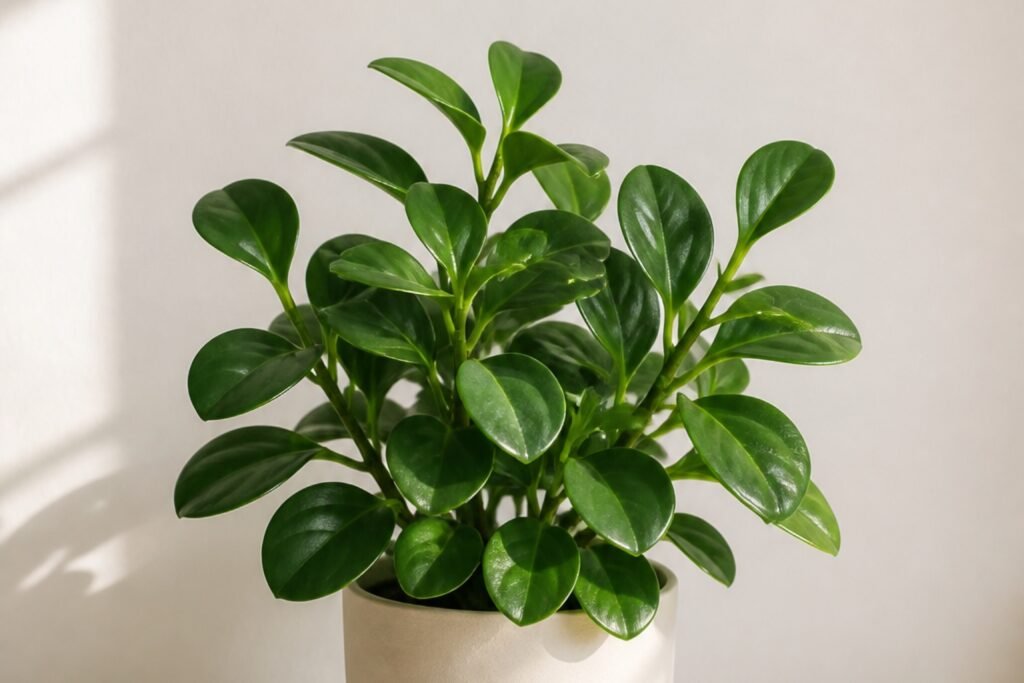
Baby rubber plant care suits a small shelf because the plant stores some water in thick leaves and grows as a compact, branching mound. Its botanical name is Peperomia obtusifolia. The plant is also sold as pepper face or American rubber plant. It is not a young Ficus elastica. The two plants belong to different families, have different sap, and reach very different sizes.
Wild Peperomia obtusifolia occurs from Florida through tropical parts of the Americas. Green cultivars tolerate lower indoor light for a time, while cream and yellow variegated forms need brighter filtered light to keep their pattern.
Baby rubber plant care snapshot
| Care point | Practical indoor target |
|---|---|
| Light | Bright indirect light; green forms tolerate medium light |
| Water | Water after the upper part of the mix dries and the pot feels light |
| Soil | Loose, fast draining indoor mix |
| Humidity | Average household humidity |
| Temperature | About 65 to 80 F, protected from cold drafts |
| Indoor size | Usually 6 inches to 2 feet tall and wide |
| Pet safety | ASPCA lists it as non-toxic to cats and dogs |
Use bright light for compact growth
Place the pot near an east window, at a bright north window, or back from a stronger south or west exposure. Gentle early sun can suit an acclimated green plant. Hot afternoon sun can bleach or scorch leaves, especially the pale sections of variegated cultivars.
In weak light, stems lengthen, leaves space out, and the pot dries slowly. Move the plant closer to useful light before pruning every stretched stem. A green cultivar handles medium light better than a heavily variegated one, but neither grows well in darkness. The low light plant guide explains the gap between tolerance and healthy growth.
Rotate the pot occasionally if the mound leans. Do not keep changing windows in response to each small mark. New compact leaves tell you more about the current placement than old damage that cannot heal.
Let part of the mix dry
Thick leaves give this Peperomia some drought buffering, but the roots are not cactus roots. Push a finger or wooden skewer into the upper part of the pot and lift the container. Water when that zone is dry and the pot feels light, before the leaves become soft and the entire root ball turns hard.
Soak the mix evenly until water drains, then empty the saucer. Small frequent sips leave moisture near the stem base and can miss deeper roots. A fixed weekday is unreliable because a shaded plant in winter dries far more slowly than one growing near a bright summer window. Our houseplant watering guide uses soil and pot weight as the trigger.
Yellow leaves and a soft, dark stem base usually deserve a wetness check. Do not add water to a heavy pot because a leaf looks limp. Damaged roots can leave foliage thirsty while the mix is already saturated. On the other hand, wrinkled or flexible leaves on a very light pot support the case for a thorough soak.
Keep the pot small and airy
Use a loose indoor mix in a pot with an open drainage hole. Coarse components help the root zone regain air after watering. The container should be only modestly larger than the root mass. An oversized decorative pot holds a ring of wet mix around a compact plant.
Repot when roots circle densely, water stops moving evenly, or the old mix has collapsed. Move up one size and keep the stem base at its previous depth. The houseplant repotting guide covers root handling, while the potting soil comparison helps judge whether a mix drains freely enough.
Average household humidity is usually adequate. Keep the plant away from a hot vent or cold draft. Misting is unnecessary and can leave water sitting in the tight leaf joints. Good spacing makes it easier to see mealybugs before they spread.
Prune and propagate a branching plant
Pinch or cut a stretched stem just above a node during active growth. The plant can branch below the cut, making the mound fuller. Do not remove most of the foliage from a weak plant in one session. Fix the light first, then shape new growth.
Stem cuttings are straightforward because each section can include several nodes. Leaf cuttings are also used for this species. Let a fresh cut stop dripping, place it in a light propagation medium, and keep the medium lightly moist rather than saturated. The houseplant propagation guide covers clean cuts and the move into potting mix.
Feed lightly during active growth with a complete houseplant fertilizer at the product label rate. Peperomias do not need aggressive feeding. Pause if roots are damaged or growth has stopped. A pale crust on the mix suggests salts are accumulating and should be flushed before another dose.
Common baby rubber plant problems
| Symptom | What to check first | First sensible move |
|---|---|---|
| Yellow leaves and soft stem | Deep moisture and root firmness | Pause watering and inspect for rot |
| Wrinkled or flexible leaves | Pot weight and moisture through the root ball | Water thoroughly only if the mix is dry |
| Long bare spaces | Light at the newest growth | Improve light, then prune above a node |
| Bleached tan patches | Direct sun on the damaged side | Move back from hot glass and acclimate gradually |
| White cottony clusters | Leaf joints and stem bases | Isolate and confirm mealybugs |
New Peperomias can hide mealybugs in tight joints. Use the quarantine routine before placing one beside other plants. If symptoms overlap, compare moisture, light, and pests in the houseplant problem diagnostic.
Pet and household safety
The ASPCA lists Peperomia obtusifolia as non-toxic to cats and dogs. Non-toxic does not mean the leaves should be offered as food. Chewing plant material can still cause stomach upset, and residue from fertilizer or pest treatments creates a separate concern. Keep treated plants out of reach and call a veterinarian if a pet eats a large amount or becomes unwell.
Frequently asked questions
Is baby rubber plant the same as rubber plant?
No. Baby rubber plant is Peperomia obtusifolia, a small herbaceous member of Piperaceae. Rubber plant is Ficus elastica, a woody fig with milky latex that can become a large indoor tree.
Why are baby rubber plant leaves falling off?
Check the pot before assuming thirst. Leaves may drop after persistent wetness, root damage, cold exposure, or severe dryness. A heavy wet pot with a soft stem base is a different problem from a light dry pot with flexible leaves.
Can Peperomia obtusifolia grow in low light?
A green cultivar can tolerate medium or lower light for a time, but growth will slow and stretch in a dim corner. Variegated plants need brighter indirect light to keep their color and compact shape.