
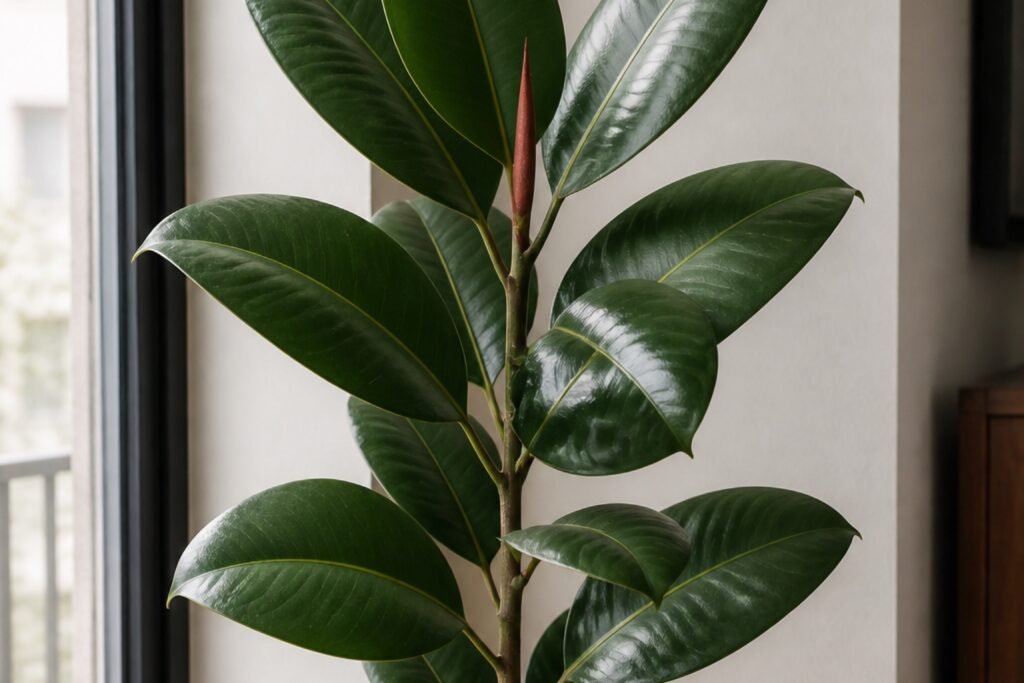
Rubber plant care is a balancing act between enough light for firm growth and enough restraint to keep the roots from sitting wet. Ficus elastica is a tropical tree in the fig family, Moraceae. Indoors it is usually maintained as a single cane or a branched floor plant, far smaller than the tree it becomes in its native range from the eastern Himalayas through Southeast Asia.
The common name causes confusion. Baby rubber plant is Peperomia obtusifolia, an unrelated, pet-safe species with much smaller leaves. A true rubber plant has large, stiff leaves, milky sap, and a pointed sheath around each emerging leaf.
Rubber plant care snapshot
| Care point | Practical indoor target |
|---|---|
| Light | Bright indirect light; gentle sun after acclimation |
| Water | Water after the upper 2 inches dry and the pot feels lighter |
| Soil | Loose, well drained indoor mix in a pot with drainage |
| Humidity | Average household humidity |
| Temperature | About 65 to 80 F, never against cold glass or a draft |
| Indoor size | Often kept 2 to 10 feet tall and 2 to 5 feet wide |
| Pet safety | Toxic to cats and dogs; sap can irritate skin |
Use light to keep the stem sturdy
Put a green rubber plant close to an east window or in bright filtered light near a stronger exposure. Variegated cultivars such as 'Tineke' and 'Ruby' need more useful light to hold their color, though their pale areas scorch more easily. Acclimate any cultivar over several days rather than shifting it from a shop shelf into direct afternoon sun.
The plant often turns every new leaf toward the window. Rotate the pot a little every week or two if you want even growth. Long gaps between leaves and a thin lean usually indicate weak light. Lower leaf loss can also follow sudden relocation, cold drafts, or a watering error, so look at timing before making another move.
If a natural window is not enough, position supplemental light close enough to matter. Our guide to grow light distance explains why wattage alone does not tell you what reaches the leaf.
Water after a real dry-down
Push a finger or wooden skewer about 2 inches into the pot. Water when that zone is dry and the container has lost noticeable weight, while the deeper mix is not bone dry. Apply water across the surface until it drains, then empty the saucer. Small daily pours keep the upper roots damp while leaving the rest of the root ball uneven.
Cooler temperatures and weak winter light slow drying. The interval might stretch well beyond what worked in summer. Use the physical checks in our houseplant watering guide instead of copying a weekly reminder.
A few old lower leaves may yellow and drop as the plant grows. Several leaves changing together while the mix remains wet are more concerning. Check for dark, soft roots and a soft stem base. If the root ball is dry and hard, water it evenly before blaming overwatering. Leaf drop describes a result, not a diagnosis.
Match the pot to the root ball
Rubber plants become top-heavy. A broad, stable pot helps, but it should still be only modestly larger than the roots. Use a loose general indoor mix that wets evenly and drains promptly. A closed decorative pot needs a removable nursery pot inside it so runoff can be emptied.
Repot when roots circle densely, lift the plant, or dry so quickly that even watering becomes difficult. Move up one size and hold the trunk at its previous depth. Do not bury a long bare stem in wet mix. The repotting guide covers root handling, while the potting soil guide compares mix behavior.
Wipe the leaves with a damp cloth. Dust makes the broad blades dull and can conceal scale or mites. Skip oil or shine products. A clean leaf makes pest inspection easier and does not need a glossy coating.
Prune for the shape you want
An unpruned rubber plant often grows as one upright stem. Cutting the growing tip can encourage buds below the cut, although no particular number of branches is guaranteed. Prune during active growth with a clean blade. Wear gloves, protect the floor, and blot the milky sap rather than rubbing it into skin.
Stem cuttings and air layering are common propagation methods. A cutting needs a healthy node; a detached leaf may root but will not reliably form a complete plant without stem tissue. Route the detailed rooting steps to the houseplant propagation guide, and do not keep a fresh cutting in saturated mix.
Feed with a complete houseplant fertilizer during active growth, following the product label. A rubber plant in strong filtered light can use more than one stalled in shade. Fertilizer does not correct root rot, a cold draft, or weak light.
Common rubber plant problems
| Symptom | What to check first | First sensible move |
|---|---|---|
| Several lower leaves drop | Recent move, cold draft, and moisture history | Stabilize the setting and inspect roots if the mix stays wet |
| Long bare stem | Light and pruning history | Improve light before deciding where to prune |
| Brown scorched patches | Sudden direct sun or hot glass | Move back and acclimate new leaves gradually |
| Yellow leaves in wet mix | Root color, smell, and firmness | Pause watering and remove decayed roots if present |
| Sticky leaves or hard bumps | Stems and leaf undersides for scale | Isolate and confirm the insect before treatment |
Scale, mealybugs, and spider mites can all settle on Ficus elastica. The houseplant problem diagnostic helps separate insects from watering or light damage. Quarantine a new specimen using the new plant checklist, especially when thick leaves make early scale easy to miss.
Pet and household safety
North Carolina Extension lists rubber plant as toxic to people, cats, and dogs if ingested. The milky latex can irritate skin and eyes. Keep fallen leaves and pruning debris away from pets and children, and wash tools and hands after cutting. If a pet chews the plant or develops symptoms, contact a veterinarian or animal poison service.
Frequently asked questions
How can I make a rubber plant branch?
First give it enough light for active growth. Then remove the growing tip at the height where you want branching to begin. Buds may break below the cut, but the response varies. Keep the plant stable while it recovers.
Why did my rubber plant drop leaves after I moved it?
Ficus plants react to abrupt changes in light, temperature, and watering. Compare the old and new locations, check the root-zone moisture, and avoid making several corrections at once. New growth is a better sign of recovery than an immediate stop to every dropped leaf.
Does a rubber plant need direct sun?
It does not require harsh direct sun. Bright indirect light is a reliable base, and an acclimated plant can use some gentle direct light. A plant raised in shade should never be pushed straight into a hot west window.