
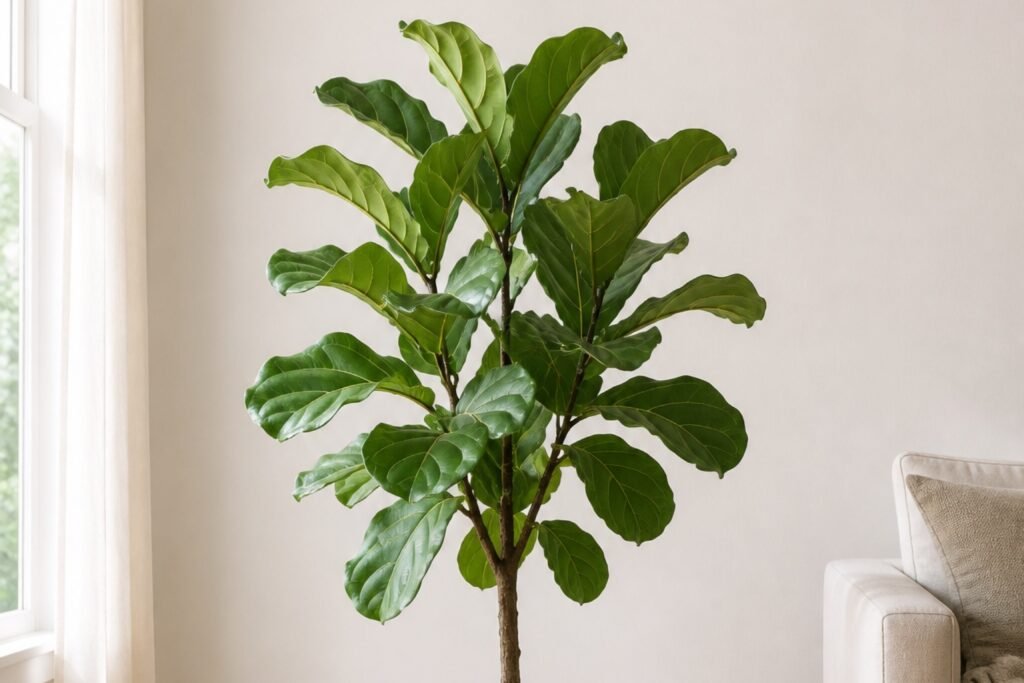
Fiddle leaf fig care rewards steadiness. Ficus lyrata reacts to abrupt changes in light, temperature, and root moisture, then shows the result on leaves that can be more than a foot long. That does not make the plant mysterious. It means one damaged leaf is visually loud, and each leaf keeps a record of old stress.
This tropical West and Central African fig is also called banjo fig. Its broad leaves have a narrow middle and a wavy outline that suggests a fiddle. Indoors, the tree rarely flowers or fruits. Most of the work goes into holding a strong crown of foliage on a stable trunk.
Fiddle leaf fig care snapshot
| Care point | Practical indoor target |
|---|---|
| Light | Bright indirect light with gentle direct sun after acclimation |
| Water | Water when the upper 2 inches dry and the pot becomes lighter |
| Soil | Loose, well drained indoor mix |
| Humidity | Average to moderately humid air |
| Temperature | About 65 to 80 F, protected from cold and vents |
| Indoor size | Often 2 to 10 feet tall and 2 to 5 feet wide |
| Pet safety | Toxic to cats and dogs; sap may irritate skin |
Start with the brightest sensible place
Choose the location before choosing the pot. An unobstructed east window works well, and a position near a south or west window can work with filtered light or a little distance from hot glass. A plant that grew under greenhouse shade needs gradual exposure before receiving direct sun.
Weak light produces slow growth, smaller leaves, and a plant that stays wet too long. Turn the pot a quarter turn every week or two if the crown leans, but avoid moving the tree between rooms whenever a leaf looks imperfect. A stable good location beats repeated searches for a perfect one.
The guide to whether a houseplant needs a grow light helps evaluate a dark winter room. If you add a lamp, place it according to measured output and plant response rather than leaving it across the ceiling.
Water what is in front of you
Push a finger or wooden skewer about 2 inches into the root ball and lift the pot if its size allows. Water when the upper zone has dried and the container feels lighter. Then soak the mix evenly until excess leaves the drainage hole. Empty the saucer or cachepot.
Do not measure a fixed cup for every watering. A partial pour may never wet the center, while the same amount can swamp a small pot. The indoor watering guide explains why light, season, roots, and pot material change the interval.
Both dry roots and damaged wet roots can produce limp leaves or brown areas. Check the mix before deciding. A waterlogged pot with dark, mushy roots needs air and root care, not another drink. A very light pot with mix pulling from the sides needs a slow, thorough soak.
Give the roots a stable, draining pot
Use a loose indoor mix that holds some moisture but releases excess water. A drainage hole matters more than a layer of stones at the bottom. Choose a container only modestly wider than the root ball. Huge pots remain wet around the edges and make a heavy tree even harder to move.
Repot when roots circle densely, emerge from drainage holes, or make even watering difficult. Fiddle leaf figs do not need an annual root disturbance just because spring arrived. When the trigger is real, move up one size, keep the trunk at the same depth, and avoid stripping healthy roots bare. Our repotting guide covers the process, and the potting soil comparison helps judge mix structure.
Feed during active growth with a complete houseplant fertilizer at the label rate. Pause when growth slows or roots are damaged. Extra fertilizer cannot repair a dark location, and accumulated salts may create further root stress.
Read brown spots by pattern
A single chart cannot diagnose every spot, but location and texture help. Crisp tan tissue on the window side may follow hot sun. Dark spreading areas on lower leaves, combined with wet mix, make root trouble more likely. Small reddish or brown marks on new leaves can develop when growth conditions fluctuate. Spots that expand, look water-soaked, or appear with stem damage deserve prompt isolation and closer inspection.
Do not cut a partly damaged leaf just to make the plant look clean. The remaining green tissue still works. Remove a leaf when most of it is dead, it is diseased, or its position interferes with the shape you are building. Use a clean tool and expect milky sap.
Wipe the large leaves with a damp cloth and support them from below. This is a good time to look for scale, mealybugs, thrips, and spider mites. The spider mite guide covers fine stippling and webbing, two signs often mistaken for dust.
Pruning and propagation
Pruning the growing tip can encourage buds below the cut, but branching is not guaranteed at every node. Work during active growth and decide where you want the crown to start. A tall bare trunk will not refill from the bottom simply because its leaves were removed.
Stem cuttings can root if they include viable stem tissue and a node. A detached leaf may form roots without producing a complete new tree. Air layering is another option for a tall stem because roots begin before the top is removed. Keep the full procedure with the houseplant propagation guide rather than improvising on a stressed plant.
Common fiddle leaf fig problems
| Symptom | What to check first | First sensible move |
|---|---|---|
| Sudden leaf drop | Recent move, cold draft, and root moisture | Stabilize conditions and inspect roots if wetness persists |
| Dark spots on lower leaves | Moisture depth, drainage, and root firmness | Pause watering and inspect the root ball |
| Crisp tan patches | Direct sun and severe dryness | Move back from hot glass and correct moisture gradually |
| Small new leaves | Light and root crowding | Improve light before increasing fertilizer |
| Fine pale speckling | Leaf undersides for mites | Isolate and confirm the pest |
If the pattern still does not fit, run it through the houseplant problem diagnostic and make one evidence-based change at a time.
Pet and household safety
North Carolina Extension lists Ficus lyrata as toxic to people, cats, and dogs if ingested. Plant material and milky sap can cause irritation, and sap may bother skin during pruning. Keep the tree out of chewing range, collect fallen leaves, wear gloves if your skin is sensitive, and contact a veterinarian or poison service after a concerning exposure.
Frequently asked questions
Why is my fiddle leaf fig dropping healthy-looking leaves?
Look for a recent move, temperature swing, or change in watering before assuming disease. Ficus trees often shed after abrupt environmental change. Check roots if the mix stays wet or the trunk base softens.
Should I mist a fiddle leaf fig?
Misting gives a short burst of surface moisture and does little for room humidity. A humidifier is more predictable in very dry air. Keep leaves clean and avoid leaving them wet where air movement is poor.
Can I cut the top off a tall fiddle leaf fig?
Yes, during active growth. Choose the height carefully, use a clean blade, and protect yourself from sap. The remaining stem may branch below the cut, while the top can be used for propagation if it includes healthy stem and a node.