
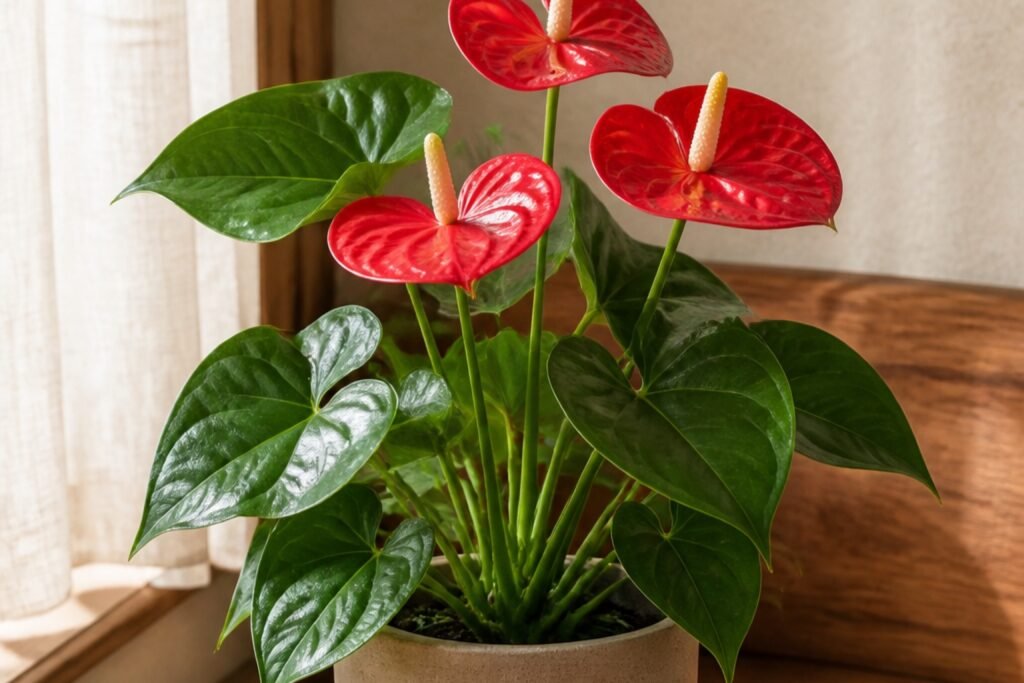
Anthurium care indoors is easier when the red "flower" is understood. The glossy heart-shaped part is a spathe, a modified leaf. The tiny true flowers cover the straight spadix rising from it. A healthy plant may keep one spathe for weeks, but the roots and new leaves tell more about long-term health than an old bloom does.
This profile covers common florist hybrids derived mainly from Anthurium andraeanum. Flamingo flower, flamingo lily, laceleaf, and tailflower are trade names. Anthurium scherzerianum looks similar but usually carries a curling spadix; an A. andraeanum type has a straight one.
Anthurium care indoors snapshot
| Care point | Practical indoor target |
|---|---|
| Light | Bright indirect light, no hot midday rays |
| Water | Water when the upper inch dries and the pot becomes lighter |
| Soil | Chunky, airy aroid or epiphyte-style mix |
| Humidity | High humidity with gentle air movement |
| Temperature | Roughly 65 to 85 F |
| Mature indoor size | Often 1 to 2 feet tall |
| Growth rate | Slow to moderate, depending on hybrid and light |
| Pet safety | Toxic to cats and dogs |
Give the plant bright filtered light
An east window often works well. At a south or west window, soften harsh midday rays or set the pot a little back from the glass. Too little light produces long petioles, small leaves, and few spathes. Too much direct sun leaves pale dry patches.
Do not buy a high-phosphorus fertilizer to solve a dark site. Flowering starts with enough useful light and a healthy root system. The guide to whether a grow light is needed helps evaluate a room without judging by brightness alone.
Colored spathes gradually fade and may turn green before they dry. That is normal aging. Cut the spent stalk near its base with a clean blade once it has declined.
Water roots, not a calendar
Check the upper inch of mix and lift the pot. Water when the top is dry and the container feels lighter, while the lower mix remains faintly moist rather than wet. Pour through the root zone and let the pot drain.
Anthurium roots need both moisture and air. Fine dense potting soil may stay wet too long, while oversized bark can dry before a small root system uses it. A chunky blend with varied particle sizes is a sensible middle. The checks in how often to water indoor plants help account for pot size, window light, and season.
Yellow soft leaves and dark roots point toward saturation. Brown crisp tips may come from a dry root ball, low humidity, or fertilizer salts. Look at the roots and recent routine before changing several variables.
Raise humidity without sealing in disease
Anthuriums prefer humid air, but wet leaves in a stagnant cabinet invite bacterial and fungal damage. A room humidifier, grouped plants, and gentle air exchange are more useful than daily misting. The humidity guide compares methods by what they actually change.
Keep the plant warm and away from cold drafts. Chilled wet roots are a poor combination. Brown wet lesions that expand should prompt isolation, dry foliage, and removal of badly affected tissue with a clean blade.
Repot when the mix breaks down
Repot after roots circle tightly, the mix collapses, or the crown rises far above the surface. A slightly larger pot is enough. Keep aerial roots near the surface rather than forcing every root under dense soil. The houseplant repotting guide covers root inspection and pot sizing.
Divide a crowded clump with roots attached. A stem section with a node can also root. A detached spathe or a leaf without a viable stem node cannot form a complete new plant.
Feed lightly during active growth with a complete fertilizer used as labeled. Flush the mix occasionally if mineral crust appears. More fertilizer commonly produces more salt damage, not more spathes.
Anthurium problem triage
| Symptom | Likely checks | First sensible move |
|---|---|---|
| Brown leaf tips | Dry roots, low humidity, or salts | Check moisture and fertilizer crust |
| Few or green spathes | Weak light, aging blooms, or hybrid traits | Assess new leaves and useful light |
| Yellow soft leaves | Wet roots or cold mix | Inspect moisture and root firmness |
| Dark wet lesions | Bacterial or fungal damage | Isolate and keep foliage dry |
| White cottony clusters | Mealybugs | Inspect leaf bases, spathes, and roots |
Mealybugs settle in tight leaf bases and along the flowering stalk. Isolate the plant and consult the mealybug guide before treating. Repeat inspection matters because hidden eggs and nymphs survive a one-time wipe.
Wipe glossy leaves with plain water so pests and lesions remain visible. Avoid commercial shine products. They cannot repair damaged tissue and may leave a film.
Understand the scope of the pet warning
Pet Poison Helpline lists Anthurium at genus level as toxic to cats and dogs because calcium oxalate crystals irritate the mouth. NC State documents the same crystals and oral, skin, and eye irritation for the exact A. andraeanum houseplant group. Together, those sources support a toxic status while keeping the source scope clear.
Chewing may cause drooling, mouth pain, swelling, vomiting, and difficulty swallowing. Keep every part away from pets and children, wash sap from skin, and contact a veterinarian or poison service after ingestion. Anthurium does not belong in a reachable pet-safe indoor plant display.
Frequently asked questions
Why are my anthurium flowers turning green?
An aging spathe often fades or greens naturally. Very weak light may also reduce color in new spathes. Judge the age of the bloom and the quality of new leaves before changing care.
Should an anthurium stay moist all the time?
No. Keep the lower root zone lightly moist during active growth, but let the upper inch dry and preserve air in the mix. Constant saturation damages roots.
Can I propagate an anthurium from a flower?
No. A cut spathe and spadix will not make a new plant. Divide a rooted clump or use a healthy stem section with a viable node.