
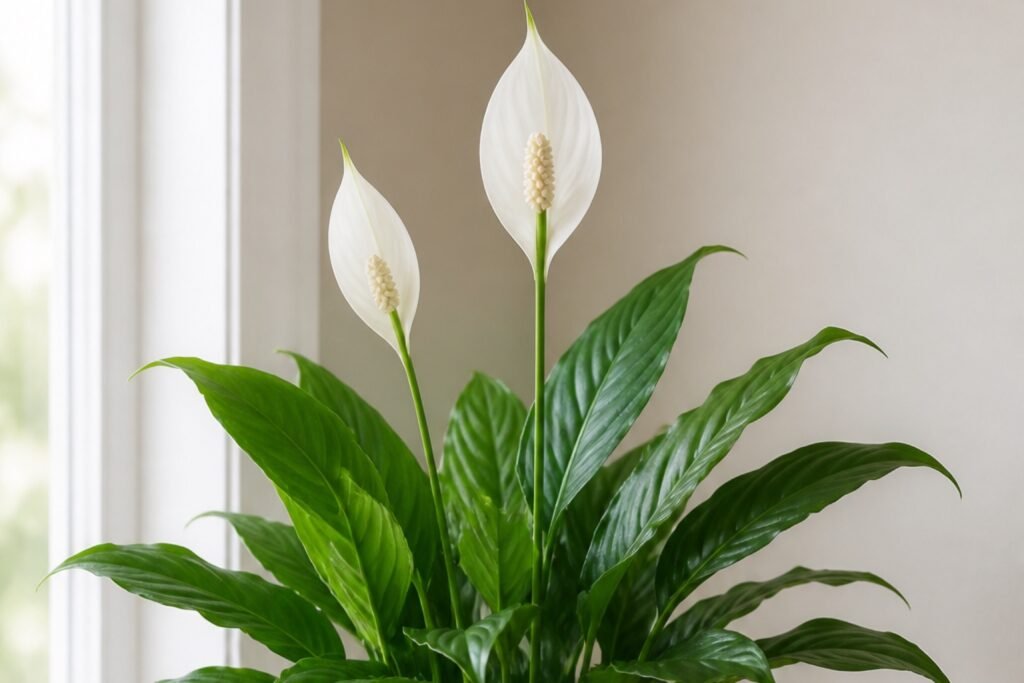
Peace lily care is mostly a matter of keeping the root zone lightly moist without leaving it waterlogged. Spathiphyllum wallisii is one of the smaller species sold under the peace lily name, though nursery labels often identify plants only as Spathiphyllum. It belongs to the aroid family and is not a true lily. That distinction matters for identification, but it does not make the plant safe to chew.
The white part people call a flower is a modified leaf called a spathe. Tiny flowers sit on the upright spadix in its center. A peace lily may hold dark green foliage in a dim room, yet it usually needs brighter filtered light to bloom well.
Peace lily care snapshot
| Care point | Practical indoor target |
|---|---|
| Light | Medium to bright indirect light; lower light slows flowering |
| Water | Water when the surface begins to dry and the pot feels lighter |
| Soil | Loose, organic potting mix in a pot with an open drainage hole |
| Humidity | Average to moderately humid household air |
| Temperature | About 65 to 80 F, away from cold glass and vents |
| Indoor size | Often 1 to 3 feet tall and wide, depending on cultivar |
| Pet safety | Toxic to cats and dogs if chewed |
Give peace lily care enough useful light
An east window with the plant set just outside the strongest direct rays is a good starting point. A bright north window can also work. Near a south or west window, use distance or a sheer curtain to soften hot afternoon sun. Pale patches and crisp areas on the side facing the glass often point to sun injury rather than a fertilizer shortage.
Low light is survivable, not ideal. The leaves may remain green while new growth slows and flowers stop. If the room is dim enough that you need a lamp during the day, move the plant closer to a window or use a measured grow light. The guide to low light indoor plants explains why room labels are less useful than checking light at leaf level.
Read the pot before watering
Peace lilies can wilt dramatically when dry, which makes the droop look like a convenient watering alarm. Waiting for a full collapse every time stresses roots and leaves. Check earlier. Press a finger into the surface, lift the pot, and water when the upper layer has begun to dry while the mix below still feels faintly cool. A lighter pot is a useful second clue.
Soak the whole root ball, let excess water leave the drainage hole, and empty the saucer. Do not keep a decorative outer pot filled with runoff. A plant that wilts while its mix is wet may have damaged roots, not a lack of water. The process in our indoor plant watering guide helps separate a dry pot from a root problem.
Tap water can leave pale mineral marks on glossy leaves. It may also contribute to tip burn where water is naturally high in salts. Brown tips have several other causes, including dry air, a missed watering, too much fertilizer, or hot sun, so change one verified condition at a time.
Use a pot that can drain
Choose a container only a little wider than the root mass. An oversized pot holds a large collar of wet mix around the roots. A loose indoor mix with organic matter should absorb water evenly, then release the excess. If the current mix has collapsed into a dense block or stays wet for many days in useful light, it needs attention.
Our potting soil comparison covers the texture differences among common mixes. Repot when roots crowd the pot, the plant dries unusually fast, or water runs around a shrunken root ball without wetting it. The houseplant repotting guide walks through the job without stripping healthy roots clean.
Do not bury the crown during repotting. Set the plant at roughly the same depth, firm the mix gently, and water it through. A recently divided or repotted peace lily may droop for a short time while disturbed roots recover.
Feed for growth, not as a rescue
A complete houseplant fertilizer can support active growth, but this plant is sensitive to excess salts. Follow the product label and use the lower end of its recommended rate. Pause when growth has slowed in winter or when the root ball is already stressed. Fertilizer cannot compensate for weak light or soggy soil.
Flush plain water through the mix occasionally if a white crust forms on the soil or pot rim. Wipe broad leaves with a damp cloth so dust does not hide mealybugs or scale. The leaf cleaning guide uses plain water and skips shiny coatings that can leave residue.
Blooms, division, and routine pruning
Useful light is usually the first thing to check when a healthy peace lily will not bloom. Also check whether the plant is receiving some nutrition during active growth and whether it has been moved repeatedly. Do not expect a fresh white spathe to stay white forever. It naturally becomes greenish and eventually browns.
Cut a spent flower stalk close to its base with clean shears. Remove fully yellow leaves the same way. For propagation, divide a crowded clump during repotting. Each section needs its own roots and several healthy leaves. Division is more dependable for a home grower than trying to raise seed. Keep the new divisions in stable filtered light while they settle.
Common peace lily problems
| Symptom | What to check first | First sensible move |
|---|---|---|
| Whole plant droops, mix is dry | Pot weight and moisture below the surface | Water thoroughly and drain |
| Whole plant droops, mix is wet | Root color, smell, and firmness | Stop adding water and inspect the root ball |
| Brown leaf tips | Dry air, salt crust, missed watering, direct sun | Correct the condition you can confirm |
| No flowers | Actual light at leaf level and recent growth | Move gradually into brighter indirect light |
| White cottony patches | Leaf joints and undersides | Isolate the plant and confirm mealybugs |
If several symptoms overlap, use the houseplant problem diagnostic before changing light, water, and fertilizer together. New plants should also spend time apart from the collection. Our quarantine guide gives a simple inspection routine.
Pet and household safety
The ASPCA lists peace lily as toxic to cats and dogs because it contains insoluble calcium oxalates. Chewing can cause mouth irritation, drooling, vomiting, and trouble swallowing. This is different from the severe kidney risk associated with true lilies, but it still requires prompt veterinary advice if a pet bites the plant or develops symptoms. Sap may irritate sensitive skin, so wash after pruning and keep cut pieces away from children.
Frequently asked questions
Why does my peace lily droop even after watering?
Check whether water reached the center of the root ball. Old, peat-heavy mix can shrink and shed water down the sides. If the mix is thoroughly wet and the plant stays limp, inspect roots for dark, soft tissue. More water will not repair root damage.
Can a peace lily grow in a windowless bathroom?
Humidity does not replace light. A windowless room needs a suitable grow light that supplies enough intensity for enough hours. Ordinary ceiling lighting may keep the room visible to people while providing little usable light to the plant.
Should I cut green peace lily flowers off?
A white spathe often turns green as it ages. Leave it while it still looks good, then remove the entire flower stalk near the base once it browns or collapses. Cutting it early does not force a replacement bloom.