
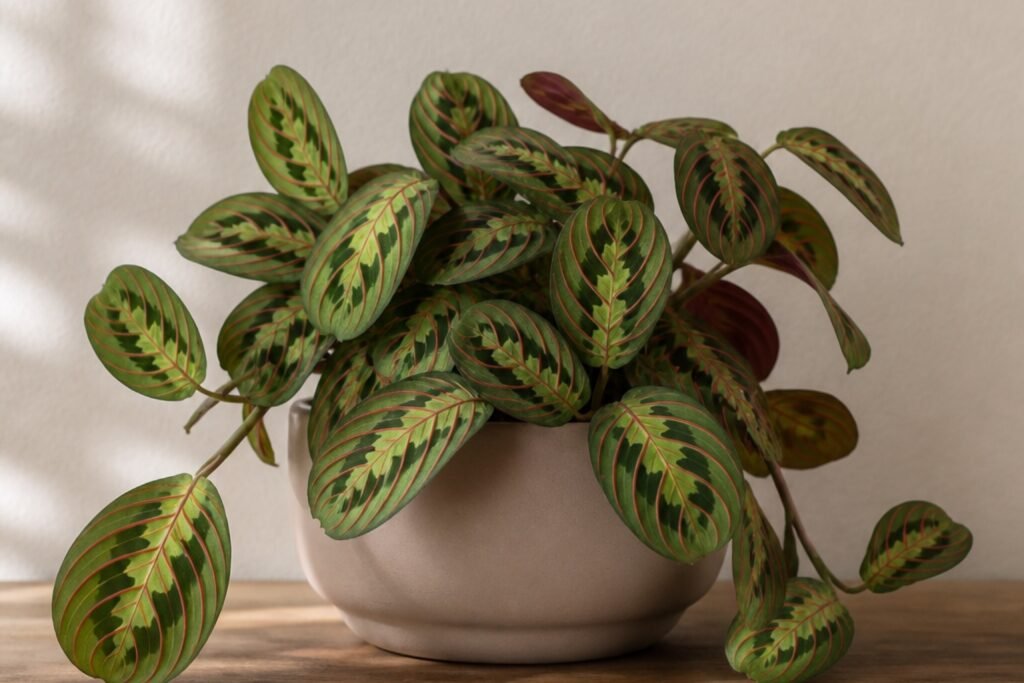
Prayer plant care is less about constant watering than keeping a small root ball from swinging between swampy and bone dry. Maranta leuconeura is a low, spreading member of Marantaceae, native to Brazil. Its patterned leaves rise in the evening and lower again by day, a normal movement called nyctinasty.
The name prayer plant is used loosely for Maranta, Calathea, Goeppertia, and several related plants. This profile covers Maranta leuconeura. Red veins, rabbit-track markings, or lime-colored patterning depend on the cultivar, but the plant keeps the same horizontal, rhizomatous habit.
Prayer plant care snapshot
| Care point | Practical indoor target |
|---|---|
| Light | Medium to bright indirect light, without hot direct sun |
| Water | Water when the surface begins to dry and the pot feels a little lighter |
| Soil | Airy mix that holds light moisture but drains fully |
| Humidity | Moderate to high humidity with gentle air movement |
| Temperature | About 65 to 80 F, away from cold drafts |
| Indoor size | About 6 to 12 inches tall and up to 2 feet wide |
| Pet safety | Not verified; a species-specific veterinary source says presumably non-toxic, but not suitable as feed |
Keep prayer plant care out of harsh sun
Place the pot near an east window, beside a bright north window, or farther back from a stronger exposure. Direct midday and afternoon sun can bleach the colored markings and leave crisp patches. Very weak light has the opposite effect: new leaves may be smaller, less colorful, and spaced farther apart.
Watch the newest growth rather than judging one old leaf. A prayer plant naturally turns and raises its foliage through the day. Movement alone does not mean thirst. Leaves that remain tightly curled, feel thin, or develop dry margins need a closer check of roots, heat, humidity, and pests.
If winter light collapses, a small grow light can be easier to manage than moving the plant onto cold window glass. Our grow light timing guide explains how to give plants a dark period instead of leaving the lamp on around the clock.
Keep the mix moist, not saturated
Feel the surface and lift the pot. Water when the surface has started to dry and the container is a little lighter, before the entire root ball hardens. Soak evenly until water drains, then empty the saucer. A shallow prayer plant pot may dry faster than a deep cachepot, so compare the plant with its own freshly watered weight.
The goal is consistent access to moisture and oxygen. A wet pot that smells sour, yellowing stems near the crown, or roots that turn dark and soft point to too little air. A very light pot with limp, curled foliage points toward dryness. The indoor plant watering guide uses those physical clues instead of a calendar.
Some Marantas develop brown edges where tap water contains a lot of dissolved minerals or where fertilizer salts accumulate. Check for crust on the mix and pot rim. Water quality is only one possibility; low humidity, hot sun, and repeated dry spells can leave the same crisp edge.
Give fine roots an airy mix
Use an indoor mix that retains light moisture without packing into mud. A pot with an open drainage hole is essential. Maranta spreads outward, so a container that is a little wider than it is deep can fit its habit, provided it is not oversized.
Repot when roots and rhizomes crowd the pot, water stops moving evenly through the mix, or the plant needs division. Move up one modest size and keep the crown at its previous depth. Our houseplant repotting guide covers the job, and the potting mix guide helps compare texture.
Moderate or high humidity reduces crispy margins, particularly during heating season. A room humidifier has a measurable effect. Misting only wets the leaf briefly and can leave spots. The humidity guide compares methods and explains why a pot should not sit in a tray of water.
Feed and divide without pushing the plant
Apply a complete houseplant fertilizer during active growth at the lower end of the label rate. Pause when the plant has stopped growing or when roots are stressed. Marantas can react to excess salts, so generous feeding is more likely to create edge burn than to deepen every color.
Division is the simplest propagation method. Slide out a crowded plant, find natural rooted sections along the rhizomes, and separate a few substantial pieces. Pot each at the same depth and keep the root zone steady while it settles. Stem cuttings with nodes may also root, depending on where the vine is cut. Keep the propagation setup lightly moist and use clean tools.
Check leaf undersides for spider mites and mealybugs. Fine stippling, dusty webbing, or cottony clusters are pest evidence, not a humidity measurement. Isolate a new plant and follow the quarantine routine before putting it among other foliage.
Common prayer plant problems
| Symptom | What to check first | First sensible move |
|---|---|---|
| Leaves remain tightly curled | Root moisture, heat, and leaf undersides | Confirm dryness or pests before watering |
| Brown crisp edges | Humidity, salt crust, sun, and dry spells | Correct the condition you can verify |
| Yellowing near the crown | Wet mix, drainage, and root firmness | Pause watering and inspect the root ball |
| Faded markings | Light intensity and fertilizer history | Move out of harsh sun or closer to useful filtered light |
| Fine pale speckling | Undersides for spider mites | Isolate and confirm with close inspection |
When symptoms overlap, use the houseplant problem diagnostic before changing several conditions at once.
Pet and household safety
The University of Zurich veterinary toxicology database describes Maranta leuconeura as presumably non-toxic because it found no literature evidence of potential toxicity. It also says the plant is not suitable as feed. That cautious wording is not a species-specific ingestion study, so this profile keeps the status for cats and dogs as not verified. Discourage chewing, and contact a veterinarian or animal poison service if a pet becomes unwell after eating it.
Frequently asked questions
Why does a prayer plant fold its leaves at night?
The daily raising and lowering of the leaves is normal movement, not an automatic sign of thirst. Judge watering by the root-zone moisture and pot weight. A leaf that stays tightly curled all day needs a separate diagnosis.
Should I mist a prayer plant every day?
No. Misting changes surface moisture briefly and does not maintain room humidity. Use a humidifier if the air is consistently dry, and keep enough airflow that leaves do not remain wet.
Can a prayer plant grow in low light?
It can tolerate the lower end of medium indoor light, but very dim conditions reduce color and growth. Bright filtered light is a better target. Keep it out of harsh direct sun, which can bleach the pattern.