
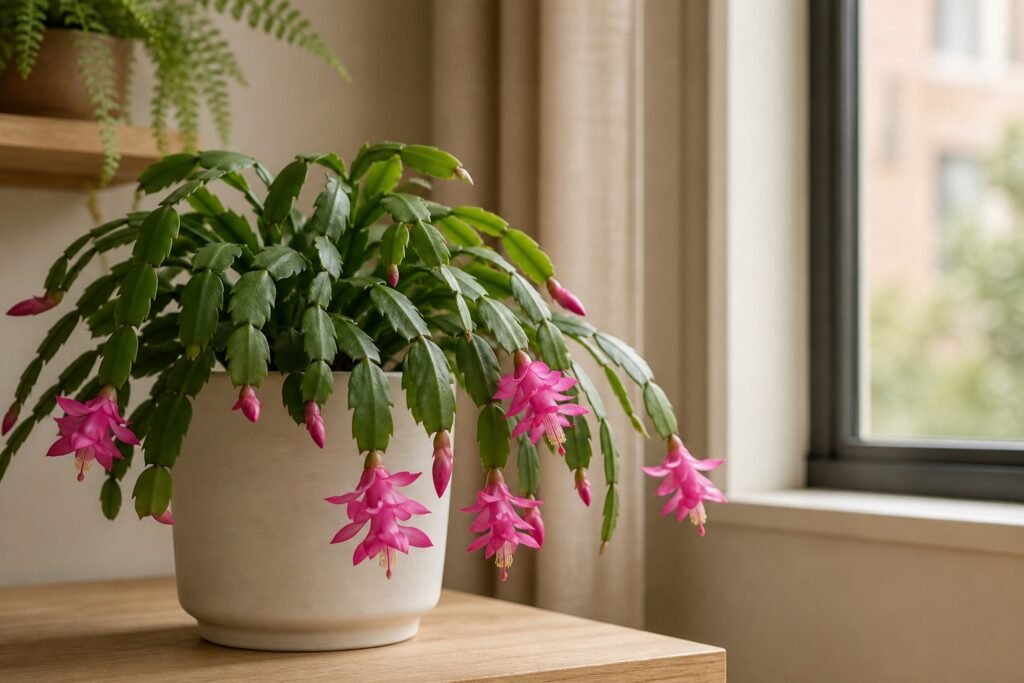
Christmas cactus care starts with checking whether the plant is a true Christmas cactus. Schlumbergera × buckleyi has flattened stem segments with rounded scalloped margins and flowers that hang from their tips. The Thanksgiving cactus, S. truncata, has sharper claw-like points and usually holds its flowers more upright.
Shops use "Christmas cactus" for several holiday cacti, so bloom date alone is not proof. The older name Schlumbergera bridgesii still appears in extension and veterinary references. This profile uses the accepted hybrid name and calls out that naming gap where safety evidence is discussed.
Christmas cactus care snapshot
| Care point | Practical indoor target |
|---|---|
| Light | Bright indirect light with gentle morning sun |
| Water | Water after the upper inch dries and the pot becomes lighter |
| Soil | Airy, fast-draining epiphyte mix |
| Humidity | Moderate humidity with air movement |
| Temperature | Roughly 55 to 80 F |
| Mature indoor size | About 6 to 12 inches tall and 1 to 2 feet wide |
| Growth rate | Moderate |
| Pet safety | Exact veterinary status for the accepted hybrid name not verified |
Grow it like a rainforest cactus
This plant is an epiphyte derived from Brazilian rainforest species, not a desert barrel cactus. It appreciates filtered light, some humidity, and an airy medium that dries modestly between drinks. Hot midday sun can bleach the flat green segments.
An east window is often suitable. A bright south or west window may need a sheer curtain. If the plant sits far from natural light, use the grow-light decision guide and keep the lamp on a timer rather than running it late into autumn nights.
Red-tinged segments can follow strong light, cold, drought, or nutrient stress. Check where the color appears and what changed. Firm growth with a light red edge in strong light is different from soft red tissue near a wet base.
Water firm segments and airy roots
Feel the upper inch and lift the pot. Water when the surface is dry and the container is lighter while segments remain firm. Soak the root ball and drain. Do not let the pot sit in runoff.
Unlike many desert cacti, Christmas cactus should not stay bone dry for a long growing-season stretch. It also rots in constant moisture. The method in how often to water indoor plants helps balance touch, pot weight, temperature, and light.
After flowering, growth may pause and water use drops. Reduce frequency without abandoning the physical check. During spring and summer growth, feed monthly as the product label directs, then reduce fertilizer before the autumn bud period.
Build an autumn night the plant can read
Short days and cool nights encourage buds. NC State and Missouri Botanical Garden describe long uninterrupted nights, around 13 hours, paired with cooler temperatures. Indoor lamps can break the dark period even when the plant sits away from a window.
For about six to eight weeks in early autumn, give bright daytime light and a genuinely dark night. A cool room can support bud formation, but avoid frost and abrupt cold drafts. The guide to how long to run a grow light helps keep supplemental light from erasing the night.
Once buds are visible, keep placement, watering, and temperature steady. Moving a pot from a cool spare room to a hot mantel may cause bud drop. So can a dry root ball, saturation, or a draft.
Repot after flowering and propagate by segments
Use a loose epiphyte mix in a draining pot. Repot after flowering when particles have broken down, drainage slows, or roots are packed. A slightly snug pot is fine. The houseplant repotting guide explains why a large jump in pot size keeps too much unused mix wet.
For propagation, twist off a short chain of two or three healthy segments. Let the broken end dry briefly, then place the basal segment into lightly moist airy mix. Do not bury the whole chain. Several cuttings around one small pot make a fuller plant. The general houseplant propagation guide explains node and hygiene basics, although direct rooting in mix is usually simpler here.
Pinching a few terminal segments after flowering encourages branching. Stop well before the autumn bud-setting period so new tips have time to mature.
Christmas cactus problem triage
| Symptom | Likely checks | First sensible move |
|---|---|---|
| Buds fall before opening | Move, heat, draft, dry roots, or saturation | Review recent changes and stabilize conditions |
| No buds in autumn | Nights interrupted or too warm | Check evening light and night temperature |
| Soft translucent segments | Wet mix, cold, or rot | Inspect roots and stem bases |
| Red-tinged segments | Strong light, cold, drought, or nutrient stress | Compare exposure, moisture, and feeding |
| White cottony clusters | Mealybugs | Inspect segment joints and the root crown |
Mealybugs hide in segment joints and around roots. Isolate the pot and confirm the pest before treating. Soft brown scale and spider mites also occur, so a white residue is not enough by itself.
Soft stem bases over damp mix demand fast action. Remove the pot, trim to firm tissue, and replace decomposed mix. Saving an overwatered plant helps judge what can still be rooted.
Preserve uncertainty in the safety record
NC State describes Schlumbergera × buckleyi as non-toxic and suitable around pets and children. ASPCA lists Christmas cactus as non-toxic under the legacy name Schlumbergera bridgesii. Those records are reassuring, but an exact veterinary entry under the accepted hybrid name was not verified for this review. The database therefore uses not verified instead of converting near-match evidence into a definitive label.
Keep chewed plant material and potting mix away from pets anyway. Any plant can cause mechanical or digestive upset, and products applied to the pot may have their own risks. A veterinarian should assess symptoms after an ingestion.
Frequently asked questions
How can I tell Christmas cactus from Thanksgiving cactus?
True Christmas cactus has rounded scalloped segment margins and hanging flowers. Thanksgiving cactus has sharper tooth-like points and generally more upright flowers. Store labels and bloom date are unreliable by themselves.
Why does my Christmas cactus have buds but no flowers?
Bud drop often follows a move, a hot room, a cold draft, a dry root ball, or saturated mix. Keep conditions stable once buds form and check moisture physically.
Can Christmas cactus root from one segment?
Yes. A healthy segment can root, though a short chain of two or three gives a larger start. Let the broken end dry briefly and insert only the basal section into airy lightly moist mix.