
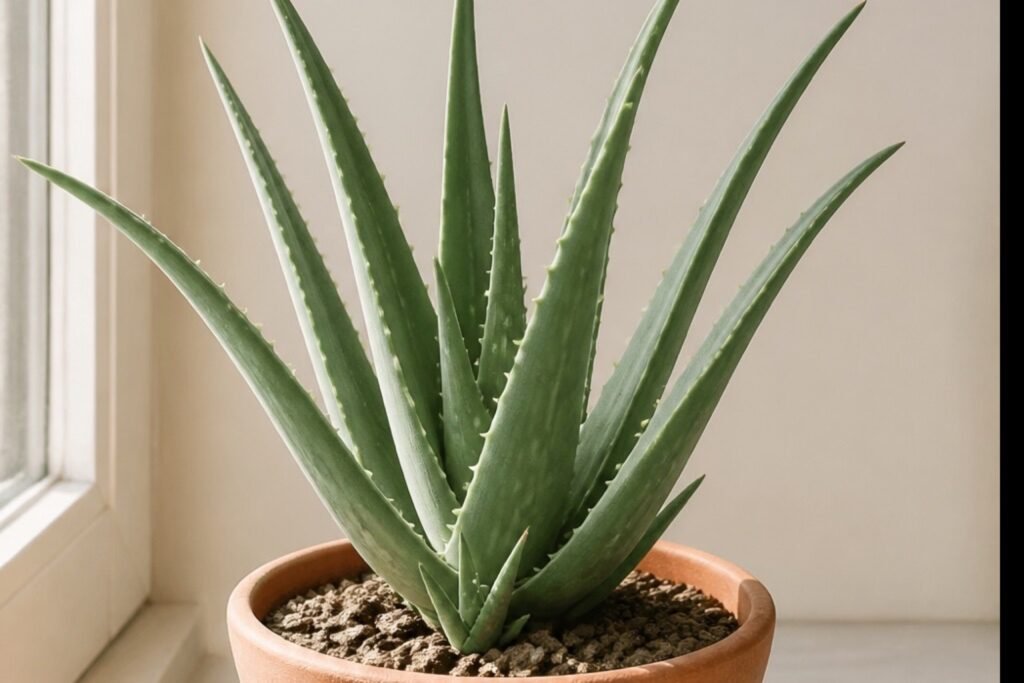
Aloe vera care indoors goes wrong when a medicinal reputation replaces ordinary plant care. Aloe vera is a sun-loving succulent with roots that need air and a pot that must dry. The leaf gel has familiar topical uses, but the whole leaf is not a harmless snack for pets or people. Grow the plant first; treat medical use as a separate question.
The species is associated with the Arabian Peninsula and belongs to Asphodelaceae. It forms a rosette of toothed, fleshy leaves and produces offsets around the base. Mature plants may send up a tall flower stalk in strong light, though flowering is not a reliable measure of indoor health.
Aloe vera care indoors snapshot
| Care point | Practical indoor target |
|---|---|
| Light | Very bright light with several hours of direct sun after acclimation |
| Water | Let the mix dry fully, then soak and drain |
| Soil | Coarse, fast-draining succulent mix |
| Humidity | Average to low household humidity |
| Temperature | Roughly 55 to 85 F indoors |
| Mature indoor size | Commonly 1 to 2 feet tall and wide |
| Growth rate | Moderate |
| Pet safety | Toxic to cats and dogs |
Acclimate aloe to real sun
Put the pot beside a bright south, west, or east window. Aloe grown in strong light stays compact, with sturdy leaves angled upward or outward. A plant kept too far from the window stretches, pales, and may flop.
Move a newly purchased aloe into direct sun gradually. Greenhouse shade and store lighting leave the leaves unprepared for hot glass. Add exposure over a week or two. Pale tan patches on the window-facing side indicate scorch and will not turn green again.
Brown or reddish color can be a stress response to intense light, drought, or cold. Check all three before changing the routine. If the room is dim, the guide to whether a grow light is needed can help assess the gap.
Water the root ball and leave it alone
Wait until the potting mix is dry through the container and the pot feels light. Then water slowly until the entire root ball is moist. Let excess drain and empty the saucer.
Avoid frequent sips. They wet a small part of the mix and make it harder to know whether deeper roots are dry. The thick leaves carry a reserve, so the plant handles a sensible dry interval better than constant moisture.
Thin, inward-curving leaves over dry soil may need water. Soft translucent leaves or a loose center over damp soil suggest rot. Root damage can make a wet plant look thirsty because damaged roots cannot supply the leaves. The process in how often to water indoor plants helps separate these cases.
Keep the crown above an airy mix
Use a pot with a drainage hole. Unglazed clay can speed drying, though any material works when pot size, mix, and watering are sensible. Choose a coarse succulent mix that stays open after repeated watering.
The article on soil for indoor succulents explains why a gravel layer under dense potting soil does not create drainage. The full root zone needs usable pore space.
Repot when roots fill the container, offsets crowd the rim, or the old mix collapses. Move up one size and keep the crown above the soil line. Buried leaf bases hold moisture and rot. Follow the houseplant repotting guide for root inspection and aftercare.
Feed lightly during active growth. A fertilizer labeled for succulents, used as directed, is enough. Pause when the plant is stressed or barely growing.
Separate offsets instead of taking leaf cuttings
Offsets, often called pups, form beside the parent. Wait until a pup has several leaves and roots of its own. Unpot the clump, ease the offset away or cut the connection cleanly, and let any fresh wound dry briefly before potting.
Aloe leaf cuttings usually rot rather than producing a new plant. The leaf contains plenty of moisture but lacks the right basal tissue for reliable household propagation. Division of rooted offsets is the practical method.
Leave some pups attached if you like a full clump. Separation is not required for health unless the pot is crowded or the plant becomes hard to water evenly.
Common aloe vera problems
| Symptom | Likely checks | First sensible move |
|---|---|---|
| Soft translucent leaves | Wet mix, cold damage, or rot | Check roots and crown before watering |
| Thin inward-curving leaves | Dry roots, heat, or damaged roots | Check the root zone and recent conditions |
| Long floppy leaves | Light too low | Increase light gradually and support new growth |
| Pale tan patches | Sun introduced too quickly | Move away from harsh exposure and acclimate |
| White cottony clusters | Mealybugs | Isolate and inspect leaf bases and roots |
Water trapped in the rosette is especially risky in a cool room. Aim water at the soil and remove any standing water from the center. Good airflow helps, but a fan cannot rescue saturated mix.
If roots are dark and soft, trim back to firm tissue and repot in fresh porous mix. The guide to saving an overwatered plant helps decide whether enough healthy tissue remains.
Inspect new plants for mealybugs and scale around the leaf bases. If you find white cottony insects, use the mealybug guide to confirm the pest before choosing a treatment.
Separate plant safety from gel claims
ASPCA lists Aloe vera as toxic to cats and dogs, citing saponins and anthraquinones. Reported signs include vomiting, lethargy, and diarrhea. Keep leaves and offsets out of reach and call a veterinarian or animal poison service after a suspected ingestion.
NC State also notes that the latex beneath the outer leaf can cause digestive symptoms and skin irritation. Commercially prepared gel products are not the same as chewing a whole raw leaf. This plant profile does not give medical treatment advice. Ask a qualified health professional before using home-grown aloe on skin or consuming any part.
Frequently asked questions
Why is my aloe vera turning brown?
Check light, drought, cold, and roots. A red-brown cast can be stress pigmentation, crisp pale patches suggest scorch, and soft brown tissue near the base points toward rot.
Can I propagate aloe from a broken leaf?
Not reliably. Broken leaves commonly rot. Wait for a rooted offset, separate it carefully, and pot it in a small container of airy succulent mix.
Should aloe vera stay in a terracotta pot?
Terracotta can help a slow-drying setup, but it is not mandatory. Drainage holes, appropriate pot size, coarse mix, strong light, and careful watering matter more than the pot material alone.