
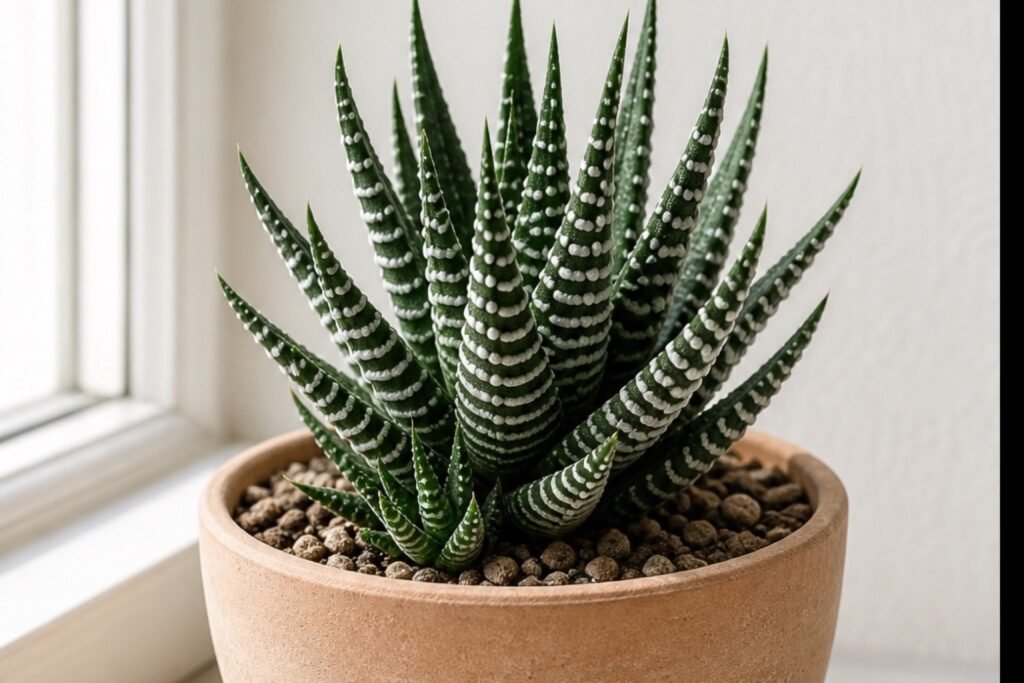
Zebra haworthia care starts with the right zebra. Haworthiopsis attenuata has raised white bands on both sides of its narrow leaves. The rarer Haworthiopsis fasciata usually has a smoother inner leaf surface, and several unrelated tropical plants also use the name zebra plant. Once the label is clear, care is pleasantly modest: bright light, porous soil, and a proper drying interval.
This small South African succulent belongs to Asphodelaceae. Older labels may say Haworthia attenuata. It grows as a compact rosette and slowly makes offsets, producing a clump that fits a windowsill much better than many sun-hungry succulents.
Zebra haworthia care snapshot
| Care point | Practical indoor target |
|---|---|
| Light | Bright filtered light with mild direct sun after acclimation |
| Water | Let the mix dry fully, then soak and drain |
| Soil | Coarse, fast-draining succulent mix |
| Humidity | Average to low household humidity |
| Temperature | Roughly 55 to 80 F indoors |
| Mature size | Usually 4 to 8 inches tall; clumps spread wider |
| Growth rate | Slow |
| Pet safety | NC State lists it as non-toxic to pets and humans |
Give it bright light without baking it
Place the rosette near an east, south, or west window. It tolerates more shade than many desert succulents, but a dim shelf produces loose, stretched growth. Gentle morning sun or filtered later sun helps the plant remain compact.
Acclimate it gradually. Harsh sun through hot glass can bleach the exposed side or turn leaves reddish brown from stress. Some color response in bright light is normal, but crisp pale patches are damage.
If the rosette opens wider and new leaves grow unusually long, improve the light. A small lamp can help, and how long to run a grow light provides a practical starting routine.
Soak the mix, then let it dry
Wait until the potting mix is dry through the container and the pot feels light. Water deeply, allow runoff, and empty the saucer. Try to keep water out of the center if the room is cool or air movement is poor.
The leaves may lose a little firmness during a long dry spell, but do not use that cue alone. A plant with damaged roots can also look thirsty while sitting in damp soil. Check the root zone before adding more.
Water use falls in winter and in lower light. The interval may change from one season to the next. The process in how often to water indoor plants helps replace calendar watering with evidence.
Use a small pot and coarse mix
Choose a container with a drainage hole. A commercial succulent mix can work if it remains open after repeated watering; otherwise, add coarse mineral material. Dense peat in a deep pot stays wet around the compact roots.
The full guide to soil for indoor succulents explains how particle size, drainage, and pot depth work together. A layer of stones at the bottom does not turn heavy soil into a porous mix.
Repot when the clump crowds the rim, roots block the drainage hole, or the old mix has broken down. Move up one size. Keep the base of the rosette above the soil surface so water does not collect between buried leaves.
Feed lightly during active growth. A diluted succulent fertilizer used according to its label is sufficient. Slow growth is normal and should not be chased with frequent feeding.
Divide offsets when they are useful
Offsets appear around a mature rosette. Leave them attached for a fuller clump or separate a pup once it has several leaves and roots. Let any cut surface dry briefly, then pot it in a small container of airy mix.
Leaf propagation is possible but slower and less reliable than offsets. A cleanly removed whole leaf with some basal tissue has a better chance than a broken tip. Do not sacrifice the center of the parent rosette for a cutting.
The houseplant repotting guide helps with clean root handling and pot depth. Zebra haworthia offsets belong in an airy mix, not a glass of water.
Common zebra haworthia problems
| Symptom | Likely checks | First sensible move |
|---|---|---|
| Soft translucent base | Wet mix or crown rot | Stop watering and inspect roots and lower leaves |
| Long open rosette | Light too low | Increase filtered light gradually |
| Pale tan patches | Sun introduced too quickly | Move away from harsh direct exposure |
| Thin wrinkled leaves | Dry roots, heat, or root damage | Check soil and root condition together |
| White cottony insects | Mealybugs | Isolate and inspect between leaves and roots |
Root mealybugs can hide below the soil, while ordinary leaf bands remain fixed plant tissue. Suspect an insect when cottony material collects in irregular clusters or the plant declines despite reasonable care. Follow the mealybug guide after confirming the pest.
Do not peel off firm lower leaves simply because they are older. Remove only leaves that are dry and detached or soft from rot, using clean tools.
Pet safety and accurate labeling
NC State describes Haworthiopsis attenuata as non-toxic to pets and humans. ASPCA also lists Haworthia species as non-toxic to cats and dogs, though its separate zebra haworthia page names Haworthia fasciata. The exact plant label still matters.
Chewed plant material or potting mix can cause ordinary stomach upset. Keep small pots where they cannot be knocked down and use the pet safe plant guide when comparing lookalikes.
Frequently asked questions
Is zebra haworthia the same as Haworthia fasciata?
No. They are closely related and often mislabeled. H. attenuata usually has raised white bumps on both leaf surfaces, while H. fasciata tends to have a smoother inner surface.
Why is my zebra haworthia turning brown?
Reddish brown color can be a light stress response, while crisp pale patches point to scorch. Soft brown tissue at the base is more consistent with excess moisture or rot.
Should I separate zebra haworthia pups?
Only if you want more pots or the clump is crowded. Wait until a pup has several leaves and roots. Leaving offsets attached creates an attractive mature cluster.