
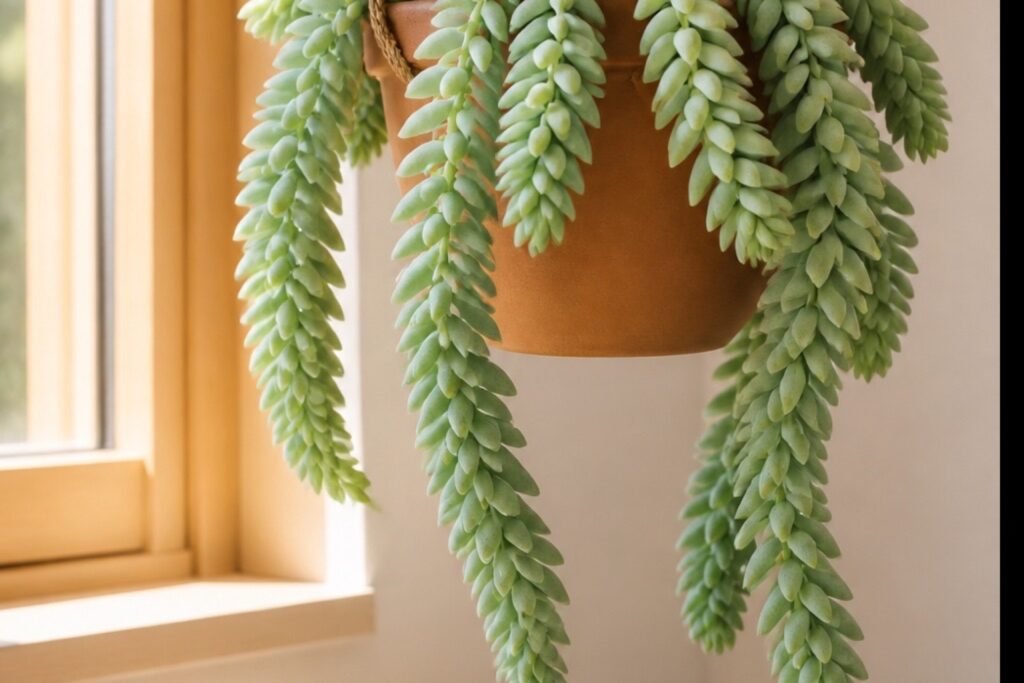
Burro's tail care asks for restraint in two places: the watering can and your hands. Sedum morganianum wants strong light and a dry interval, but its plump blue-green leaves detach at the slightest bump. A healthy plant can look battered after one careless repotting. Give it a stable location before the stems grow long.
This Mexican succulent belongs to the stonecrop family, Crassulaceae. Donkey's tail, horse's tail, and lamb's tail are other common names. Mature stems hang from the pot and can reach two feet or more, packed with overlapping leaves that carry a powdery protective bloom.
Burro's tail care snapshot
| Care point | Practical indoor target |
|---|---|
| Light | Very bright light with several hours of gentle sun after acclimation |
| Water | Let the mix dry, then soak and drain |
| Soil | Coarse, fast-draining succulent mix |
| Humidity | Average to low household humidity |
| Temperature | Roughly 55 to 80 F indoors |
| Indoor length | Trailing stems commonly reach 1 to 3 feet |
| Growth rate | Moderate |
| Pet safety | ASPCA lists it as non-toxic to cats and dogs |
Build light slowly
Set the plant close to a bright south, west, or east window. A few hours of direct sun can produce dense growth, but a plant raised under greenhouse shade needs gradual exposure. Increase sun over a week or two and watch the most exposed leaves.
Stretched stems with generous gaps between leaves need more light. A weak stem does not tighten after the move, so judge the next section of growth. Our article on leggy indoor plants explains why pruning and light correction work together.
Strong sun introduced too quickly leaves pale or brown patches. The waxy bloom that rubs off does not grow back on an old leaf, so avoid touching the foliage while moving the pot.
Water deeply after the mix dries
Let the mix dry well through the pot, then water until the full root ball is moist. Allow every bit of runoff to leave. The thick leaves hold a reserve, so this plant is safer slightly dry than constantly damp.
Lift the pot when it is freshly watered and again when dry. The change in weight becomes more useful than poking among fragile stems. Slightly softer leaves can support the decision. Deeply wrinkled leaves mean the plant has gone too far, while yellow translucent leaves over damp soil point toward rot.
Winter growth often slows and the drying interval lengthens. Use the observations in how often to water indoor plants instead of keeping a fixed schedule.
Choose the pot before the tails get long
A hanging pot or a container set securely on a high stand shows the stems without forcing them against a shelf. Make sure you can still remove it for watering. A narrow decorative vessel that cannot drain turns every watering into a risk.
Use a shallow pot with a hole and a coarse succulent mix. The guide to indoor succulent soil explains how mineral particles and stable structure keep air around the roots. Do not rely on a gravel layer under dense soil.
Repot only when roots crowd the container or the mix has failed. Let the soil dry first, support the stems on folded towels, and move up one size. Expect a few leaves to fall even with careful handling. The repotting guide covers root depth and drainage.
Turn fallen leaves into new plants
Healthy dropped leaves can root. Let the broken end dry for a day or two, then lay the leaf on dry or barely moist succulent mix. Do not bury it. Roots and a tiny rosette may form at the base while the original leaf slowly shrivels.
Stem cuttings are faster. Cut a healthy end, remove the lowest leaves, let the wound dry, and place the bare stem into a small pot of airy mix. Keep it bright but out of harsh sun until roots form. Water lightly enough to avoid keeping the cut end wet.
Leaf propagation is slow and not every leaf succeeds. A failed leaf is not evidence that the parent plant needs more water.
Common burro's tail problems
| Symptom | Likely checks | First sensible move |
|---|---|---|
| Leaves drop when touched | Normal fragility or a stressed plant | Stop moving the pot and check light and roots |
| Wide gaps on new stems | Light too low | Increase light gradually and assess new growth |
| Yellow translucent leaves | Wet mix or root damage | Inspect drainage and roots before watering |
| Wrinkled leaves, dry mix | Prolonged drought or heat | Water deeply and allow runoff |
| White cottony clusters | Mealybugs | Isolate and inspect between packed leaves |
Leaf drop without contact can accompany poor roots, severe drought, or a sudden environmental change. Check the newest growth and the soil before choosing a cause. If the base is soft or dark, take clean stem cuttings above the damage.
Mealybugs hide between the tight leaves where wiping is awkward. Follow the identification and repeat-treatment method in the mealybug guide and test any product on a small section first.
Pet safety and handling
ASPCA lists Sedum morganianum as non-toxic to cats and dogs. That does not make the pot a chew toy. Swallowed leaves or potting mix can still upset an animal's stomach, and a pulled hanging basket can cause injury.
Keep the botanical label because donkey's tail and horse's tail are used for other plants. The pet safe houseplant guide explains how exact identification changes a safety check.
Frequently asked questions
Why does burro's tail lose leaves so easily?
The leaves attach loosely and detach as a natural propagation strategy. Handling, repotting, or brushing against the stems causes losses even on a healthy plant. Persistent drop without contact deserves a root and light check.
Can burro's tail live in a north window?
Most north windows do not provide enough light for dense growth. A very bright unobstructed exposure may work, but add measured overhead light if new stems stretch.
Should I water newly propagated leaves?
Keep them on dry or barely moist airy mix while roots begin. Saturated soil rots a detached leaf quickly. Increase water only after a small rooted plant develops.