
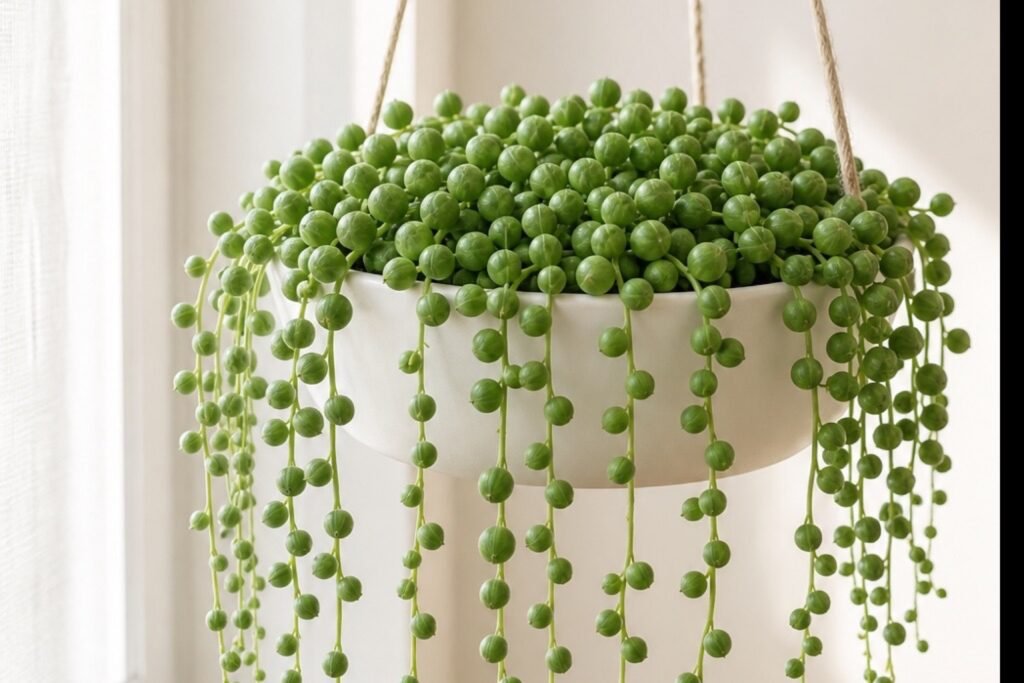
String of pearls care has a narrow sweet spot. Curio rowleyanus needs strong light on the crown, a fast-draining pot, and water before every pearl becomes deeply shriveled. Too much water rots the roots and stems. Too little light makes the strings sparse. The same symptoms can appear in both cases, so the soil must join the diagnosis.
This trailing succulent comes from dry parts of South Africa. Older labels may use Senecio rowleyanus. Each round leaf has a translucent window that helps light enter its inner tissue, and the small pointed tip separates a healthy pearl from a smooth green bead used in craft decor.
String of pearls care snapshot
| Care point | Practical indoor target |
|---|---|
| Light | Very bright light with gentle direct sun after acclimation |
| Water | Water after most of the mix dries, before severe shriveling |
| Soil | Coarse, fast-draining succulent mix |
| Humidity | Average to low household humidity |
| Temperature | Roughly 60 to 80 F during active growth |
| Indoor length | Commonly 1 to 3 feet |
| Growth rate | Moderate |
| Pet safety | Toxic to cats and dogs |
Light the crown, not only the strings
Place the pot close to a bright east, south, or west window. Filter harsh midday sun until the plant has adjusted. The vines hanging below a shelf can receive plenty of light while the crown sits in shade, which leads to bare soil and weak new stems.
Pearls should remain close together along the vine. Wide spaces and tiny new leaves suggest insufficient light. A grow light placed above the pot can be more useful than one aimed at the hanging ends. Use the measured approach in how far a grow light should be from plants instead of relying on a universal distance.
Sun scorch leaves pale tan or brown areas on the most exposed side. Move the plant gradually and judge the placement by new growth. Damaged pearls do not refill or turn green again.
Read the pearls and the root zone together
Wait until most of the potting mix is dry and the container feels light. Mature pearls may lose a little firmness, and their translucent windows can look more closed. Water the entire root ball, let excess drain, and empty the saucer.
Do not add small sips every few days. They wet the upper stems without flushing the pot, while deeper roots may remain dry or salty. A deep watering followed by a drying interval is easier to judge.
Wrinkled pearls over bone-dry soil need water. Wrinkled or translucent pearls over damp soil suggest damaged roots. That distinction prevents the familiar cycle of watering a rotting plant because it looks thirsty. The indoor plant watering guide explains how pot weight and recent conditions help.
Use a small, shallow pot
Choose a container with a drainage hole. A coarse succulent mix with mineral structure is a safer base than dense all-purpose soil. The crown has a modest root system, so a deep oversized pot holds unused moisture beneath it.
Repot when roots fill the container, the mix breaks down, or water no longer enters evenly. Support the vines on a tray or towel, move up one size, and keep the crown at its original depth. The steps in how to repot a houseplant help limit root damage.
Our guide to soil for indoor succulents explains why drainage comes from the whole mix and container, not a layer of rocks at the bottom.
Feed lightly during active growth with a fertilizer labeled for houseplants or succulents. Pause when growth slows. Fertilizer cannot correct a dark location or a rotten root system.
Root stems across the soil surface
Stem cuttings are more reliable than single pearls. Cut a healthy string, remove a few leaves from the base, and place several bare nodes against lightly moist mix. You can also coil the stem across the surface and pin nodes down while it remains attached to the parent.
Keep the propagation pot bright and warm, but protect it from harsh sun while roots form. The mix should be lightly moist, never saturated. Once several nodes have rooted, new growth is better able to handle a normal drying cycle.
Pruning and layering help rebuild a bare crown. Do not bury healthy pearls. Contact with wet mix can make them rot before the node establishes roots.
Common string of pearls problems
| Symptom | Likely checks | First sensible move |
|---|---|---|
| Shriveled pearls, dry mix | Thirst or prolonged heat | Water deeply and reassess after drainage |
| Shriveled pearls, damp mix | Root or stem rot | Inspect roots and save healthy cuttings |
| Bare crown and wide spacing | Light too low above the pot | Increase overhead light gradually |
| Translucent mushy pearls | Excess moisture or cold damage | Remove damaged tissue and correct conditions |
| White cottony clusters | Mealybugs | Isolate and inspect nodes and the crown |
Mealybugs can disappear between crowded pearls. Check the base of each leaf and the soil surface. Use the mealybug treatment guide after confirming the insect.
If rot has reached the crown, healthy vine tips may be the only salvageable part. Take cuttings above soft or dark tissue and discard the contaminated mix. The article on saving an overwatered plant helps you judge when a root inspection is worth doing.
Keep it away from pets and children
NC State identifies Curio rowleyanus as toxic to humans and pets and notes that sap can irritate skin. Place the pot where trailing strings cannot be pulled down. Wear gloves if sap bothers you and wash after pruning.
Vomiting, diarrhea, or a skin reaction after contact deserves professional advice. Keep a photo of the plant and its botanical label for the veterinarian or poison service.
Frequently asked questions
Why are my string of pearls shriveling after watering?
Check whether the mix is still damp. Shriveling in wet soil often means damaged roots cannot supply the leaves. Stop watering, inspect the crown and roots, and save healthy cuttings if rot is present.
Can string of pearls grow in a north window?
It may survive beside a very bright unobstructed north window, but sparse growth is common. Add measured overhead light if the crown becomes bare or the spaces between pearls widen.
Should I mist string of pearls?
No routine misting is needed. It briefly wets the foliage without watering the root ball and can keep the crowded crown damp. Water the mix thoroughly, then let it drain and dry.