
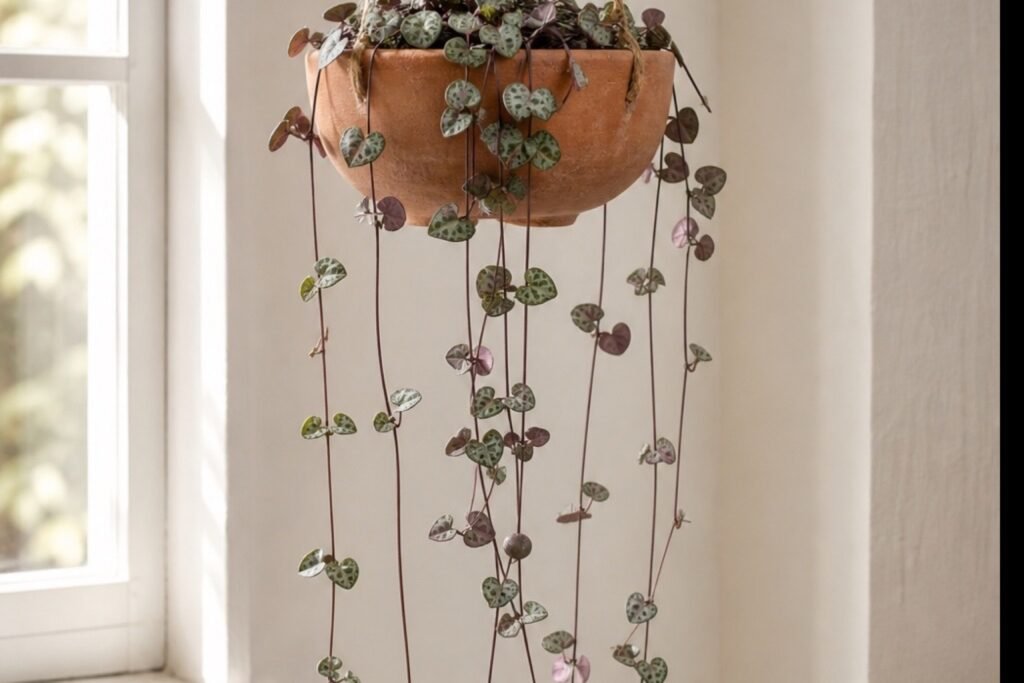
String of hearts care becomes much easier once you stop treating the plant like a thin-leaved tropical vine. Ceropegia woodii stores water in its leaves, basal tubers, and small aerial tubers along the stems. It likes bright filtered light, an airy pot, and a real drying spell. Wet soil is far more dangerous than a missed watering day.
The species comes from southern Africa and belongs to the dogbane family, Apocynaceae. Chain of hearts, rosary vine, and necklace vine are other common names. The narrow stems can trail several feet indoors, carrying paired heart-shaped leaves marked with silver.
String of hearts care snapshot
| Care point | Practical indoor target |
|---|---|
| Light | Bright indirect light with a little gentle sun after acclimation |
| Water | Let the mix dry well, then soak and drain |
| Soil | Fast-draining succulent mix with coarse structure |
| Humidity | Average household humidity |
| Temperature | Roughly 60 to 80 F indoors |
| Indoor length | Commonly 2 to 4 feet, controlled by pruning |
| Growth rate | Fast in strong filtered light |
| Pet safety | Species-specific veterinary status not confirmed here |
Put light on the top of the pot
A high shelf may give the hanging vines good light while leaving the crown in shade. That setup slowly produces a bare top. Place the pot where bright filtered light reaches the soil surface and the first several inches of growth. Gentle morning or late-day sun can deepen the leaf pattern after a gradual adjustment.
Wide gaps between leaves, tiny new leaves, and a greener, less silver pattern point to low light. Variegated plants need even more filtered light to maintain cream and pink tissue. Move them in stages because pale sections scorch readily.
If a window cannot reach the crown, overhead lighting can help. The guide to whether indoor plants need a grow light gives a practical way to judge the room.
Let the root zone dry between drinks
Check more than the surface. A shallow pot may dry quickly, while a deep decorative pot stays wet below. Water when the mix is dry through much of the container and the pot feels light. Soak evenly, let water escape, and empty the saucer.
Plump leaves become thinner and softer as stored water runs low. That can support your soil check. It is not a reason to water while the mix is still damp. Yellow translucent leaves or soft tubers over wet soil point toward root trouble.
Winter growth often slows, so the same pot takes longer to dry. Follow the observations in how often to water indoor plants rather than keeping a fixed weekly schedule.
Choose a shallow, breathable setup
Use a container with a drainage hole and a coarse succulent mix. A broad, relatively shallow pot fits the compact root system better than a deep oversized one. Standard indoor soil can be amended with mineral particles or fine bark, but a dense mix should not be rescued by adding a thin gravel layer at the bottom.
Repot only when roots and tubers fill the container, drainage has changed, or the old mix no longer wets evenly. The plant often grows well while snug. Gather the vines gently, move up one size, and keep the crown at the same depth. Our houseplant repotting guide covers how to avoid burying stems.
Feed sparingly during active growth. A diluted complete fertilizer used at its label interval is enough. Fast vines in poor light do not need more feed; they need more usable light.
Use the tubers to rebuild a full crown
Small round tubers may form at nodes along the vines. Press one against lightly moist mix while it remains attached to the parent. Once it roots and starts growing, cut the connecting stem. This layering method loses less moisture than an unrooted cutting.
Stem cuttings also work. Lay a vine across the surface and pin several nodes down, or place bare nodes into a small pot. A cutting with a tuber attached has stored energy but still needs protection from soggy soil.
Prune above a node to encourage branching and use the removed section for propagation. The broader water propagation guide explains node anatomy, though layering into mix is often simpler for this species.
Common string of hearts problems
| Symptom | Likely checks | First sensible move |
|---|---|---|
| Large gaps between leaves | Light too low at the crown | Move the pot, not only the hanging vines, into brighter light |
| Yellow translucent leaves | Wet mix or root damage | Check roots and tubers before watering |
| Thin wrinkled leaves | Dry roots, damaged roots, or heat | Check moisture through the pot and inspect the root zone |
| Bare soil surface | Crown shaded or old vines unbranched | Add overhead light and layer healthy nodes into the pot |
| White cottony clusters | Mealybugs | Isolate and inspect nodes and tubers |
Mealybugs hide where leaves meet the fine stem and around tubers. If you find white cottony material, follow the identification and repeat-treatment steps in the mealybug guide. Aerial tubers are firm plant tissue, not insects.
Long vines tangle quickly. Untwist them slowly on a flat surface instead of pulling a knot apart while the pot hangs. A few broken stems are useful cuttings, but rough handling can strip a whole section.
Pet safety is not verified for this profile
This review did not find a species-specific ASPCA listing for Ceropegia woodii. NC State's plant page does not mark it as poisonous, but absence of a warning is not a veterinary guarantee. Keep it out of reach if a pet chews trailing plants, retain the botanical label, and contact a veterinarian about a known ingestion.
The pet safe indoor plant guide explains why the common name rosary vine is not enough for an identification. Several unrelated plants share similar names.
Frequently asked questions
Why is my string of hearts bare on top?
The crown may be shaded even when the hanging vines look bright. Put filtered light on the pot surface, prune long unbranched growth, and pin healthy nodes onto the mix so they can root.
Do string of hearts tubers need to be buried?
No. Press an aerial tuber against the surface of lightly moist mix. Deep burial keeps it wetter and makes rot harder to spot.
How can I tell whether string of hearts needs water?
Check the mix through much of the pot, lift the container, and feel a few mature leaves. Water when the root zone is mostly dry and the pot is light, not merely because the surface looks pale.