
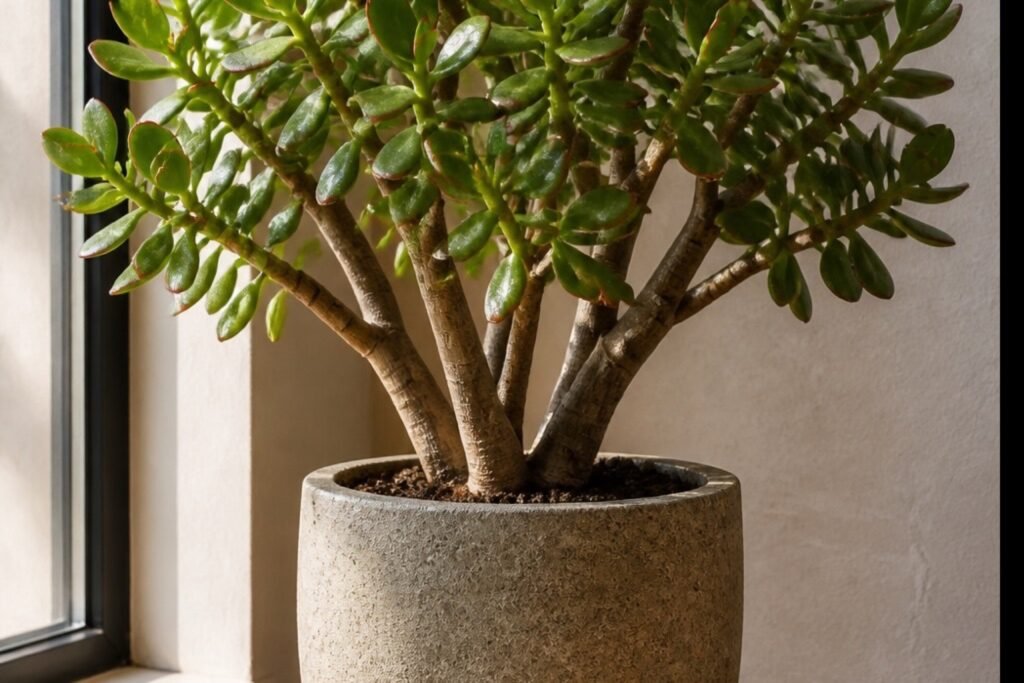
Jade plant care rewards patience. Crassula ovata can live for years in the same home, but it grows poorly in dim light and rots in soil that never dries. Its fleshy leaves store water, while older stems thicken into a small trunk. Treat it as a sun-seeking succulent, not as a leafy plant that needs a weekly drink.
Jade plant comes from southern Africa and belongs to the stonecrop family, Crassulaceae. Jade tree, baby jade, and Chinese rubber plant are other common names. The last name is confusing because jade is not a rubber plant and should not be cared for like Ficus elastica.
Jade plant care snapshot
| Care point | Practical indoor target |
|---|---|
| Light | Very bright light with several hours of direct sun after acclimation |
| Water | Let the mix dry fully, then soak and drain |
| Soil | Coarse, fast-draining succulent mix |
| Humidity | Average to low household humidity |
| Temperature | Roughly 55 to 80 F indoors |
| Mature indoor size | Commonly 2 to 4 feet with years of growth and pruning |
| Growth rate | Moderate |
| Pet safety | Toxic to cats and dogs |
Give the plant enough sun to hold its shape
Set jade close to the brightest suitable window. A south or west exposure often works once the plant has acclimated, while a bright east window provides gentler sun. Increase direct light over a week or two after purchase or a seasonal move.
Low light makes new stems thin, spaces the leaf pairs farther apart, and causes the crown to lean. No amount of pruning can keep a jade compact in a dark room. Correct the location, then cut back weak growth. The guide to why plants become leggy shows what to watch in the next flush.
Red leaf margins can develop in bright light and are not automatically a problem. Pale tan or bleached patches on the exposed side are sunburn. Judge the new placement by healthy new leaves rather than expecting scars to heal.
Let the pot dry all the way through
Wait until the mix is dry through the root zone and the pot feels light. Water slowly until the whole root ball is moist, then let excess drain. Empty the saucer or cachepot.
Firm leaves soften slightly as the stored water is used. Deeply wrinkled leaves over dry soil mean the plant has waited too long. Soft yellow leaves over damp soil are a different signal and often accompany root stress.
The interval changes with season, light, pot size, and root health. Winter drying may take much longer. Use the checks in how often to water indoor plants instead of choosing a weekday.
Build drainage through the whole pot
Use a container with a drainage hole and a coarse succulent mix. A heavy ceramic pot can steady a mature top-heavy plant. Keep the pot only a little wider than the root ball, since a large unused ring of soil holds moisture.
Our guide to indoor succulent soil explains why adding rocks only at the bottom does not improve a dense mix. Air must remain available around the roots throughout the container.
Repot when roots fill the pot, the plant becomes unstable, or the mix has broken down. Move up one size and keep the trunk at its old depth. The houseplant repotting guide covers drainage and aftercare.
Feed lightly during active growth. A complete fertilizer labeled for succulents or houseplants is enough when used as directed. Heavy feeding produces soft growth and salt buildup without fixing poor light.
Prune for balance, not a perfect miniature tree
Cut a healthy stem just above a leaf pair. New branches can form below the cut, making the crown fuller. Avoid removing a large share of the foliage at once from a weak plant. Correct light and roots first.
Turn the pot gradually so the trunk develops balanced growth. Stake only when necessary. A plant that leans because the crown is one-sided needs better light distribution and pruning, not a permanent tight tie.
Stem cuttings are straightforward. Let the cut end dry for a few days, then place it in a small pot of dry or barely moist succulent mix. Leaf cuttings can also root, but they take longer to produce a useful plant.
Common jade plant problems
| Symptom | Likely checks | First sensible move |
|---|---|---|
| Soft yellow leaves | Wet mix or root damage | Stop watering and inspect the root zone |
| Wrinkled leaves, dry soil | Prolonged drought | Water deeply and allow runoff |
| Thin leaning stems | Light too low or one-sided | Increase light gradually and rotate |
| Pale corky spots | Edema, moisture swings, or physical damage | Review recent watering and humidity changes |
| White cottony clusters | Mealybugs | Isolate and inspect leaf joints and roots |
Edema happens when roots take up water faster than leaves can use it, leaving small corky marks. Old spots remain. More regular drying and better light may prevent marks on new leaves.
If a trunk is soft at the soil line, cut into clean firm tissue and salvage healthy sections. Our guide to saving an overwatered plant helps decide whether to inspect, trim, or propagate.
Mealybugs hide where leaf pairs meet the stem. Confirm the cottony insects and follow the mealybug treatment guide rather than treating every white mineral mark.
Keep jade away from pets
ASPCA lists jade plant as toxic to cats and dogs. Its page uses the synonym Crassula argentea and reports vomiting, depression, and incoordination. Place the plant where animals cannot chew leaves or knock down the heavy pot.
Contact a veterinarian or animal poison service after a suspected ingestion. A photo and the botanical label help distinguish this plant from several unrelated species sold with jade in the name.
Frequently asked questions
Why are my jade plant leaves falling off?
Check the soil and leaf texture. Soft yellow leaves over damp mix point toward excess moisture or root damage. Firm leaves knocked from a healthy stem may be simple physical damage.
Can a jade plant grow in low light?
It may survive, but growth usually becomes thin and unstable. Jade needs very bright light and often several hours of acclimated direct sun to keep a compact shape indoors.
How often should I repot a jade plant?
Repot by condition, not by year. Move it when roots crowd the container, the mix no longer drains correctly, or the plant is unstable. A snug pot is not a problem by itself.