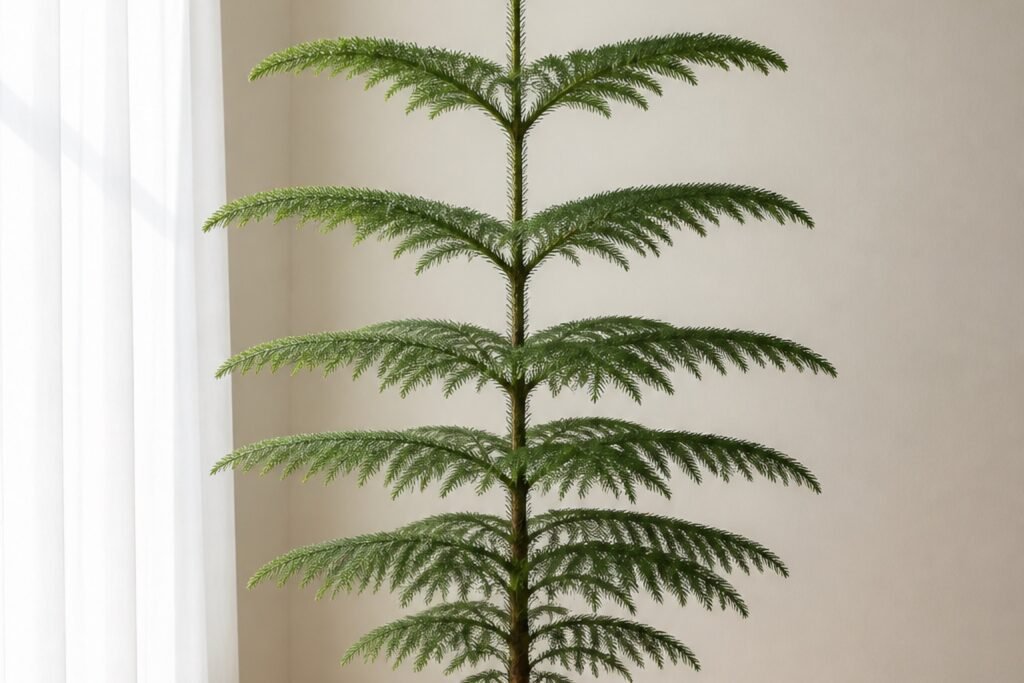
Norfolk Island pine care indoors is a long game. Araucaria heterophylla grows in even tiers around one central leader, and every lost lower branch changes that outline permanently. It is a tropical conifer from Norfolk Island, not a cold-hardy pine. Warmth, bright light, and steady root moisture matter more than holiday decorations.
Young plants fit on a table, but healthy specimens slowly become floor plants. The soft foliage is less prickly than a true pine. Australian pine is another common name, though that label can also refer to unrelated Casuarina trees.
Norfolk Island pine care indoors at a glance
| Care point | Practical indoor target |
|---|---|
| Light | Bright indirect light with gentle direct sun |
| Water | Water after the upper inch or two dries |
| Soil | Airy, moisture-retentive mix with reliable drainage |
| Humidity | Moderate to high humidity with airflow |
| Temperature | Roughly 60 to 75 F indoors |
| Indoor size | Commonly 3 to 8 feet over many years |
| Growth rate | Slow indoors |
| Pet safety | ASPCA lists the species as non-toxic to cats and dogs |
Light the whole tree, not one side
Put the plant close to a bright east, south, or west window, with protection from abrupt hot midday sun. Rotate the pot a quarter turn every week or two. Without rotation, the top leans toward the glass and the tiers develop unevenly.
Weak light produces thin, drooping new growth and long gaps between branch levels. Once a lower branch dies, the trunk does not reliably replace it. Move the plant closer before the bottom half thins. The guide to whether indoor plants need a grow light helps evaluate a winter position.
Summer outdoors can improve growth if the tree is moved into bright shade first and protected from strong wind. Bring it in before nights become cold, and inspect every branch for pests.
Keep the root ball lightly moist
Water when the upper inch or two of mix is dry and the pot is beginning to feel lighter, while the deeper root zone remains slightly moist. Soak the full root ball and drain it. Do not let the container sit inside a water-filled cachepot.
Repeated complete drought can turn branch tips brown and cause lower branches to drop. Constant wetness can damage roots and produce similar drooping. Check moisture at depth before choosing a remedy. The general indoor watering guide explains why pot weight and a wooden skewer work better than a weekly alert.
Water use falls in cool, dim weather. It rises when the tree is actively growing in bright light. Keep the physical cue and let the number of days change.
Prevent dry air and temperature shocks
Indoor heating can crisp tender tips, especially when the pot sits beside a vent. Grouping plants can raise local humidity a little, but do not crowd foliage so tightly that air stops moving. A humidifier is more dependable in a very dry room. The guide to raising humidity for houseplants compares practical methods.
Keep the tree away from cold door drafts and hot radiators. Chilled roots beside a winter window can stay wet long after the top of the plant warms during the day. A stable room is better than a cycle of extremes.
Brown tips are not automatically a humidity diagnosis. Check root moisture, fertilizer salts, temperature, and pests before changing several conditions at once. The brown leaf tip guide gives a sensible order.
Preserve the central leader while repotting
Use a pot with a drainage hole and a loose mix that holds some moisture without becoming airless. Repot only when roots crowd the container, the tree becomes unstable, or the mix stops draining evenly. Move up one size. A large decorative planter can hold too much wet soil around a small root system.
Keep the trunk at its original depth and disturb roots gently. The houseplant repotting guide covers sizing and aftercare. A tall plant may need a heavy outer cachepot for stability, but the inner growing pot must still drain freely.
Do not cut the central growing tip to control height. Removing the leader ruins the natural symmetrical form and may produce irregular growth. Prune only dead branches close to the trunk. Soft ties can steady a leaning young tree while light and pot position are corrected.
Feed lightly in spring and summer with a complete fertilizer used according to its label. Skip feeding during a dim winter slowdown. Heavy fertilizer does not restore missing tiers and may burn roots.
Common Norfolk Island pine problems
| Symptom | Likely checks | First sensible move |
|---|---|---|
| Lower branches dropping | Drought, weak light, or root stress | Check moisture depth and light before moving the tree |
| Brown branch tips | Dry roots, dry air, salts, or heat | Check one cause at a time, starting with root moisture |
| Central top leaning | Light arriving from one direction | Rotate regularly and improve overhead brightness |
| Limp growth over wet mix | Root damage or cold roots | Warm the root zone and inspect drainage |
| White cottony insects | Mealybugs or scale near branch joints | Isolate and inspect the full trunk and tiers |
Scale insects can blend into the branchlets, while spider mites leave fine stippling and webbing. Clean foliage gently and inspect a new plant before it joins the collection. Avoid heavy ornaments, wires, flocking sprays, or lights that heat and bend tender branches.
Pet safety and household placement
ASPCA lists Araucaria heterophylla as non-toxic to cats and dogs. That record appears under the name Australian pine. Non-toxic plants can still cause stomach upset when chewed, and fallen potting mix presents its own mess. Keep the tree stable and out of a habitual grazer's route.
The pet-safe indoor plant guide explains how botanical names resolve shared common names. Correct ID matters here because Australian pine can mean an unrelated species.
Frequently asked questions
Can I cut the top off a Norfolk Island pine?
Do not remove the central leader unless the plant is already damaged beyond normal shaping. The tree depends on that tip for its symmetrical form, and a cut top rarely regrows into the same outline.
Why are the lower branches falling off?
The usual checks are repeated drought, weak light, cold wet roots, and pests. Lost lower branches do not reliably return, so correct the cause before the next tier declines.
How do I know when to water Norfolk Island pine?
Water when the top inch or two is dry and the pot is beginning to feel lighter, while deeper mix still holds slight moisture. Soak evenly and empty the saucer.