
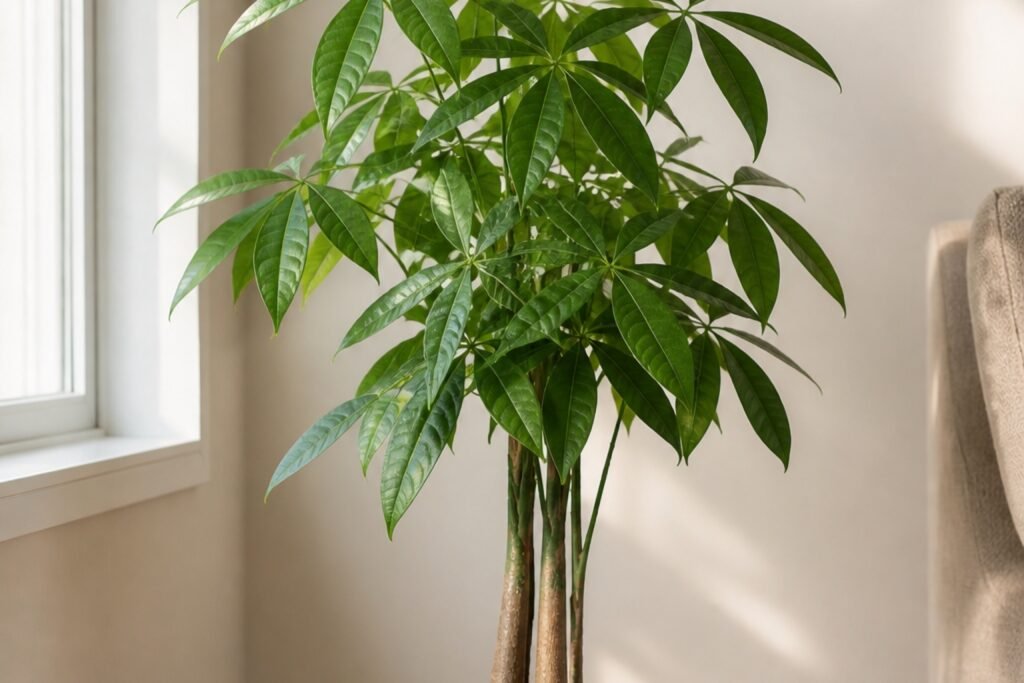
Money tree care gets muddled by two things: the braided trunk sold in stores and the word "money," which belongs to several unrelated plants. This profile covers Pachira aquatica, the tropical tree with five to nine glossy leaflets arranged like fingers around a hand. A jade plant may also be labeled money tree, but it needs much drier succulent care.
The species grows in wet tropical habitats from Mexico into South America, yet a potted indoor plant does not want to sit in a swamp. Container roots have little oxygen once dense mix stays saturated. The useful compromise is a thorough drink followed by a measured dry interval.
Money tree care snapshot
| Care point | Practical indoor target |
|---|---|
| Light | Bright filtered light with gentle early sun |
| Water | Soak after the upper 2 to 3 inches dry and the pot gets lighter |
| Soil | Loose indoor mix that drains freely but holds modest moisture |
| Humidity | Moderate household humidity or better |
| Temperature | Roughly 60 to 85 F |
| Mature indoor size | Commonly 3 to 8 feet tall |
| Growth rate | Moderate in useful light |
| Pet safety | ASPCA lists it as non-toxic to cats and dogs |
Give the canopy useful window light
Set the pot near an east window or a few feet back from a bright south or west window. The leaflets should receive open sky light for much of the day. A dim corner may keep the plant alive for a while, but stems stretch, the canopy thins, and wet mix takes longer to dry.
A sharp jump from store light to hot direct sun can bleach or scorch leaves. Increase exposure in stages. If the room never becomes bright enough, the guide to whether a grow light is needed helps separate a genuinely dark site from one that merely looks dim to human eyes.
Rotate the pot a quarter turn every week or two if growth leans toward the glass. Do not change its room, window, watering, and temperature at once. Money trees can shed leaves after an abrupt environmental change, so one adjustment at a time gives a much clearer answer.
Read the whole root ball before watering
Push a finger or wooden skewer 2 to 3 inches into the mix, then lift the pot. Water when that upper zone is dry and the container feels distinctly lighter. Pour slowly across the surface until water reaches the drainage hole. Empty the saucer.
The swollen lower trunk holds some reserve, but it is not permission to let a small pot become dust dry for weeks. A severely dry root ball can shrink away from the pot, causing the next drink to run down the sides without wetting the center. The physical checks in how often to water indoor plants are more dependable than a recurring Sunday reminder.
Yellow leaves do not automatically mean thirst. Yellowing over damp soil, especially with a soft trunk base, points toward poor root aeration. Unpot before giving another drink. The recovery steps in saving an overwatered plant show what healthy and damaged roots look like.
Keep the braid loose and the pot stable
Braiding is nursery styling, not a natural requirement. Ties left around expanding trunks can cut into bark. Remove wire or tape that has started to bite, but do not force older fused trunks apart. A natural cluster of stems is fine.
Use a pot with a drainage hole and a mix that stays springy after watering. Repot when roots make a dense wall, drainage slows, or the tree becomes top-heavy. Move up one practical size instead of placing a modest root ball in a decorative floor planter full of wet mix. The houseplant repotting guide covers root inspection and pot sizing.
Prune a long bare shoot just above a healthy node during active growth. New branches may develop below the cut. Sterilize the blade and avoid removing a large share of the canopy at once. Light, not repeated trimming, is what keeps the replacement growth compact.
Propagate a correctly identified tree
A softwood tip cutting can root in a warm, humid, airy medium. Air layering is useful for a thicker branch because roots form before the new plant is detached. Fresh seed works too, although indoor money trees rarely flower or fruit.
Do not eat home-grown seeds based on the common name. NC State notes conflicting information about their safety. A cutting also needs at least one viable node; a loose compound leaflet will not grow a new trunk.
Money tree problems at a glance
| Symptom | Likely checks | First sensible move |
|---|---|---|
| Sudden green leaf drop | Move, cold draft, lower light, or moisture shock | Review changes from the previous two weeks |
| Yellow lower leaves | Wet mix, old foliage, or poor root aeration | Check moisture through the pot |
| Crisp brown edges | Dry roots, hot glass, or dry air | Compare pot weight and window heat |
| Soft trunk base | Persistent saturation or rot | Inspect roots and trunk promptly |
| Sticky leaves or brown bumps | Scale insects | Isolate and inspect stems and leaflet undersides |
Leaf drop after bringing a plant home is common enough to be recognizable, but it should slow once conditions stabilize. Continuing loss means the new site still has a problem. Check for cold air from a vent, a dark corner, or a decorative cachepot holding runoff.
Scale often settles on stems and the undersides of leaflets. Quarantine a newly purchased tree before it joins the collection. That small pause is covered in the new-houseplant quarantine guide.
Keep the safety label tied to the botanical name
ASPCA lists Pachira aquatica as non-toxic to cats and dogs. Non-toxic does not mean edible or consequence-free. Chewing fibrous leaves or contaminated potting mix can still cause nausea or loose stool.
Common names are the bigger trap. Jade plant, Crassula ovata, is also called money tree and has a different pet-safety status. Check the botanical label before relying on a list of pet-safe indoor plants.
Frequently asked questions
Why is my money tree dropping green leaves?
Look for a recent move, a colder draft, weaker light, or a sharp change in root moisture. Keep the plant stable while correcting the clearest problem. Repeatedly moving it usually prolongs the adjustment.
Should a money tree trunk be braided?
No. The braid is decorative nursery training. Natural unbraided trunks grow normally. Remove tight ties that cut into bark, but leave older fused trunks alone.
Is a money tree a succulent?
No. Its swollen lower trunk stores some water, but Pachira aquatica is a tropical tree in the mallow family. Let part of the root ball dry, then water thoroughly rather than using an extreme cactus routine.