
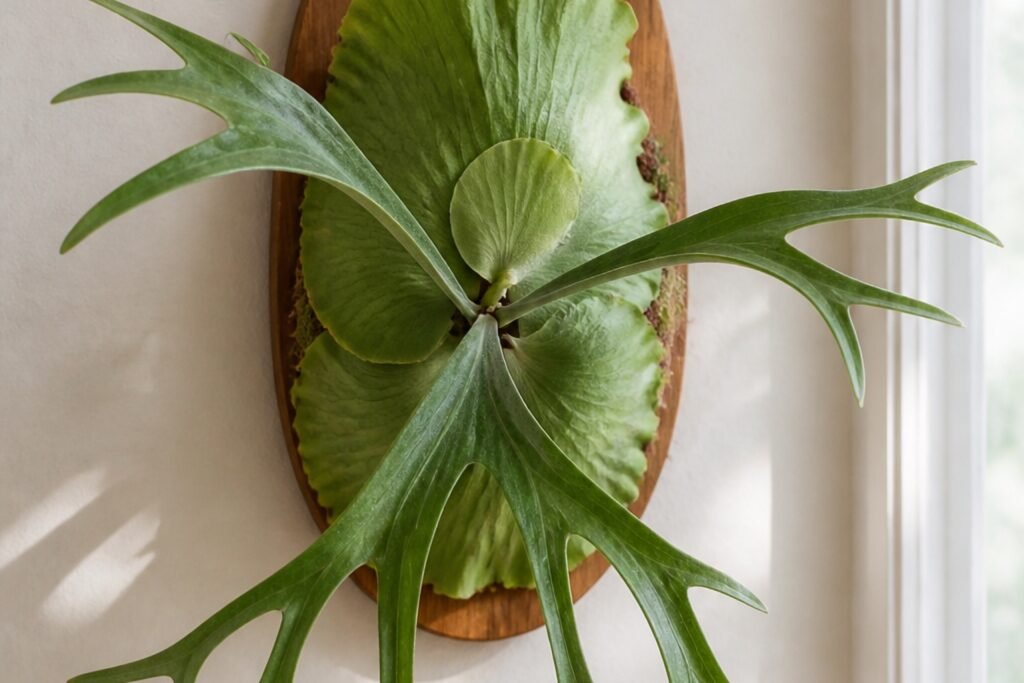
Staghorn fern care indoors makes more sense when you remember that Platycerium bifurcatum is an epiphyte. It grows attached to trees in nature, not rooted in ordinary ground soil. Indoors, a plant may be mounted on wood, held in a wire basket, or kept temporarily in a small pot of very open material.
The fern also makes two kinds of fronds. The green forked fronds handle photosynthesis and spores. Rounded shield fronds cover the roots and eventually turn tan or brown. That color change is normal, and the dry shields should not be peeled away.
Staghorn fern care indoors at a glance
| Care point | Practical indoor target |
|---|---|
| Light | Bright indirect light, with gentle sun only after acclimation |
| Water | Soak when the root pad is almost dry and the mount feels much lighter |
| Growing setup | Wood mount, bark slab, or open basket with a small moisture-holding root pad |
| Humidity | Moderate to high, with reliable air circulation |
| Temperature | About 55 to 85 F |
| Mature indoor size | Commonly 18 to 36 inches across |
| Growth rate | Moderate once established |
| Pet safety | ASPCA lists exact Platycerium bifurcatum as non-toxic to cats and dogs |
Staghorn fern care indoors depends on the setup
A mounted fern often sits over a compact pad of sphagnum or another moisture-holding material. The roots grow into that pad while shield fronds gradually cover it. Tie or mesh should cross old firm shields or the root pad, never crush a soft green frond.
Small plants can grow in a pot with rich, extremely well-drained material, but a dense indoor potting soil is a poor long-term match. It holds water around roots adapted to an airy surface. The potting soil guide is useful for understanding ingredients, though a mounted staghorn is an exception to a normal houseplant recipe.
Remount when the fern has outgrown its board, the root pad has broken down, or the attachment is no longer secure. Do not bury the crown. A standard pot-size formula does not apply to a mature mounted plant.
Give it bright filtered light and moving air
Bright indirect light supports sturdy forked fronds. An east window or a position back from stronger glass often works. Direct sun is easier for an outdoor, acclimated plant to handle when humidity is high. A fern moved from indoors can burn quickly, so increase exposure in stages.
Watch the temperature around a wall mount. A spot above a heater may dry the pad long before the rest of the room. Cold glass can chill the crown at night. If the position stays dim, use the grow light guide to plan a gentle supplement rather than placing a hot lamp close to the fronds.
The pale, dusty-looking coating on green fronds is normal. Do not wipe it away. These small scales help reduce water loss, and rubbing can bruise the surface.
Water a mount by weight and root-pad dryness
Lift the mount and feel the exposed edge of the root pad. Water when the pad is almost dry and the entire mount feels noticeably lighter, before the green fronds lose firmness. Soak the root pad and basal fronds thoroughly, then hang the plant where it can drain and dry in moving air.
For a small potted staghorn, feel the upper inch of the open medium and lift the pot. Water when that layer is dry and the container is lighter. Do not leave either setup standing in a tray of water. The cue-based principles in how often to water indoor plants still apply, but a mounted fern needs a setup-specific check rather than a soil-depth rule.
Warm bright weather shortens the interval. A cool dim room lengthens it. Rot follows a pad that stays saturated, especially when air cannot move around the shield. If a mount remains heavy for many days, improve light and airflow before increasing watering.
Humidity cannot replace a proper soak
Moderate humidity slows drying around the fronds, but it does not fully wet the roots. Misting is not a substitute for soaking a dry root pad. A room humidifier can help during heating season if it does not keep the shield continually wet. The humidity guide covers changes that can be measured.
Feed lightly during active warm-season growth. A diluted balanced fertilizer applied to the damp root pad is enough; follow the label and avoid concentrating salts in a small mount.
Propagation is usually by separating a pup that has roots plus both shield and forked fronds. Spore propagation is possible but slow. Do not cut a pup away until it can survive with its own root section.
Common Staghorn fern problems
| Symptom | Likely checks | First sensible move |
|---|---|---|
| Shield frond turns tan or brown | Normal maturation if it stays firm | Leave it attached and watch the green fronds |
| Green fronds wilt or curl | Dry root pad, heat, or damaged roots | Lift the mount and check pad moisture |
| Soft dark crown | Saturated pad, poor airflow, or rot | Stop soaking and inspect the mounting material |
| Pale bleached patch | Abrupt direct sun | Move out of the hot beam and acclimate slowly |
| Brown bumps or cottony clusters | Scale or mealybugs | Isolate and inspect around shield edges |
The most common mistake is treating every brown shield as dead foliage. It protects the rhizome and helps hold the plant to its support. Remove a green fertile frond only after it has withered. Use the houseplant problem diagnostic when several clues overlap.
Scale can hide where a shield meets the mount. Inspect before applying anything oily because coatings can damage the fronds. The mealybug guide covers isolation and repeated checks for cottony insects.
Pet and household safety
The ASPCA record names Platycerium bifurcatum and lists it as non-toxic to cats and dogs. The exact species matters because staghorn fern can describe several Platycerium species.
Keep wire ends, fishing line, staples, and loose mounting material away from pets and children. Those hardware risks have nothing to do with plant toxicity. A secure board is also less likely to fall if a pet bumps the wall or shelf. The pet-safe plant guide covers placement as well as toxicity.
Frequently asked questions
How do I know when a mounted Staghorn fern needs water?
Lift the mount and feel the edge of the root pad. Soak when the pad is almost dry and the mount is noticeably lighter. Let it drain fully before returning it to the wall.
Should I remove brown shield fronds?
No. A firm shield naturally turns tan or brown and continues to protect the roots. Leave it until it releases on its own. Remove only tissue that is soft, foul, or clearly rotting after checking the root pad.
Can I grow a Staghorn fern in regular potting soil?
A small plant can stay briefly in an extremely open container mix, but dense regular soil holds too much water. Mature plants are better suited to a mount or open basket with a small airy root pad.