
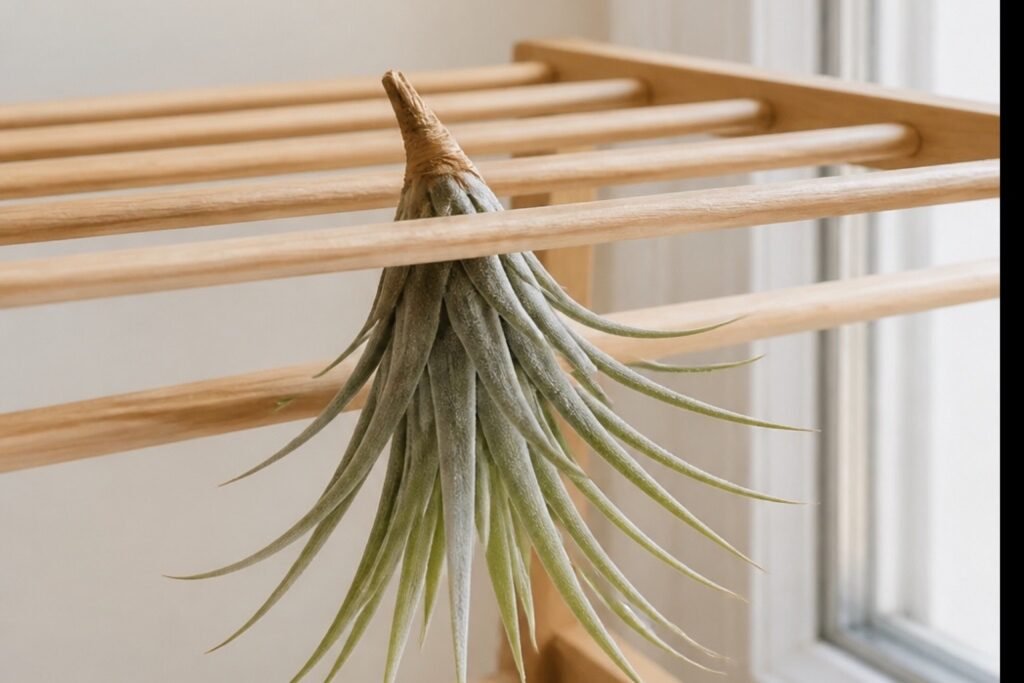
Air plant care fails most often for one simple reason: the display looks dry while the plant stays wet in its center. Tillandsia ionantha has no potting soil to judge, so light, watering, and drying must work as one routine. A weekly soak is not automatically right, and misting is not automatically wrong. The plant's room and drying speed decide which method makes sense.
This small bromeliad is an epiphyte from Mexico and Central America. Its roots mostly hold it to bark or rock rather than feeding it from soil. Fine scales called trichomes cover the leaves and take up moisture. That clever surface does not mean the plant lives on air alone.
Air plant care snapshot
| Care point | Practical indoor target |
|---|---|
| Light | Bright indirect light with gentle early sun if acclimated |
| Water | Wet thoroughly, then drain upside down until fully dry |
| Growing medium | None; mount or rest it on a dry, open surface |
| Humidity | Moderate, paired with moving air |
| Temperature | Roughly 60 to 85 F indoors |
| Mature size | Commonly 4 to 8 inches across, cultivar dependent |
| Growth rate | Moderate before and after flowering |
| Pet safety | No exact veterinary listing was confirmed for this species |
Bright light pays for every watering
Set T. ionantha near a bright window with filtered light. An east window often works well. Strong midday sun through glass can scorch a plant that came from a shaded shop, while a dim shelf slows drying and weakens growth.
Watch the leaf spacing and color. A plant that stays green is not necessarily underlit, since the inner leaves often blush red only as flowering approaches. Weak stretched growth and a display that remains damp for hours are better reasons to question the location.
Artificial light can help in a windowless room. Use the principles in how far grow lights should be from plants and adjust for the lamp rather than copying a random distance.
Wet it well, then dry it completely
Rinsing, soaking, and thorough misting can all work. The common requirement is that the entire plant gets wet and then dries within a few hours. In an average home, a rinse or short soak once or twice a week is a reasonable starting point. Dry heat, strong light, and fast air movement may call for more frequent water. A humid, cool room usually calls for less.
After watering, shake the plant gently and place it upside down on a towel or open rack. Water trapped in the leaf bases can rot the center. Do not return it to a glass globe until it feels dry. Penn State Extension recommends good circulation and a full drying period after watering.
Curled leaves can indicate dehydration, but naturally narrow cultivars also curl. Notice whether the leaves become more tightly rolled and whether the plant feels unusually light. Our general guide to watering indoor plants explains why environment changes the interval, even though an air plant has no soil.
Skip soil and choose an open display
Do not bury Tillandsia ionantha in potting mix. Rest it on ceramic, cork, untreated wood, wire, or another surface that does not hold water against the base. An open glass vessel is safer than a sealed terrarium. Moss may look natural, but damp moss wrapped around the base slows drying.
Avoid copper wire, which can be harmful to bromeliads. If you use an adhesive, keep it off living leaf tissue and use a method recommended for air plants. A loose cradle is easier to inspect and water than a permanent mount.
Bathrooms can suit air plants only when there is enough window light and circulation. Humidity does not replace watering. The article on increasing humidity for houseplants explains why a brief shower spike is different from stable room conditions.
Feed cautiously and mind the water
Fertilizer is optional for a small household collection. If you use it, choose a product labeled for bromeliads or air plants and apply it very weakly during active growth. Products that depend on soil microbes to release nitrogen are a poor match for a plant with no soil. Heavy feeding can burn leaf surfaces.
Mineral residue sometimes collects on trichomes after repeated use of very hard water. Rainwater or suitable filtered water can help if deposits are obvious. Do not use artificially softened water that contains added sodium. Changing the water source makes more sense than scrubbing the delicate scales.
Expect one bloom, then pups
An individual rosette flowers once. Before bloom, inner leaves may turn red and a violet flower can emerge. Afterward, the parent slowly declines while producing pups at the base. That change is the plant's normal life cycle, not a sudden care failure.
Leave pups attached until they are roughly one-third to one-half the parent's size. They can remain together as a clump or be eased apart when the connection loosens. Do not rush to discard the mother plant while it is still supporting offsets.
Common air plant problems
| Symptom | Likely checks | First sensible move |
|---|---|---|
| Soft dark center | Water trapped in the rosette or poor airflow | Remove from the display and let it dry in moving air |
| Tight curling leaves | Dehydration, heat, or natural form | Compare recent watering and drying conditions |
| Pale bleached patches | Harsh direct sun | Move to filtered light and assess new growth |
| Brown leaf tips | Drying too far, heat, or mineral buildup | Review water quality and room conditions |
| Cottony clusters | Mealybugs | Isolate and identify the pest before treatment |
Once the center pulls out easily and smells rotten, recovery is unlikely. If only a few tips are brown, trim for appearance without cutting into healthy tissue. The broader brown tips guide can help you check heat and water quality.
Inspect a new air plant even though it has no pot. Mealybugs and scale can hide between the leaf bases. If you find cottony insects, use the identification steps in the mealybug guide before treating the plant.
Pet safety remains unverified here
This review did not find a species-specific ASPCA entry for Tillandsia ionantha. NC State does not flag the species as poisonous, but that is not the same as a veterinary guarantee. Keep it out of reach if a pet likes to chew plants, and contact a veterinarian after a known ingestion.
Frequently asked questions
Does an air plant need to soak every week?
Not always. It needs thorough wetting followed by complete drying. A rinse, soak, or heavy mist can work when the frequency fits the room. Adjust by drying speed and leaf condition rather than obeying one universal schedule.
Can I keep an air plant inside a glass globe?
Yes, if the globe is open and the plant is completely dry before it goes back. A closed or damp vessel traps water around the base and raises the risk of rot.
Why is my air plant turning red?
Healthy inner leaves often blush before flowering. Red color paired with a developing flower is normal. Bleached tan tissue on the window-facing side is more consistent with sun damage.