
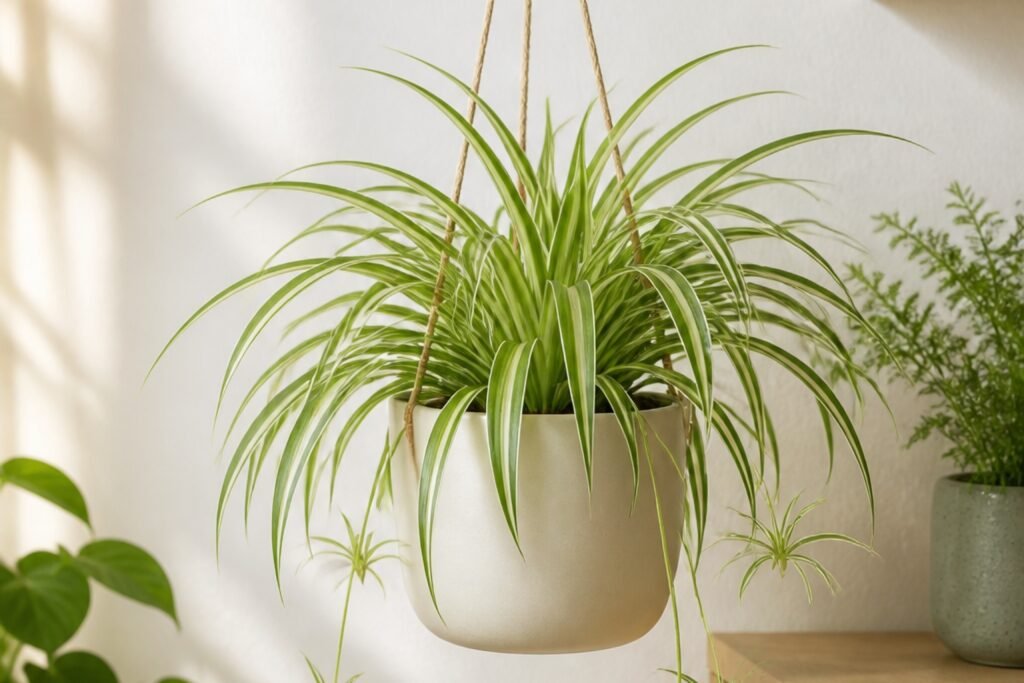
Spider plant care is forgiving, but the plant is not indestructible. It can put up with a missed watering and still send out long stems covered in small plantlets. What usually spoils the effect is less dramatic: harsh sun, a pot that never drains, or a slow buildup of fertilizer salts that turns every leaf tip brown.
The common spider plant is Chlorophytum comosum, a clumping perennial from southern Africa. Ribbon plant and spider ivy are two other names you may see. Green plants exist, although striped cultivars such as 'Vittatum' and 'Variegatum' are far more common indoors.
Spider plant care snapshot
| Care point | Practical indoor target |
|---|---|
| Light | Bright indirect light; moderate light is acceptable |
| Water | Water after the upper inch or two begins to dry |
| Soil | Airy indoor mix in a pot with drainage |
| Humidity | Average household humidity, with fewer dry drafts |
| Temperature | Roughly 60 to 80 F |
| Mature indoor size | About 1 to 2 feet across, plus longer flowering stems |
| Growth rate | Moderate to fast in useful light |
| Pet safety | ASPCA lists it as non-toxic to cats and dogs |
Spider plants appear in our guides to easy indoor plants and pet safe indoor plants. Those lists help with choosing a plant. This profile deals with the quieter work of keeping one full, green, and firmly rooted after the novelty of the plantlets wears off.
Find bright light without baking the leaves
An east window or a place near a bright north window often suits a spider plant. Filter strong afternoon sun with a sheer curtain or move the pot back from the glass. Dark green cultivars manage lower light better than heavily striped ones, but even they grow more slowly and produce fewer plantlets when the room is dim.
Pale, washed-out foliage can mean too much sun. Long, weak leaves with little new variegation suggest too little. Move the plant in stages and judge the new leaves, since old damage will not reverse. Our low light plant guide gives a practical definition of low light instead of treating every shaded corner as equal.
Water the root ball, not the calendar
Check the pot every few days during active growth. When the upper layer feels dry but the deeper mix still has a little moisture, soak the root ball and let it drain. A root-bound spider plant may use water quickly. A recently divided plant in a larger pot may stay damp much longer.
Leaf tips can brown after repeated drying, but more water is not always the answer. Soluble salts from fertilizer, softened water, or a tired potting mix can produce the same symptom. Flush the pot with plenty of plain water occasionally, provided the drainage works, and avoid letting the container stand in the runoff.
The broader indoor watering guide explains how pot material, light, and root volume alter the interval. That is useful here because a hanging spider plant often dries faster than a similar plant sitting inside a decorative cachepot.
Give the fleshy roots some air
Spider plants form thick, pale storage roots. They enjoy consistent moisture while actively growing, but those roots still need oxygen. Use a loose indoor potting mix and a container with an open drainage hole. If water crawls across the surface or the pot remains heavy for many days, inspect the mix before increasing the watering interval.
Repot when roots crowd the pot so tightly that water runs around the root ball, growth stalls, or the container tips easily. Move up one pot size. You can also divide a large clump, which is often neater than placing it in an ever larger hanging basket. The houseplant repotting guide shows how to keep the crown at its former depth.
Feed for leaves, not for speed
A complete houseplant fertilizer used according to its label is enough during active growth. More fertilizer does not guarantee more plantlets. It often produces weak growth or brown tips instead. Reduce or pause feeding when the plant is barely growing in winter or when it lives in lower light.
Trim a brown tip with clean scissors if it bothers you, following the natural point of the leaf. Removing the mark is cosmetic. Fix the water, salt, or humidity issue that caused it or the next leaf will end the same way.
Plantlets are the easiest propagation method
Wait until a plantlet has several leaves and small root nubs. You can pin it onto moist potting mix while it remains attached to the parent, then cut the runner after roots hold. Or remove it and root it in a small pot. Water rooting also works, but long water roots need a careful transition to potting mix. Our guide to propagating houseplants in water covers that move.
Division is useful for an old, crowded plant. Separate the root mass into a few generous sections rather than many weak fragments. Each piece needs healthy roots and a central crown.
Common spider plant problems
| Symptom | Likely checks | First sensible move |
|---|---|---|
| Brown leaf tips | Dry spells, fertilizer salts, softened water, hot drafts | Review water quality and flush the mix if drainage is good |
| Pale or bleached bands | Direct sun or abrupt light increase | Move back from the window and acclimate gradually |
| Limp leaves in wet soil | Root stress from poor drainage | Unpot and inspect the roots before watering again |
| Few plantlets | Low light, immature plant, excessive nitrogen | Improve light and give the plant time |
| Fine webbing or stippled leaves | Spider mites | Isolate and confirm the pest on leaf undersides |
If several symptoms appear together, compare them with our guide to brown tips on houseplant leaves and change one condition at a time. That makes it easier to see whether the plant is responding.
Pet safety still needs common sense
ASPCA lists Chlorophytum comosum as non-toxic to cats and dogs. Non-toxic does not mean edible or harmless in unlimited amounts. Chewed leaves can still upset an animal's stomach, and a hanging basket can become a pulling hazard. Secure the hook and keep the plant out of reach if your cat is determined to graze.
Frequently asked questions
Should I cut the babies off my spider plant?
You can leave them for a cascading look or remove them when the parent becomes crowded and thirsty. Cutting runners does not harm a healthy plant. Use clean scissors near the base of the stem.
Why does my spider plant have brown tips?
Check for repeated dry spells, excess fertilizer, salt buildup, softened water, and hot or cold drafts. A single brown tip is cosmetic. A pattern across new leaves calls for a care adjustment.
Can a spider plant grow in water forever?
A plantlet can root in water, but long term water culture needs deliberate nutrient and sanitation management. Ordinary potting mix is simpler for most homes. Move a rooted plantlet to mix while its water roots are still short and fresh.