AeroGarden vs Click & Grow: Honest 9-Pod Comparison
Last updated: August 5, 2026.
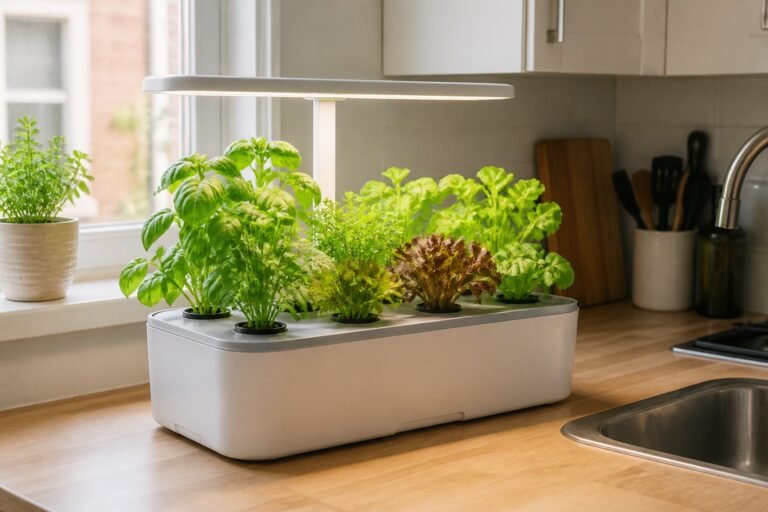
AeroGarden vs Click & Grow sounds like a close comparison because both put nine plants under a countertop light. Living with them feels less similar than the pod count suggests.
Start here: For a complete overview, see our 7 Best Hydroponic Systems for Beginners in 2026.
Click & Grow is quieter and asks less of you. AeroGarden gives you more control, more vertical room, and stronger growing performance. We used both in the same kitchen during our six-month smart garden test, and the choice came down to whether we wanted calm convenience or a more hands-on hydroponic system.
The short answer
Choose the Click & Grow Smart Garden 9 if you want the simplest routine, near-silent operation, and a garden that looks comfortable on a kitchen counter. It is the easier first system.
Choose the AeroGarden Bounty Basic if you care more about plant height, harvest size, and using your own seeds. Its pump makes some noise, but the stronger light and taller growing space give vigorous herbs more room.
On August 5, 2026, Click & Grow listed the Smart Garden 9 at $249.95. AeroGarden listed the Bounty Basic at $107.97 on clearance, down from $179.95. That discount is useful, but it may disappear or the model may sell out, so treat it as a dated snapshot.
What we compared
Both gardens have nine planting sites, so we used the closest match in each lineup:
- Click & Grow Smart Garden 9
- AeroGarden Bounty Basic
Both grew basil, lettuce, parsley, mint, and cherry tomato in the same kitchen. We followed each brand’s care routine and used its supplied pods during the first cycle. Setup time, daily maintenance, noise, germination, and harvest performance all counted. This page stays with those two brands. It does not try to rank every smart garden on the market.
1. Setup and daily routine
The Smart Garden 9 took us about eight minutes to set up. The unit uses passive watering, so there is no pump to configure. Fill the four-liter tank, insert the pods, plug in the light, and leave it alone until the water float drops.
The Bounty Basic took about 22 minutes. It has more pieces, liquid plant food, a circulating pump, and an onboard display. None of that is difficult. It simply asks for a few more decisions at the beginning and during the grow.
This difference sticks around. Click & Grow feels like a planter with a timer. AeroGarden feels like a small hydroponic appliance. I prefer the first approach in a quiet room, but I like the Bounty controls when I am growing a crop that needs closer attention.
2. Pods and using your own seeds
Click & Grow’s standard Plant Pods arrive with seed and growing medium already inside. Nine-packs were $29.95 on the brand’s US site when we checked, or about $3.33 per planting site. Thirty-packs bring that cost down to about $2 per pod.
You are not limited to the pre-seeded catalog. Click & Grow sells official Grow Anything pods without seeds, and you add your own. They keep the brand’s growing medium and convenience, so this route does not make the consumable cost disappear. It does open up the seed choice.
AeroGarden is more flexible from the start. The Bounty Basic accepts branded seed kits and AeroGarden’s own Grow Anything kit. The plastic baskets can also be reused with replacement sponges and your own seeds. That route takes more preparation, and you still need nutrients, but the ongoing cost can be lower.
Click & Grow wins when you want a sealed, tidy refill. AeroGarden wins when you want to experiment and do not mind handling seeds, sponges, and plant food.
3. Light, height, and harvest
The current Smart Garden 9 has a 13-watt light, nine plant sites, two lamp extension arms, and a four-liter reservoir. The extension arms give herbs more headroom than the smaller garden suggests, although the whole setup remains fairly compact.
The Bounty Basic has a 30-watt light and up to 24 inches of growing height. In our test it produced the bigger plants and the heavier overall harvest. Basil showed the difference most clearly. Click & Grow’s plants were smaller, but every supplied pod germinated and the crop stayed even.
That does not make the Bounty a tiny indoor farm. Nine holes fill up fast once basil, mint, or tomato matures. I would use fewer than nine sites for large herbs and leave empty spaces between fruiting plants. For salad-scale harvests, both systems are too small. A larger setup from our indoor vertical garden guide makes more sense.
4. Noise, controls, and apps
Click & Grow is the easy choice for a desk, bedroom-adjacent counter, or quiet studio. Passive watering makes the unit silent. The official Click & Grow app exists, but on the Smart Garden 9 it works as a care companion with plant tips and harvest reminders. It does not turn the SG9 into a remotely controlled pump system.
The Bounty Basic cycles a water pump, and we could hear it from across a quiet room. Its onboard display handles water and plant food reminders, the light schedule, and Vacation Mode. AeroGarden’s current app page lists Bounty Basic among its compatible gardens, while an older Bounty Basic specification says the model has no WiFi or app support. The official pages conflict. Compatibility may depend on the model year and firmware, so verify the exact unit before buying.
Current price and feature check
These are official US prices checked on August 5, 2026. The Bounty figure includes a clearance discount, so this table is a snapshot rather than a promise about the price you will see.
| Feature | Click & Grow Smart Garden 9 | AeroGarden Bounty Basic |
|---|---|---|
| Official price at check | $249.95 | $107.97 clearance ($179.95 regular) |
| Plant sites | 9 | 9 |
| Light | 13W | 30W |
| Growing height | Two extension arms | Up to 24 inches |
| Water system | Passive, 4 L tank | Circulating pump, large bowl |
| Controls | Built-in light timer | Onboard display and Vacation Mode |
| App on this model | Care companion, no hardware control | Compatibility may vary by model year and firmware |
| Official own-seed option | Grow Anything Plant Pods | Grow Anything Seed Pod Kit |
I checked those figures against Click & Grow’s Smart Garden 9 page and AeroGarden’s official Bounty Basic page. AeroGarden’s current app compatibility page is the source for the compatibility caveat. Click & Grow’s Grow Anything page confirms the option for using your own seeds. Price and inventory can change, so the check date above matters.
Which one should you buy?
Buy the Smart Garden 9 if the garden will sit somewhere visible and quiet, or if you know that extra mixing and cleanup will make you use it less. The higher purchase price buys a simpler routine. Our Click & Grow value guide goes deeper into its refill cost and buyer fit.
Buy the Bounty Basic if you cook often, want taller plants, and expect to use your own seeds. At our check, its official clearance price was the lower of the two, and it produced more in our test. You will hear the pump, mix plant food, and clean more hydroponic residue. For me, that trade is reasonable when harvest size matters.
If neither sounds right, our small indoor herb garden kit guide covers soil kits and other compact systems. That is a better next step than forcing a choice between two products that solve the problem differently.
Frequently asked questions
Is AeroGarden easier than Click & Grow?
No. Both are beginner-friendly, but Click & Grow has fewer moving parts and no nutrient mixing during a standard pod cycle. AeroGarden gives you more control in exchange for a little more work.
Can I use my own seeds in both?
Yes. Click & Grow sells seedless Grow Anything pods. AeroGarden sells a Grow Anything kit and also has a reusable basket format that many owners pair with replacement sponges.
Which one is quieter?
Click & Grow. Its passive watering system is silent. The Bounty Basic pump is not loud in a busy kitchen, but you can hear it in a quiet room.
Is AeroGarden still available?
Yes. ScottsMiracle-Gro’s US store listed the Bounty Basic at a clearance price when we checked on August 5, 2026. Clearance stock can change quickly, so check the current page before relying on an older comparison.
AeroGarden vs Click & Grow: the bottom line
In an AeroGarden vs Click & Grow decision, I would give the ease of use win to Click & Grow. AeroGarden wins on performance and flexibility.
The Smart Garden 9 is calmer to live with. The Bounty Basic gives you more growing room and a bigger harvest, and its August 5 clearance price was much lower. The trade remains simple: Click & Grow costs more but keeps the routine tidy; AeroGarden needs more cleanup and makes more noise.