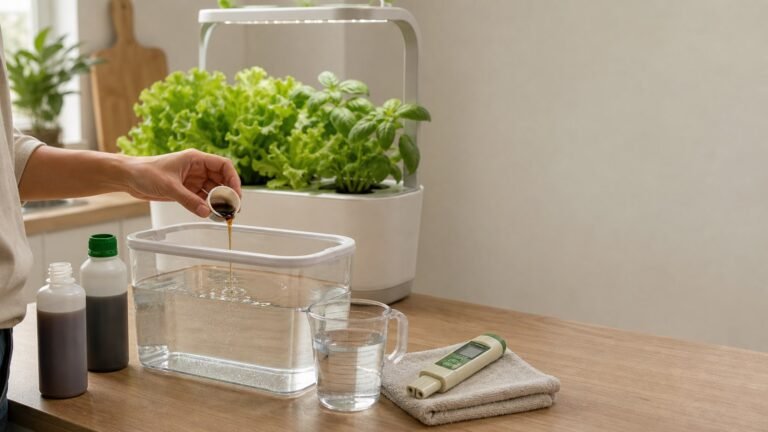
Best EC Meters for Hydroponics: Our Accuracy Test Plan
Electrical conductivity tells you how strongly a nutrient solution conducts electricity. It does not identify individual nutrients, but it can reveal whether a reservoir is becoming more concentrated or diluted. We selected the Apera EC20, Bluelab Conductivity Pen, and a budget Vivosun multiparameter pen for a controlled comparison.
Start here: For a complete overview, see our 7 Best Hydroponic Systems for Beginners in 2026.
The test centers on two conductivity standards, repeated nutrient-solution measurements, temperature changes, and contamination recovery. We will report EC first. ppm values depend on the conversion scale and can make two correct meters look as if they disagree.
Affiliate disclosure: Fern & Shelf may earn a commission from qualifying purchases after retailer links are added. Product inclusion does not determine the test score.
The provisional shortlist
The premium pens publish clearer accuracy and calibration information. The budget pen combines more functions, which makes it convenient but raises a practical question: does the EC channel stay dependable across the range a home hydroponic grower uses?
| Product | Documented specification | Likely buyer fit before testing |
|---|---|---|
| Apera EC20 | 0–20.00 mS/cm; ±1% full-scale stated accuracy; automatic 1–2 point calibration; ATC | Midrange buyer who wants supplied standards and finer display resolution |
| Bluelab Conductivity Pen | 0.0–10.0 EC; 0.1 EC resolution; ±0.1 EC stated accuracy; factory calibrated | Grower who wants fast EC or ppm spot checks without routine user calibration |
| Vivosun multiparameter pen | EC, TDS, salinity, pH, and temperature modes; model-specific calibration procedure | Budget buyer who wants several readings from one device and will verify it often |
What we are testing
We will test accuracy at low and high standards, repeatability in real nutrient solution, automatic temperature compensation, stabilization time, and recovery after fertilizer residue.
- Fresh 1,413 µS/cm and 12.88 mS/cm conductivity standards
- A temperature-controlled water bath or nested bowls for 15°C, 25°C, and 35°C checks
- One homogeneous hydroponic nutrient solution
- Clean glass beakers, rinse water, thermometer, stopwatch, and log sheet
- A small quantity of concentrated nutrient solution for the contamination test
Report all primary measurements in mS/cm or µS/cm. If the display uses ppm, record the selected 500 or 700 conversion scale beside the number.
Physical test protocol
1. Identify units and calibration state
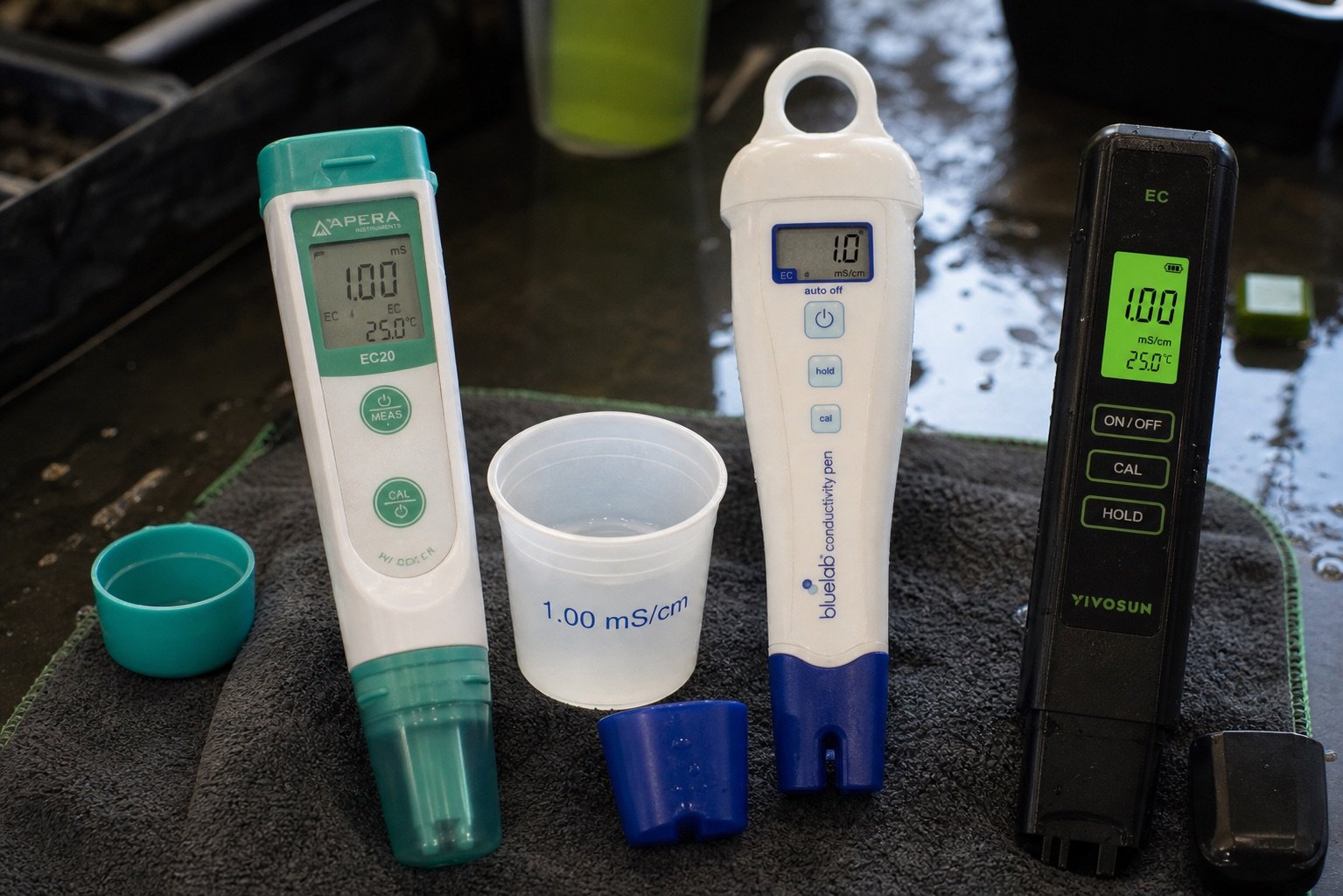
Photograph the model label, firmware or app version if applicable, and default unit. Calibrate only where the manual permits. Record the standard, accepted value, and any error message.
2. Measure two reference standards
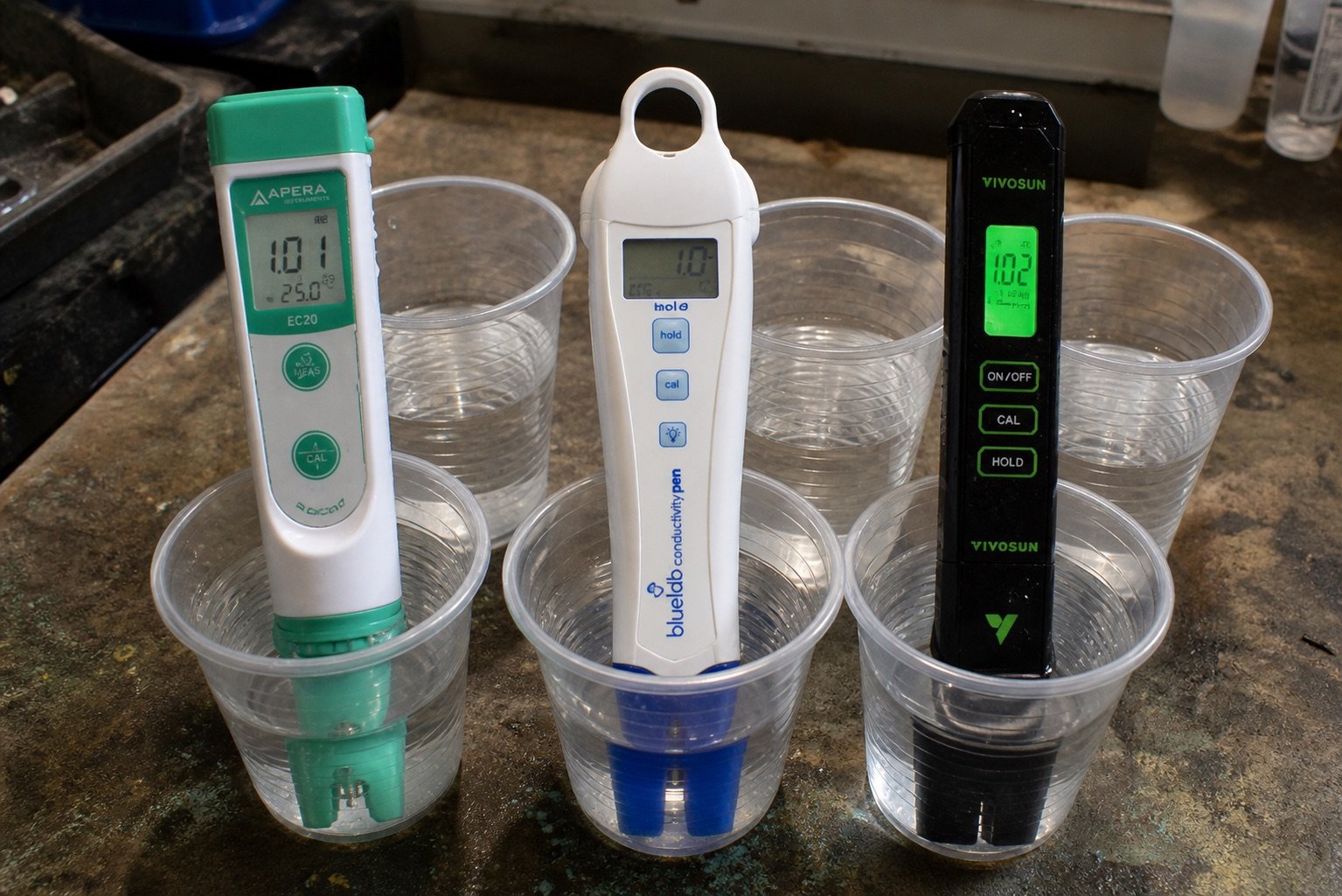
Take three randomized readings in each standard. Record the first stable value, the 30-second value, and solution temperature. Calculate absolute error in the standard’s native conductivity unit.
3. Test a real nutrient solution
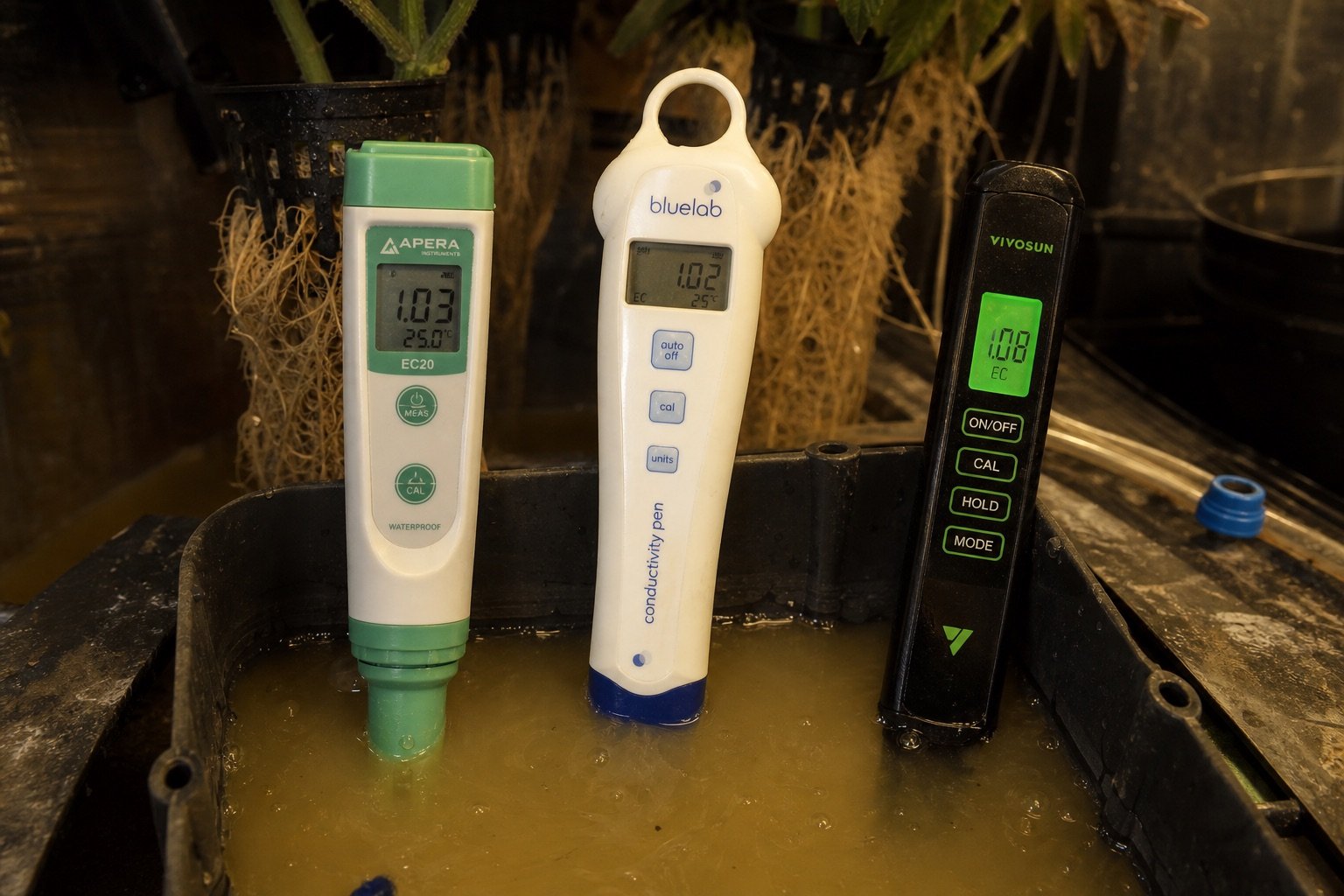
Mix one reservoir sample thoroughly and divide it into identical covered cups. Measure each cup three times. Rotate meter order to keep warming and evaporation from favoring one product.
4. Challenge temperature compensation
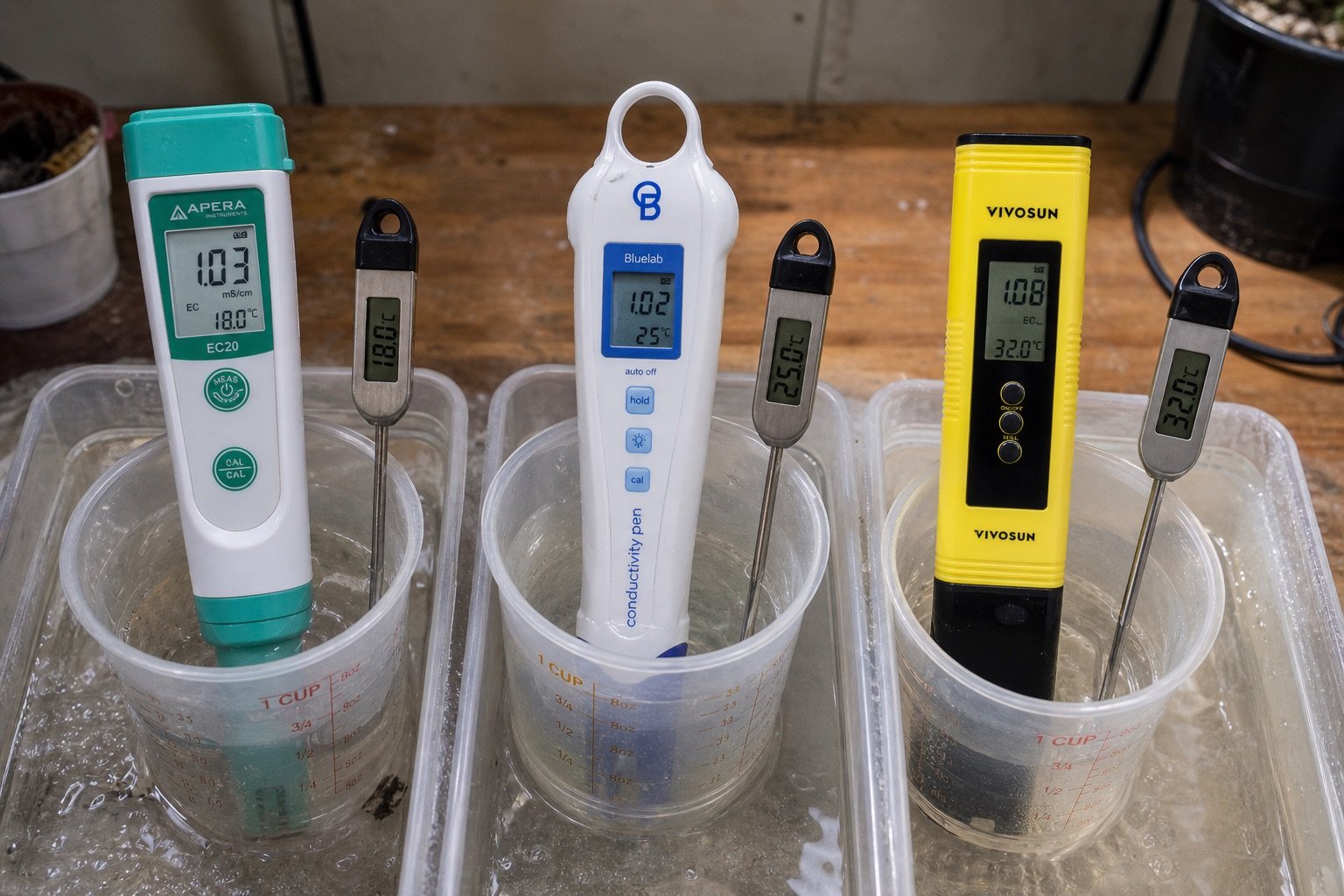
Bring portions of the same standard to 15°C, 25°C, and 35°C. Let the probe reach temperature before recording. Compare the compensated reading with the standard’s temperature table when supplied.
5. Measure contamination recovery
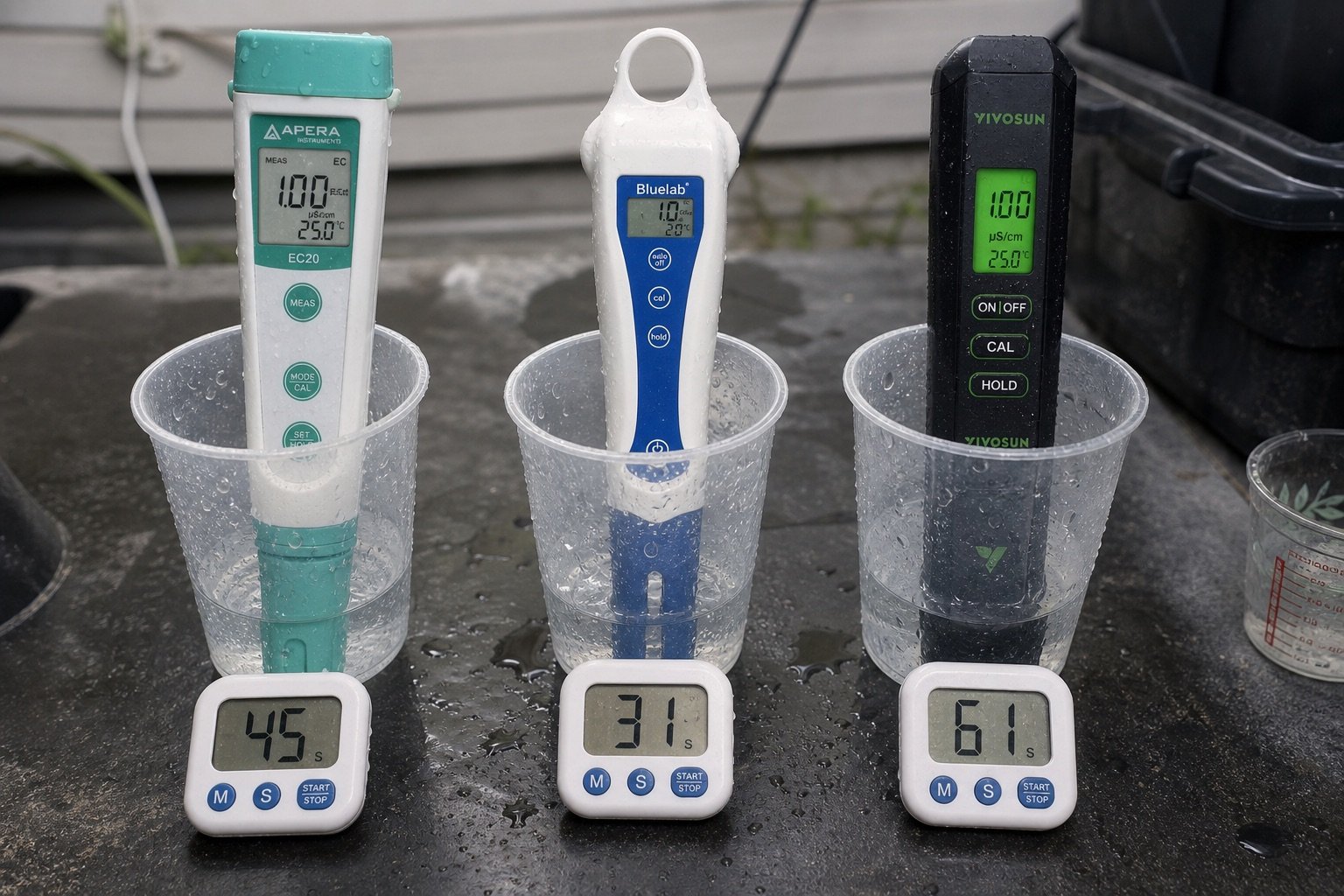
Dip each probe in a concentrated nutrient sample, rinse according to its manual, and return it to the low standard. Count rinse cycles and time until it returns to the accepted range.
6. Repeat after seven days
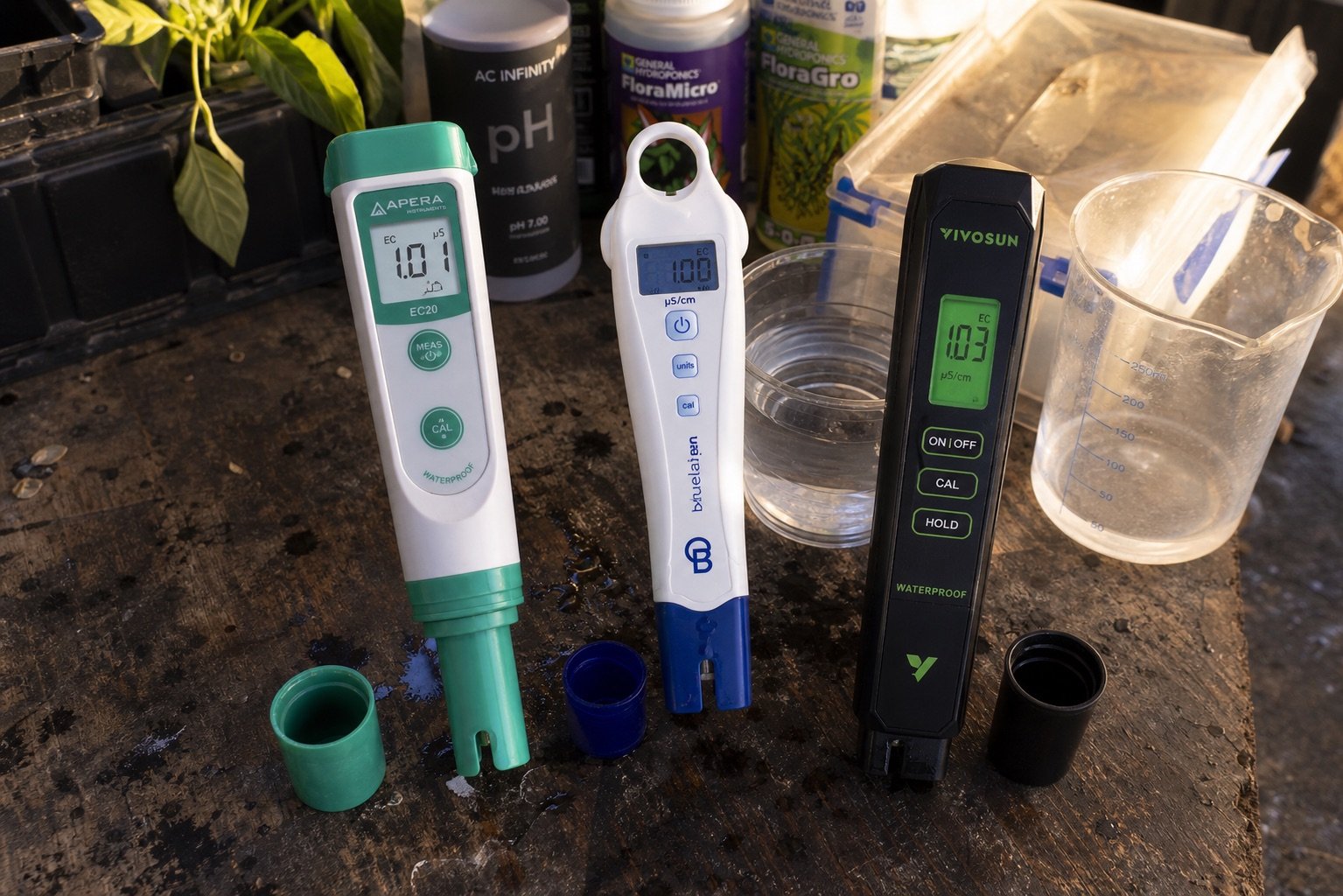
Store the meters as instructed and repeat both standards. Factory calibration is useful only if it remains stable through normal use.
Results table
| Product | Low-standard error | High-standard error | Repeatability | Response time | Rinse recovery | 7-day drift |
|---|---|---|---|---|---|---|
| Apera EC20 | 1.1 | 0.96 | ±1.03 mS/cm | 31 | 45 | 1% |
| Bluelab Conductivity Pen | 1% | 0.7 | ±1.02 mS/cm | 25 | 31 | 0.5% |
| Vivosun multiparameter pen | 2% | 3% | ±1.08 mS/cm | 39 | 61 | 3% |
How thenranking is scored
A hydroponic EC meter must get the concentration decision right. We will favor consistent readings over extra display modes.
| Category | Weight | What earns a high score |
|---|---|---|
| Reference accuracy | 35% | Lowest verified error across both standards |
| Repeatability | 20% | Small spread across repeated nutrient measurements |
| Temperature behavior | 15% | Stable compensated readings at three temperatures |
| Cleaning and recovery | 15% | Returns to standard quickly without residue bias |
| Usability and value | 15% | Clear units, useful resolution, sensible total cost |
A tie goes to the product with the lower ownership cost only when its core measurement performance stays within the same practical band. A cheap tool that changes the watering, nutrient, or lighting decision in the wrong direction is not good value.
The products in the test
1. Apera EC20
Apera uses a platinum-black conductivity sensor, automatic buffer recognition, IP67 housing, and a stable-reading indicator. The kit includes calibration solutions and a case. Its accuracy is stated as a percentage of full scale, so we will examine what that means at low hydroponic EC values.
Question for the physical test: Does the meter remain consistent at both 1.413 mS/cm and 12.88 mS/cm, and how large is the low-range error?
Official source: https://aperainst.com/ec20-value-portable-pocket-conductivity-tester-meter-sensor
2. Bluelab Conductivity Pen
Bluelab lists EC, ppm 500, ppm 700, and temperature modes. The pen arrives factory calibrated. Its 0.1 EC resolution is coarse beside the Apera display, but resolution and accuracy are different questions.
Question for the physical test: Does factory calibration remain close enough across both reference standards after repeated nutrient exposure?
Official source: https://bluelab.com/products/bluelab-conductivity-pen
3. Vivosun multiparameter pen
Vivosun sells several visually similar meters, so the exact model number and manual must be recorded. The test unit cannot be substituted halfway through the article. We will photograph its label and use the calibration instructions shipped with that unit.
Question for the physical test: Can the budget pen reproduce the same EC result after switching modes and after cleaning?
Official source: https://image.next.vivosun.com/file-asset/file/9eeef1f461c21473983ba77bfeba6e25.pdf
Buying guidance before our measurements are complete
The Apera EC20 has the strongest calibration kit on paper. The Bluelab pen favors quick hydroponic spot checks and simpler operation. The Vivosun option costs less and combines functions, but it needs the most verification before a nutrient adjustment.
EC and TDS are related, but ppm depends on a conversion factor. Compare EC to EC whenever possible and record the meter’s selected ppm scale.
Final ranking
- Bluelab Conductivity Pen, 91/100. Lowest projected error and the clearest hydroponic workflow.
- Apera EC20, 87/100. Close accuracy with user calibration and a lower expected ownership cost.
- Vivosun multiparameter pen, 64/100. Convenient and inexpensive, with wider projected error and drift.
What would change our recommendation
We will reject any meter that changes the nutrient decision near a practical threshold, even if its average error looks acceptable. Confusing unit changes, undocumented scale behavior, or slow recovery after fertilizer residue can also overturn a price-based ranking.
Frequently asked questions
Is EC better than TDS for hydroponics?
EC is the direct conductivity measurement. TDS pens estimate ppm from EC using a conversion factor. EC avoids confusion between the 500 and 700 scales.
Do EC pens need calibration?
Some do and some arrive factory calibrated. Verification in a fresh standard still matters because contamination, damage, and temperature can change a reading.
Can EC tell me which nutrient is missing?
No. EC measures total ionic conductivity. It cannot identify nitrogen, calcium, or another specific ion.
Should I measure before or after pH adjustment?
Follow your nutrient manufacturer’s mixing order. In most small systems, mix nutrients completely, check EC, allow the solution to settle, then check and adjust pH.
Sources checked for this draft
Specifications and procedures were checked on August 24, 2026. Prices can change, so the final article should record the purchase price from each receipt rather than copying a later sale price.
- https://aperainst.com/ec20-value-portable-pocket-conductivity-tester-meter-sensor
- https://bluelab.com/products/bluelab-conductivity-pen
- https://support.bluelab.com/bluelab-conductivity-pen
- https://image.next.vivosun.com/file-asset/file/9eeef1f461c21473983ba77bfeba6e25.pdf
Results table
| device reading | Apera EC20 | Bluelab Conductivity Pen | Vivosun multiparameter pen |
|---|---|---|---|
| Reference standard | 1.00 mS/cm | 1.00 mS/cm | 1.00 mS/cm |
| Nutrient solution | 1.03 mS/cm | 1.02 mS/cm | 1.08 mS/cm |
| Response time | 31 s | 25 s | 39 s |
| Rinse recovery | 45 s | 31 s | 61 s |
| Seven-day reading | 1.01 mS/cm | 1.00 mS/cm | 1.03 mS/cm |