Hydroponic pH Keeps Rising? 7 Checks That Work
Last updated: August 23, 2026.
Affiliate disclosure: As an Amazon Associate I earn from qualifying purchases. Links marked “paid link” may earn Fern & Shelf a commission at no extra cost to you. Read our full Affiliate Disclosure.
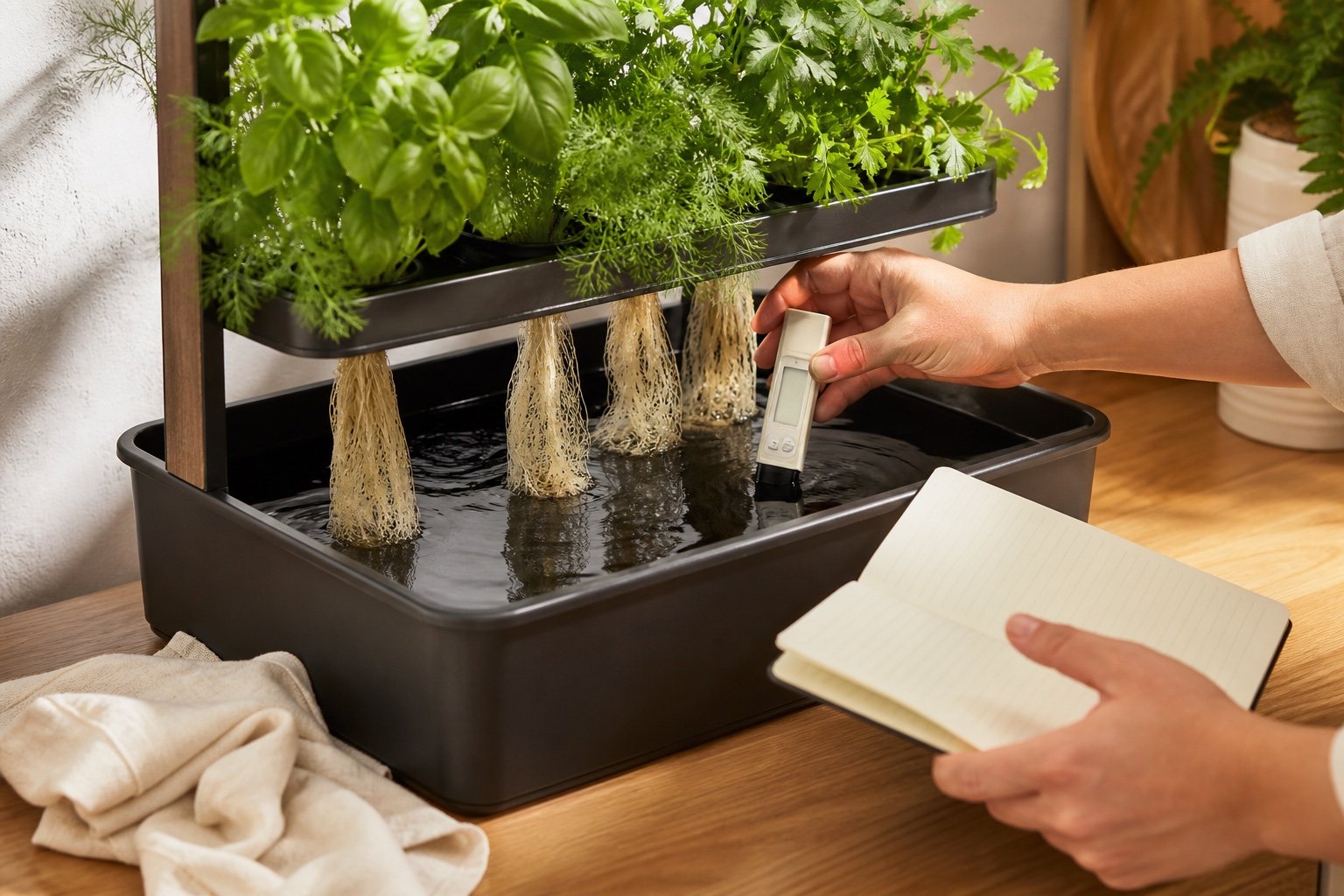
When hydroponic pH keeps rising, pouring in more acid is not a diagnosis. The reading may be wrong. Your source water may carry enough alkalinity to neutralize each correction. Plants may be changing the balance of ions in the reservoir, or a dirty system may be supporting algae and microbes that disturb the chemistry.
Start by confirming the measurement and recording what changes between readings. Then work through the water, nutrients, reservoir, roots, and adjustment method. That order prevents a faulty meter from sending you into an endless cycle of pH down and rebound.
pH and alkalinity are different measurements
pH describes how acidic or basic the solution is at the moment you test it. Alkalinity describes the water’s capacity to neutralize acid, largely through bicarbonates and carbonates. A pH meter does not measure alkalinity.
University of Missouri Extension states that high pH does not necessarily mean high alkalinity, and high alkalinity does not necessarily mean the source water starts with a high pH. The distinction explains why two reservoirs can show the same pH but require very different amounts of acid to move it.
There is no honest universal pH target for every hydroponic crop and system. Crop, growth stage, fertilizer, source water, and production method all matter. Missouri Extension gives 5.5 to 6.5 as a general rule of thumb for many crops while directing growers to crop specific guidance. Virginia Tech gives a narrower range for many deep water crops. Use the range supplied by your crop and system guidance.
Hydroponic pH keeps rising: run these seven checks
1. Calibrate the meter before changing the solution
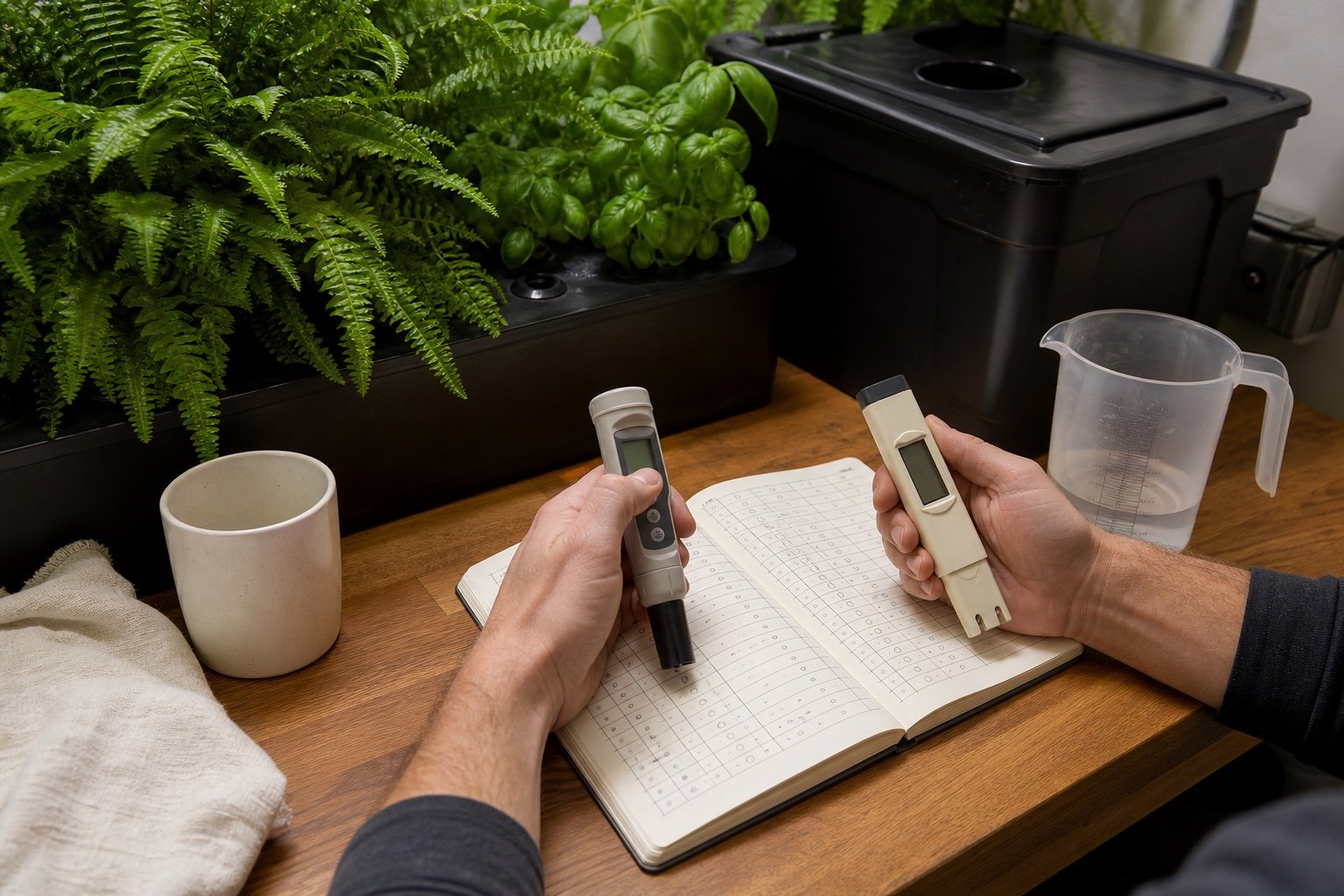
A drifting or dry probe can turn a stable reservoir into an imaginary emergency. Rinse it as directed, inspect it for residue, and calibrate with fresh buffer solutions. Two point calibration around pH 4 and pH 7 is practical for hydroponics.
University of Missouri Extension recommends weekly two point calibration and proper storage solution, not plain water. UMass Extension warns that a pen without calibration is unlikely to provide dependable results.
After calibration, test one buffer again as an unknown. If the reading will not stabilize or returns the wrong value, clean the probe according to the meter instructions and recalibrate. Replace a probe that can no longer pass that check.
Search Amazon for pH 4 and 7 calibration solution (paid link)
2. Measure the same way each time
Sample after the reservoir has circulated and the concentrate is fully dispersed. Place the clean probe at a consistent depth, keep it away from a recently added chemical, and wait for the reading to settle. Record the time, solution temperature, pH, EC, and reservoir volume.
Top offs can create misleading comparisons. A reading taken before adding source water is not equivalent to one taken immediately after. Use one repeatable sampling point whenever the system permits.
A decent meter must be calibratable and suitable for wet work. Waterproofing, a replaceable probe, and available storage solution are more useful than a long list of modes. Test strips can provide a rough cross check, but colored nutrients can make them difficult to read.
Search Amazon for a calibratable waterproof pH meter (paid link)
3. Test source water for alkalinity, not pH alone
If the meter is sound and the adjusted solution repeatedly climbs, order a laboratory irrigation water test that includes alkalinity reported as calcium carbonate equivalent. Include pH, EC, calcium, magnesium, sodium, and other elements relevant to the laboratory’s irrigation package.
High alkalinity acts like a reserve of acid neutralizing material. You may lower the pH today, then watch it rise as bicarbonate reacts with the added acid. University of Minnesota Extension specifically links higher bicarbonate levels with upward pH pressure and more frequent monitoring. Missouri Extension explains that alkalinity also changes how much acid a correction requires.
Hard water deposits around faucets can suggest mineral rich water, but they do not replace a test. Ask the laboratory or a local Extension specialist to interpret the result for the crop and fertilizer program.
Do not assume a household water softener solves the issue. Softened water can add sodium, which is not a useful trade for an edible hydroponic crop. Reverse osmosis water may reduce the mineral load, but it also changes the nutrient recipe and buffering. Treat a water source change as a new formulation, not a simple swap.
4. Check EC, reservoir volume, and the nutrient mix
pH does not tell you how much fertilizer is present. Electrical conductivity, or EC, estimates the total concentration of dissolved ions, though it cannot identify each nutrient. Read pH and EC together.
If plants remove more water than nutrients, EC can rise as the reservoir volume falls. If they remove nutrients quickly and you replace only water, EC may fall. Adding concentrate, source water, or pH adjuster changes the chemistry again. Treat nutrient strength as its own check instead of using pH as a shortcut.
Prepare nutrients according to the product label. Never mix concentrated parts directly together unless the manufacturer explicitly instructs it. Let each part disperse before adding the next. Set the nutrient strength first, circulate, and then check pH. Oklahoma State University Extension recommends adjusting EC before pH.
| Observation | What it may suggest | Next useful check |
|---|---|---|
| pH rises while EC also rises and volume falls | Water loss is concentrating the solution | Check top off method, temperature, leaks, and plant water use |
| pH rises while EC falls | Plants may be taking up nutrients faster than water, or the mix is becoming unbalanced | Compare with crop stage and decide whether a fresh solution is due |
| pH jumps after each tap water top off | Source water chemistry may be driving the change | Test source alkalinity and log top off volume |
| pH changes immediately after adding concentrate | Mixing or sampling is inconsistent | Circulate fully and follow the nutrient label’s order |
| pH rises but a second calibrated meter disagrees | Measurement failure is likely | Clean, calibrate, or replace the faulty probe |
| pH rises alongside green surfaces and light leaks | Algae may be active | Block light and clean the system |
5. Inspect roots, biofilm, algae, and reservoir light
Healthy roots, adequate oxygen, clean plumbing, and a dark reservoir support more stable management. A transparent tank, uncovered opening, or light leak around a net pot can feed algae. Slippery surfaces and accumulated plant debris give microbes more habitat.
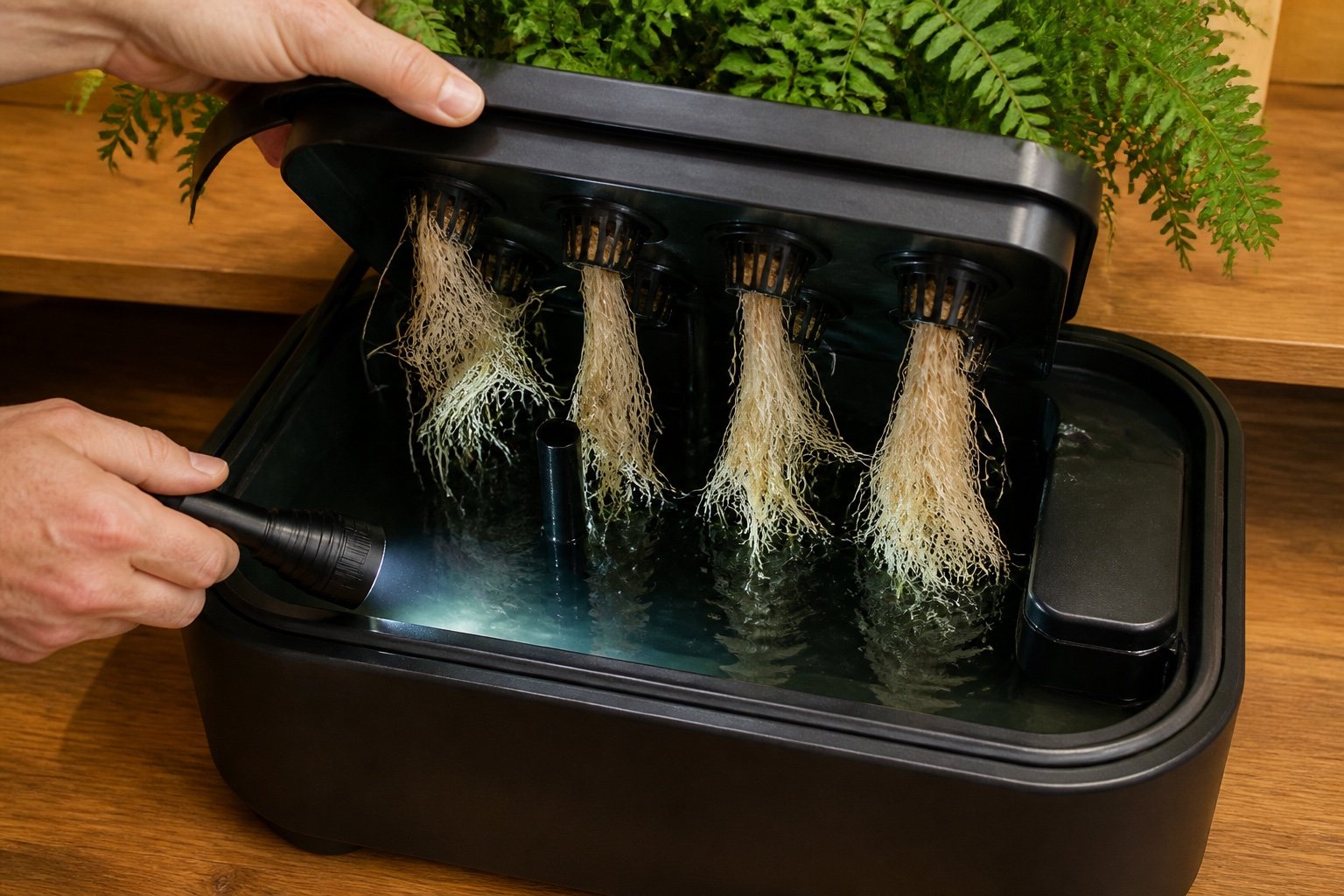
pH movement alone does not prove root disease or algae. Look for physical evidence: green film, slime, off odors, blocked flow, discolored roots, or debris trapped in the system. Check water temperature and aeration where the system uses them. One stressed plant may also have a local flow problem that a reservoir sample cannot reveal.
Remove dead roots and leaves promptly. Block light from the nutrient solution. If the system has visible buildup or is between crops, use the hydroponic cleaning procedure rather than pouring sanitizer into a planted reservoir. The guides to beginner hydroponic systems and hydroponics versus soil help identify the maintenance demands that differ by system.
6. Make small corrections, circulate, and retest
Use a pH adjuster labeled for hydroponic food crops and follow its instructions, protective equipment, and storage rules. Strong acids and bases can injure skin and eyes. Never combine incompatible chemicals, never improvise a dose from another reservoir, and keep concentrates away from children and pets.
Add a small measured amount to circulating solution, away from bare roots. Let it mix fully, then retest. Record the amount. A series of cautious additions is slower than one large pour, but it avoids overshooting and seesaw corrections.
Oklahoma State University Extension advises adding pH lowering products slowly and waiting before adding more. The amount needed depends on alkalinity, reservoir volume, and the product concentration. That is why this article does not provide a universal teaspoon formula.
Search Amazon for pH down labeled for food crop hydroponics (paid link)
7. Decide whether the old solution should be replaced
A reservoir can reach a point where repeated corrections hide an unbalanced solution. EC shows total ionic concentration, not the ratio of nitrogen, potassium, calcium, sodium, and other ions. Plants do not take every nutrient and every volume of water at the same rate.
Follow the nutrient and system guidance for solution changes. Replace sooner when the crop shows unexplained stress, EC behaves oddly, contamination is present, or you cannot restore a sensible pattern after confirming the meter and source water. Do not keep adding one product indefinitely to a reservoir whose composition is unknown.
When replacing, clean the tank as appropriate, prepare fresh source water and nutrient solution in the correct order, circulate, set EC for the crop and stage, then adjust pH. Record the new baseline. The next drift now has a clean point of comparison.
Keep a short pH and EC log
A notebook beats memory. Use the same units and sampling routine each time.
| Date and time | Reservoir volume | Source water added | Nutrient added | pH | EC | Temperature | Adjustment and observation |
|---|---|---|---|---|---|---|---|
| Baseline | Meter calibrated, fresh solution mixed | ||||||
| Next check | Note plant uptake, algae, roots, or leaks | ||||||
| After correction | Record exact product amount and mixing time |
Check at a frequency that suits the crop and system. A small passive container and a warm recirculating system do not need the same schedule. Virginia Tech recommends regular pH and EC checks in deep water culture, while University of Minnesota notes that small home systems may move more slowly. Follow the more specific system guidance when the two contexts differ.
What not to do when pH rises
Do not chase every tenth of a pH unit. Meters have limits, and a healthy crop can tolerate movement within its appropriate range. Repeated tiny corrections create more handling and more opportunities for error.
Do not use pH as a substitute for EC, alkalinity, or a root inspection. It is one measurement.
Do not assume vinegar, lemon juice, baking soda, or pool chemicals are interchangeable with a labeled hydroponic product. Concentration, persistence, added ions, crop, and food use still matter. A labeled product is easier to repeat safely.
Do not pour concentrate directly onto roots. Do not mix acid with nutrient concentrates. Do not lower the pH far below the crop range in the hope that it will rise into place later.
Finally, do not blame light for a chemical problem or chemistry for a light problem. Use the PPFD and DLI guide, grow light distance guide, and grow light duration guide to assess lighting separately.
Frequently asked questions
Why does my hydroponic pH rise every day?
Common causes include high source water alkalinity, plant nutrient uptake, repeated high alkalinity top offs, solution concentration changes, algae, microbial activity, and an inaccurate meter. Confirm the meter first, then log pH, EC, reservoir volume, and additions before choosing a correction.
Is high pH the same as high alkalinity?
No. pH is the current acid or base condition. Alkalinity is the capacity to neutralize acid. You need an alkalinity test, usually reported as calcium carbonate equivalent, to understand buffering. A pH pen cannot supply that number.
What pH should my hydroponic reservoir have?
Use a crop and system specific target from reliable production guidance and the nutrient manufacturer. Many extension sources describe a mildly acidic range for common crops, but the exact target is not universal. Plant species, growth stage, and system type can change it.
How often should I calibrate a hydroponic pH meter?
Follow the meter manufacturer. University of Missouri Extension recommends weekly two point calibration for nutrient solution management. Calibrate sooner when a reading looks implausible, the probe was stored incorrectly, or a buffer check fails.
Can I use tap water when hydroponic pH keeps rising?
Possibly. The useful decision depends on a water test, especially alkalinity, EC, sodium, calcium, and magnesium. If tap water has high alkalinity, you may need a planned acidification method, a different fertilizer program, blended water, or another source under qualified guidance.
Should I replace the reservoir or keep adding pH down?
Replace the solution according to the crop, system, and nutrient instructions. A fresh solution is sensible when repeated adjustments no longer produce a stable pattern, EC and plant symptoms do not make sense together, contamination is present, or the solution is due for renewal. More pH down cannot restore unknown nutrient ratios.
Fix the cause before repeating the correction
When hydroponic pH keeps rising, trust a verified pattern rather than one number. Calibrate the meter, standardize the sample, test source water alkalinity, read EC beside pH, and inspect the reservoir. Make small labeled adjustments only after those checks.
If the rebound continues, the log will show whether top offs, concentration, roots, or water chemistry are involved. That evidence is far more useful than another unrecorded splash of acid.
Related guides and tools
Sources and further reading
Sources were checked August 12, 2026.
- University of Missouri Extension: Hydroponic Nutrient Solutions
- Oklahoma State University Extension: Electrical Conductivity and pH Guide for Hydroponics
- University of Minnesota Extension: Small Scale Hydroponics
- UMass Extension: How to Use pH and EC Pens to Monitor Greenhouse Crop Nutrition
- Virginia Cooperative Extension: Deep Water Culture Systems
- New Mexico State University: Hydroponics, Water Saving Farming for New Mexico