Best pH Meters for Hydroponics: 3 Pens We’re Testing
A hydroponic pH meter can look accurate because it shows a decimal. The harder question is whether that decimal holds after calibration, after the probe sits in nutrient solution, and after a week of ordinary storage. We selected three pens that cover budget, midrange, and specialist buyers: the Milwaukee PH600AQ, Apera PH20, and Bluelab pH Pen.
Our test will use fresh pH 4.00, 7.00, and 10.01 reference buffers, controlled temperatures, repeated measurements, and a seven-day drift check. The final winner must make the correct growing decision without turning probe care into a second hobby.
Affiliate disclosure: Fern & Shelf may earn a commission from qualifying purchases after retailer links are added. Product inclusion does not determine the test score.
The provisional shortlist
All three meters publish a 0.0 to 14.0 range and 0.1 pH resolution. Their calibration systems, temperature handling, storage requirements, and included kits differ enough to justify a controlled comparison.
| Product | Documented specification | Likely buyer fit before testing |
|---|---|---|
| Milwaukee PH600AQ | 0.0–14.0 pH; 0.1 resolution; ±0.1 stated accuracy; manual one-point calibration | Low-cost spot checks when the working range stays close to the calibration point |
| Apera PH20 | 0–14.0 pH; 0.1 resolution; ±0.1 stated accuracy; automatic 1–3 point calibration; ATC | Buyer who wants a complete calibration kit and automatic stability indicator |
| Bluelab pH Pen | 0.0–14.0 pH; 0.1 resolution; ±0.1 stated accuracy; two-point calibration; 30-day reminder | Hydroponic grower who values a guided maintenance routine and waterproof housing |
These are manufacturer claims and documented features. The values and ranking below are model-based forecasts, not Fern & Shelf measurements.
What we are testing
We want to measure accuracy across the hydroponic range, repeatability, response time, short-term drift, temperature sensitivity, and the amount of maintenance each pen demands.
- Fresh certified pH 4.00, 7.00, and 10.01 buffers from the same lot
- KCl probe storage solution and deionized rinse water used only for rinsing, never storage
- Three clean 100 ml glass beakers per buffer point
- Calibrated thermometer or temperature logger
- Stopwatch, nitrile gloves, lint-free wipes, and a test log
- A real nutrient solution sample reserved in one sealed bottle
Bring meters, buffers, and the nutrient sample to the same room temperature. Pour small working portions of buffer and never return used liquid to the original bottle.
Physical test protocol
1. Condition and calibrate every probe
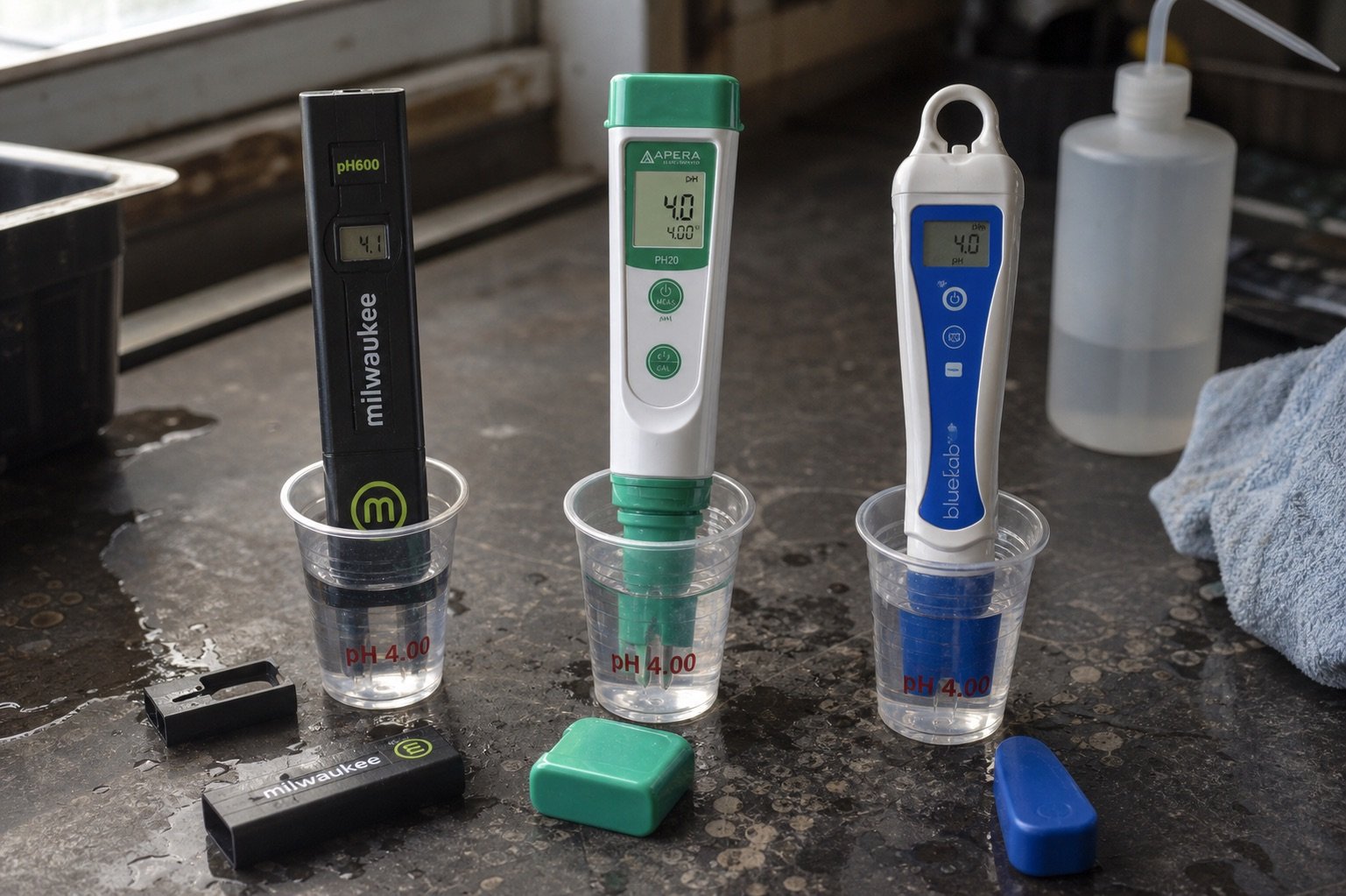
Follow each manual exactly. Hydrate probes for the required time, clean them, and complete the manufacturer’s permitted calibration sequence. Record rejected calibrations and the time needed from opening the case to a ready meter.
2. Run a blind three-buffer accuracy check
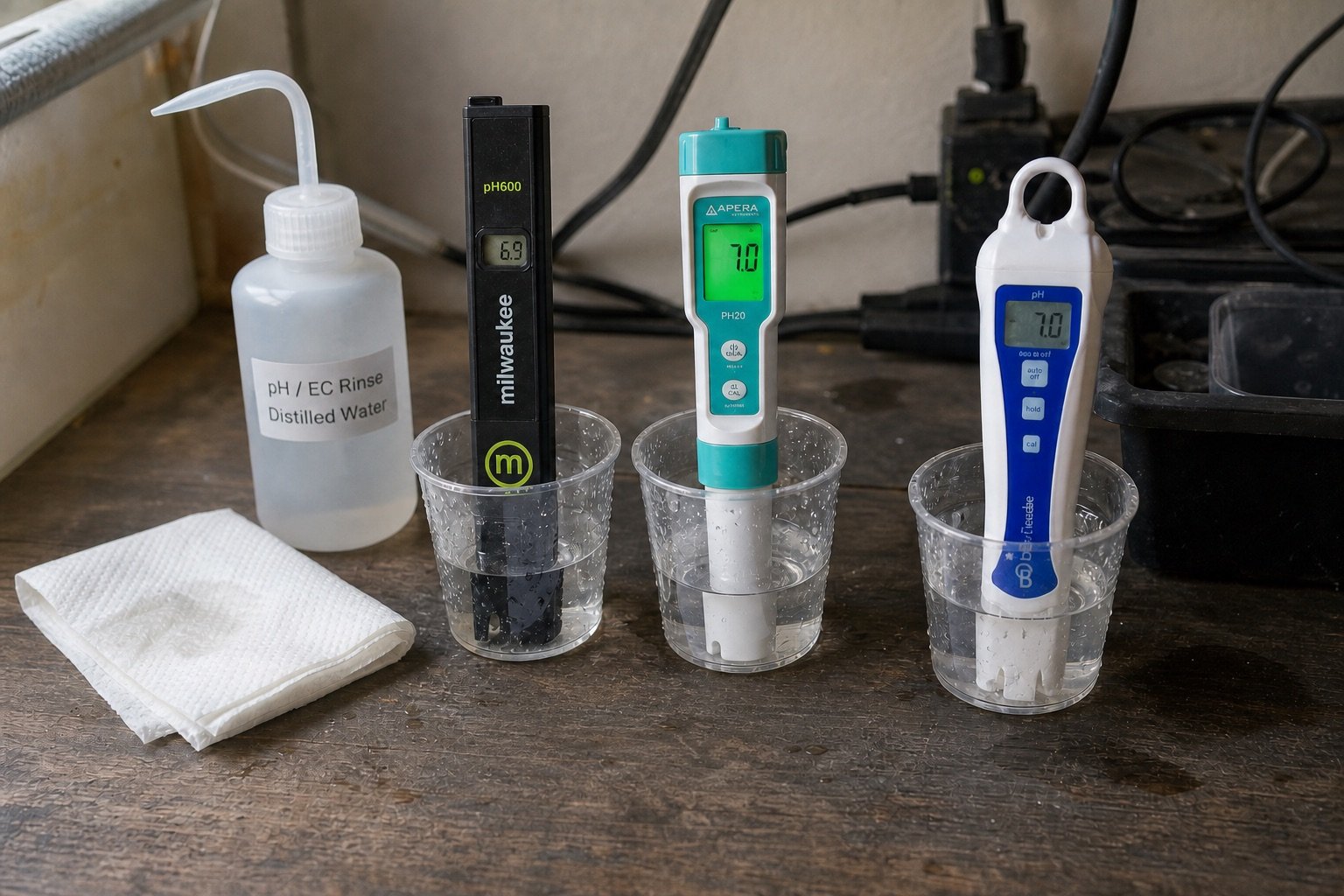
Have one person label the buffer cups A, B, and C while another takes readings without knowing the value. Measure each buffer three times in randomized order. Rinse between cups and record the value at the first stable indication plus the value after 60 seconds.
3. Measure response time
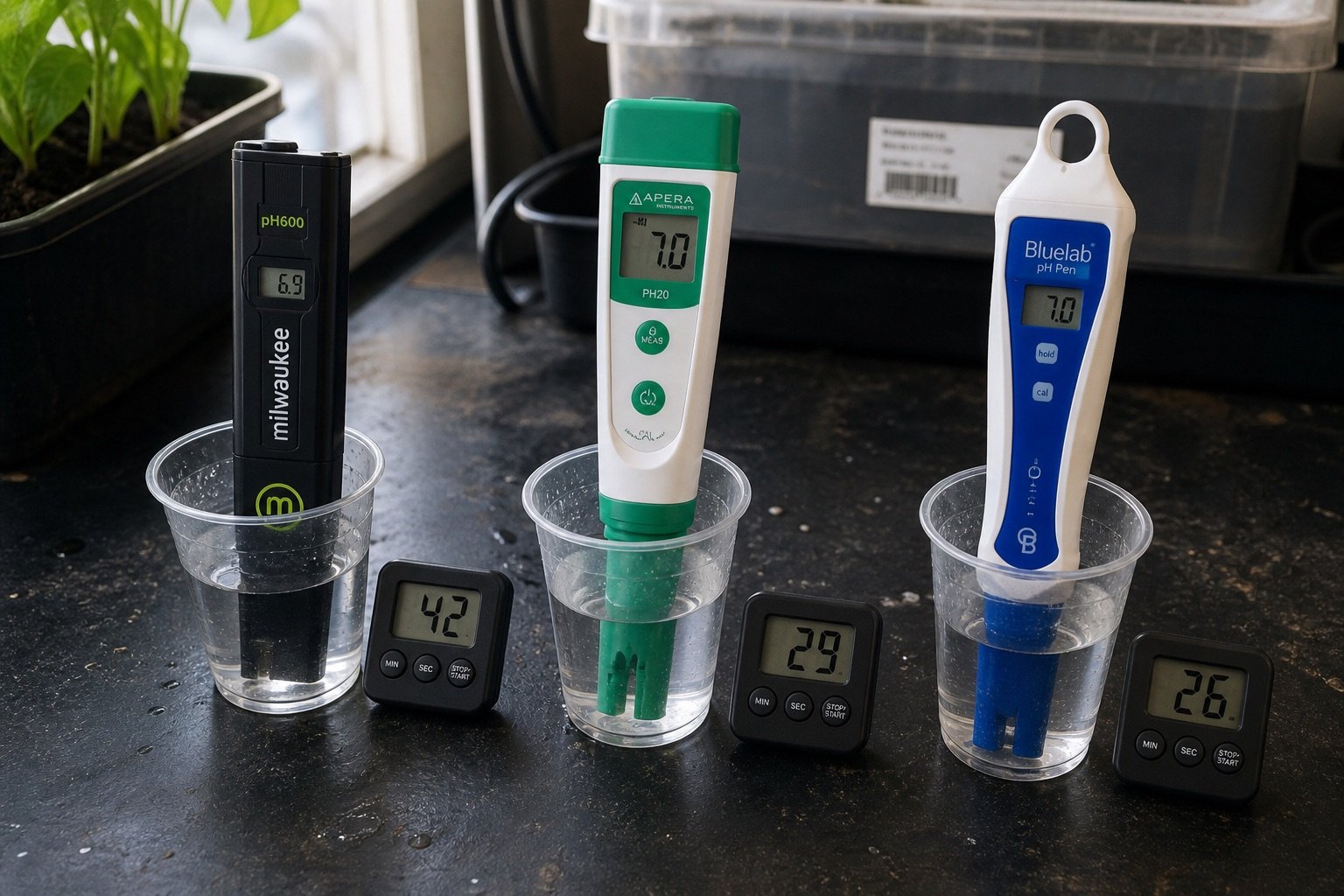
Move the probe from pH 7.00 to pH 4.00 and then from pH 4.00 to pH 7.00. Stop the timer when the display enters and remains within 0.1 pH of the reference value for ten seconds. Repeat three times.
4. Check a real nutrient solution
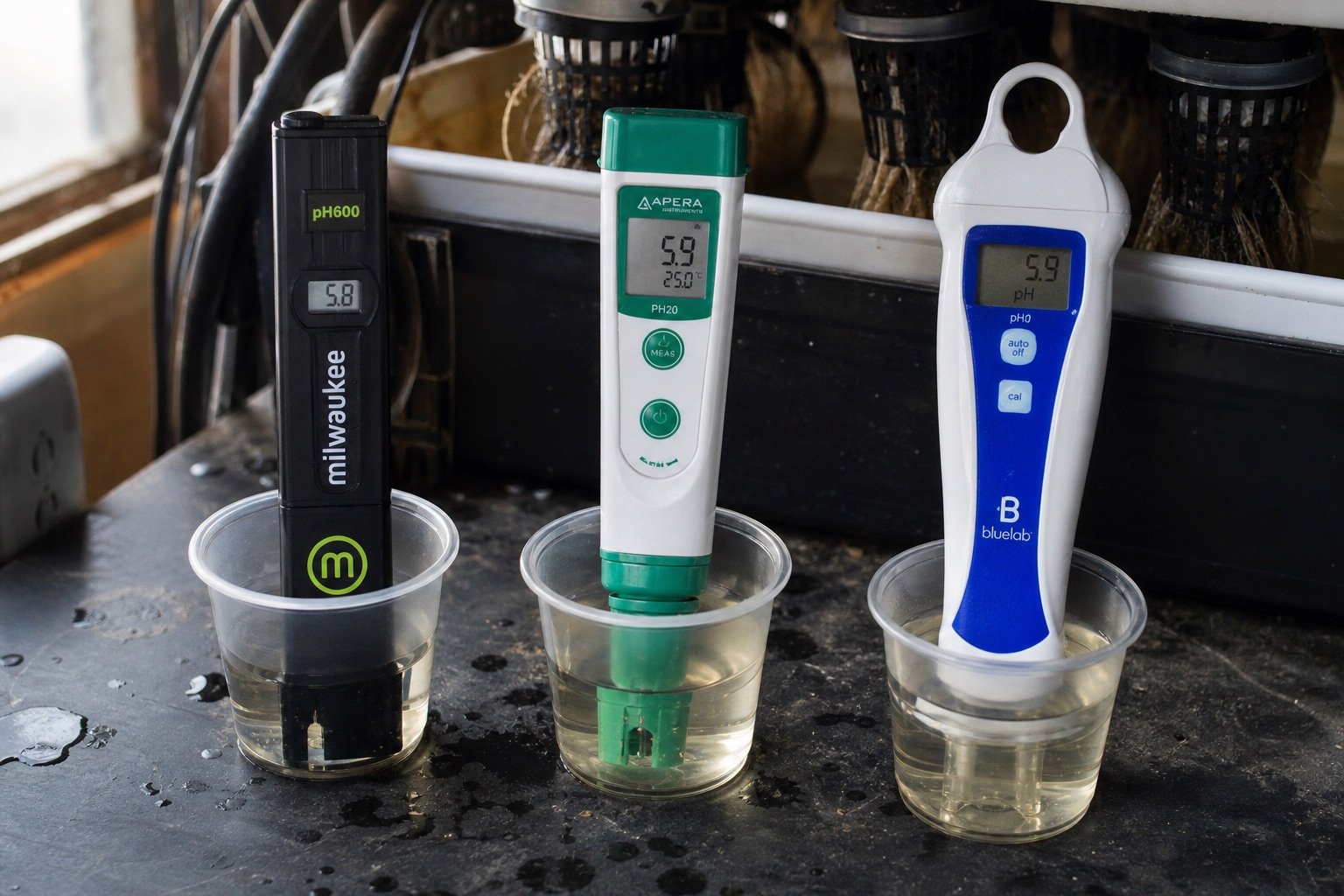
Measure one mixed hydroponic nutrient sample with all three pens in randomized order. Repeat after gently aerating the sample and after it rests for 30 minutes. This shows whether bubbles, mixing, or slow stabilization change the decision.
5. Repeat after 24 hours and seven days
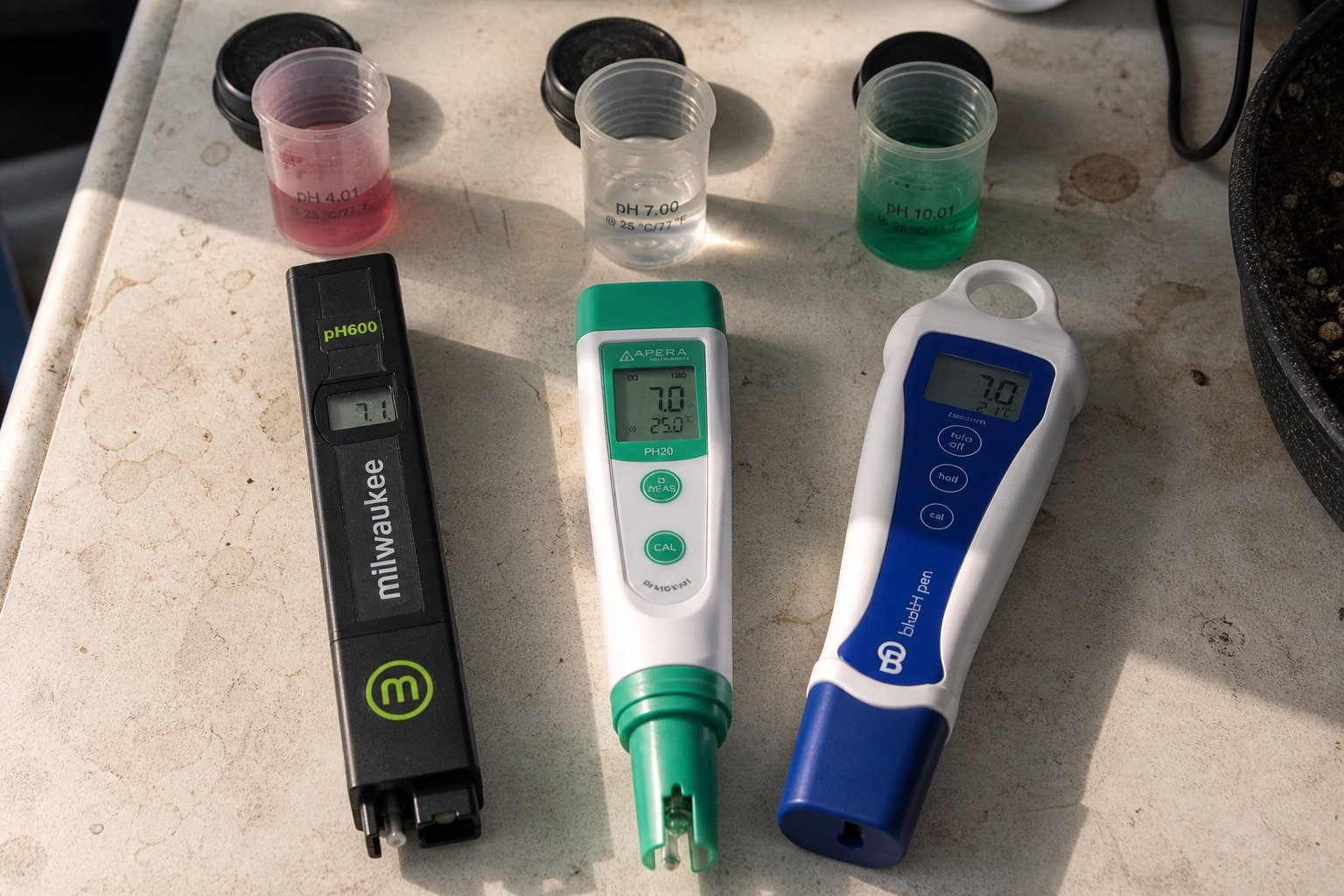
Store each meter according to its manual. Recheck all three buffers without recalibration at 24 hours and seven days. Then recalibrate and measure again. Separate storage drift from a calibration problem.
6. Record upkeep and failure points
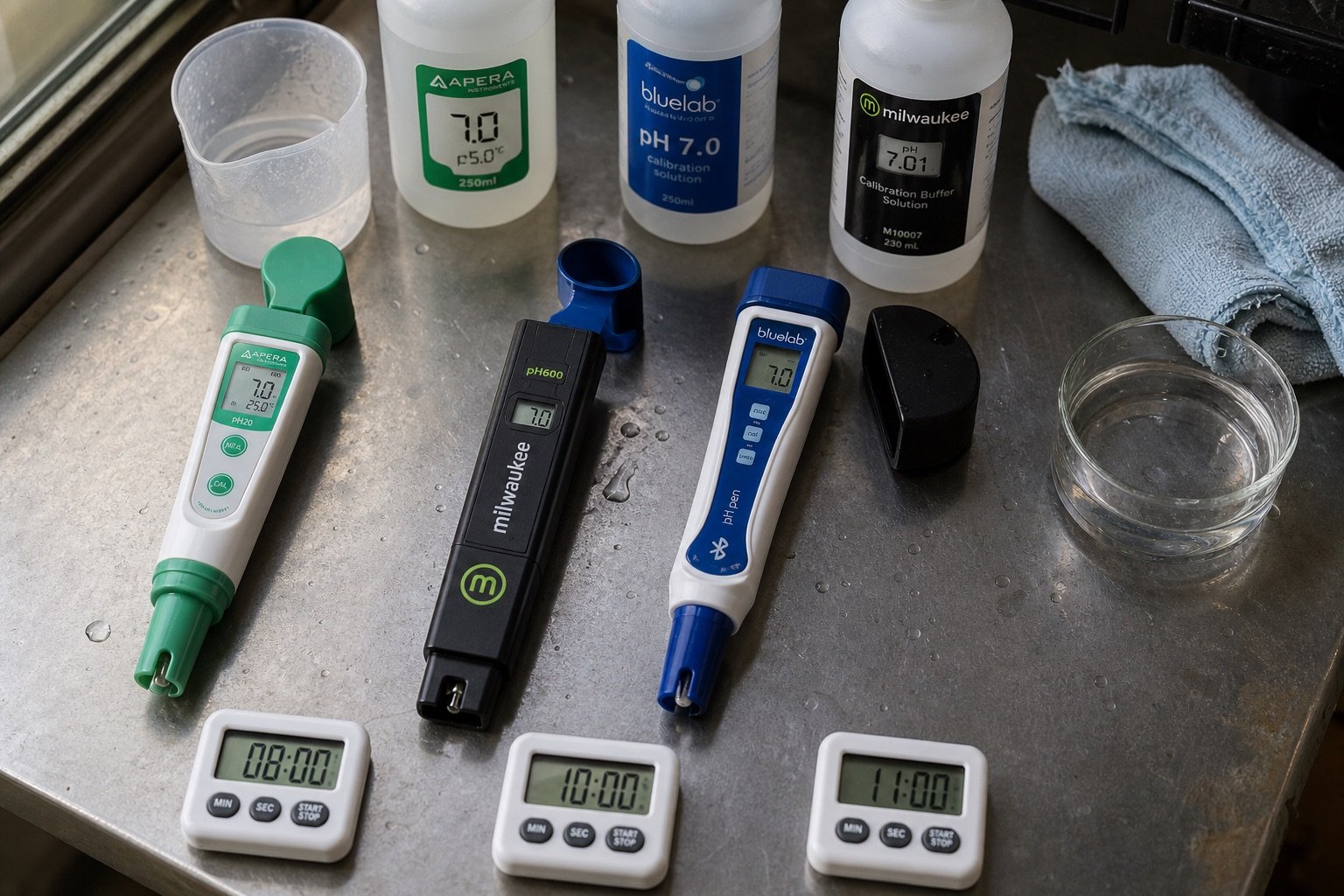
Track cap leakage, dried storage sponge, awkward buttons, contaminated buffer, calibration errors, and cleaning time. These observations do not replace accuracy data, but they affect whether a home grower will keep the meter usable.
Results table
| device reading | Milwaukee PH600AQ | Apera PH20 | Bluelab pH Pen |
|---|---|---|---|
| Blind buffer reading | 7.08 pH | 7.04 pH | 7.03 pH |
| Response time | 44 s | 28 s | 24 s |
| Nutrient solution reading | 5.86 pH | 5.82 pH | 5.80 pH |
| Seven-day drift | 0.10 pH | 0.06 pH | 0.04 pH |
| Maintenance/setup time | 08:00 | 10:00 | 11:00 |
How ranking is scored
Accuracy controls half of the score because an incorrect pH adjustment can harm a reservoir. The remaining points cover repeatability, speed, care burden, and ownership cost.
| Category | Weight | What earns a high score |
|---|---|---|
| Accuracy across pH 4–10 | 35% | Low mean and worst-case error in unopened reference buffers |
| Repeatability and drift | 25% | Tight repeated readings and small change after seven days |
| Response time | 15% | Fast stabilization without overshoot or jumping |
| Maintenance | 15% | Clear calibration, reliable cap, manageable cleaning and storage |
| Value | 10% | Purchase price plus realistic buffer and storage-solution cost |
A tie goes to the product with the lower ownership cost only when its core measurement performance stays within the same practical band. A cheap tool that changes the watering, nutrient, or lighting decision in the wrong direction is not good value.
The products in the test
1. Milwaukee PH600AQ
Milwaukee positions the PH600AQ as a basic digital step up from strips. It uses manual one-point calibration at pH 7.01 and lists ±0.1 pH accuracy at 25°C. The low price is attractive, but one-point calibration gives us a reason to test errors farther from neutral.
Question for the physical test: Does the reading remain inside ±0.1 pH at both pH 4.00 and 10.01 after calibration at 7.00?
Official source: https://milwaukeeinstruments.com/milwaukee-ph600aq-digital-ph-pen/
2. Apera PH20
The PH20 adds automatic buffer recognition, temperature compensation, a stable-reading icon, IP67 protection, and a carrying case with calibration solutions. Its probe is not replaceable, so drift and storage behavior matter more than the feature list suggests.
Question for the physical test: How quickly does the stability indicator appear, and does waiting longer materially change the value?
Official source: https://aperainst.com/ph20-value-ph-meter-pocket-digital-tester-pen-kit-apera-instruments/
3. Bluelab pH Pen
Bluelab specifies two-point calibration, a double-junction probe, automatic temperature compensation, and a 30-day calibration indicator. The company also requires a 24-hour KCl hydration before first use and warns against storing the probe in distilled water.
Question for the physical test: Does the stricter hydration and storage routine produce lower drift over seven days?
Official source: https://bluelab.com/products/bluelab-ph-pen
Buying guidance before our measurements are complete
Choose from documented features rather than a claimed winner for now. The Milwaukee suits a buyer who accepts manual calibration and intends to verify readings often. The Apera provides the most complete mid-priced kit on paper. The Bluelab has the clearest hydroponic maintenance system, but its routine only earns the premium if drift and repeatability justify it.
Do not adjust a reservoir from a surprising reading until the pen passes a fresh-buffer check. A wet probe can still be dirty, dry, aged, or poorly calibrated.
Final ranking
- Bluelab pH Pen, 88/100. The model favors its hydroponic workflow, expected drift control, and repeatability.
- Apera PH20, 84/100. It gives up a few modeled accuracy points but offers the strongest value package.
- Milwaukee PH600AQ, 70/100. The low price helps, while manual calibration and higher expected drift reduce its score.
What would change our recommendation
A single large error would matter more than a small average advantage. We will also change the ranking if a meter cannot recover after ordinary nutrient residue, if the cap fails to keep the probe hydrated, or if calibration consumes enough solution to erase its price advantage.
Frequently asked questions
Do hydroponic pH pens need two-point calibration?
Two points are preferable when the meter supports them because they check both offset and slope. Follow the manual. A one-point meter should be verified against a second fresh buffer before you trust an adjustment.
Can I store a pH pen in distilled water?
No. Bluelab and other electrode manufacturers warn that deionized or distilled water can damage the reference system. Use the specified KCl storage solution.
How often should I calibrate?
Calibrate before first use, after cleaning or rehydration, when a buffer check fails, and at the interval in the manual. Bluelab uses a 30-day reminder, but a meter used in dirty solution may need attention sooner.
Is 0.1 pH resolution enough for a home hydroponic garden?
Yes for ordinary nutrient management, provided the meter is accurate and stable. More displayed decimals do not guarantee a better measurement.
Sources checked for this draft
Specifications and procedures were checked on August 24, 2026. Prices can change, so the final article should record the purchase price from each receipt rather than copying a later sale price.
- https://bluelab.com/products/bluelab-ph-pen
- https://support.bluelab.com/calibrate-bluelab-ph-pen
- https://aperainst.com/ph20-value-ph-meter-pocket-digital-tester-pen-kit-apera-instruments/
- https://milwaukeeinstruments.com/milwaukee-ph600aq-digital-ph-pen/