
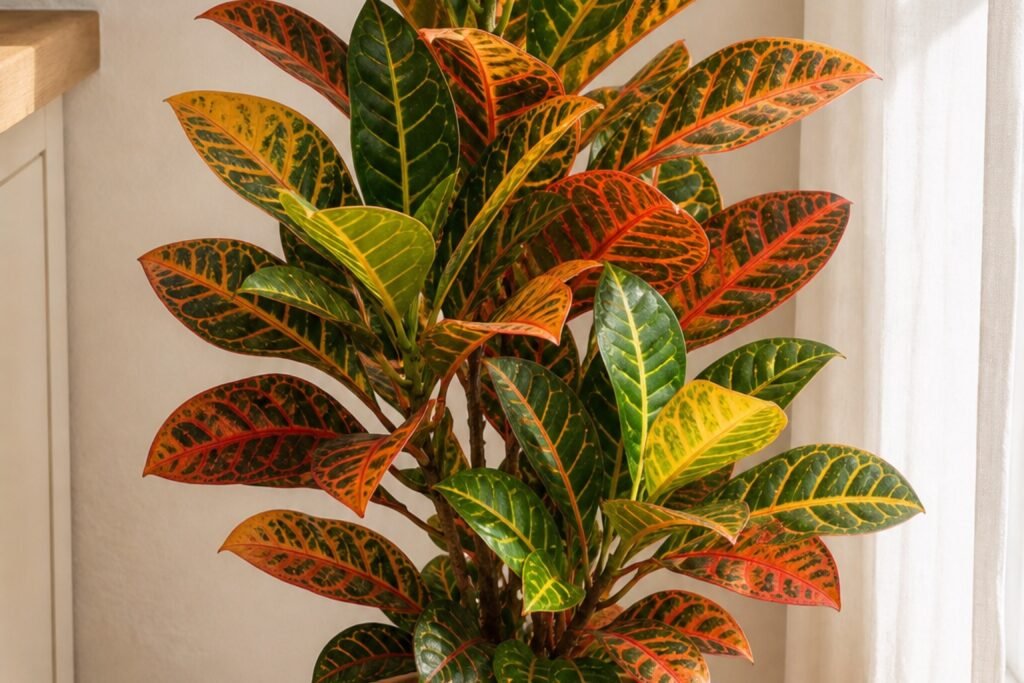
Croton plant care indoors is a test of conditions, not gardening willpower. Codiaeum variegatum keeps its strongest yellow, orange, red, and green patterns in bright light and steady warmth. Put it in a cool dark corner and the plant often answers with greener growth, slow drying, and a sudden floor full of leaves.
Garden croton, fire croton, and Joseph's coat all refer to this species in the spurge family. The last name also belongs to unrelated outdoor plants, so use the botanical label when checking care or safety. Different croton cultivars have broad oak-like leaves, narrow straps, spirals, or rounded blades. Color and shape alone do not define health.
Croton plant care indoors snapshot
| Care point | Practical indoor target |
|---|---|
| Light | Very bright light with some acclimated direct sun |
| Water | Water after the top 1 to 2 inches dry, before the whole pot is dust dry |
| Soil | Humus-rich, airy mix with reliable drainage |
| Humidity | Moderate humidity or better |
| Temperature | Roughly 60 to 85 F, with no cold draft |
| Mature indoor size | Commonly 2 to 6 feet tall |
| Growth rate | Moderate in warmth and strong light |
| Pet safety | Toxic to cats and dogs |
Use enough light to hold the color
Set the plant close to an east, south, or west window. A sheer curtain can soften the hottest rays while keeping the site bright. Acclimate a new croton over a week or two; tender store leaves can bleach when they meet abrupt afternoon sun.
New leaves may emerge green and develop color as they harden. Give one leaf time before assuming the light is wrong. If several mature new leaves remain plain and stems stretch, light is probably too weak. The guide to whether a grow light is needed helps assess a site through winter.
Do not keep moving the pot to chase color. Crotons respond badly when light, temperature, and watering change together. Choose a suitable place, rotate it for even growth, and keep it away from an exterior door or air-conditioning vent.
Water before collapse, but after a real dry check
Feel the upper 1 to 2 inches and lift the pot. Water when that zone is dry and the pot has lost weight, while the center is no longer wet. Soak the root ball slowly, let it drain, and empty the saucer.
A croton can droop when dry, but using wilt as the routine signal pushes the plant through repeated stress. Constant moisture is not the answer. Wet roots in a cool room lose function, which can produce the same droop plus yellow leaves. The physical checks in how often to water indoor plants are safer than treating every limp leaf as thirst.
If the old mix has pulled from the pot wall, water may bypass the roots. Rehydrate slowly or replace failed mix. If the mix stays damp for many days and smells sour, inspect the roots before adding more water.
Keep roots warm and the air reasonably humid
Croton roots dislike cold windowsills. A sunny glass pane can be warm by day and sharply colder at night. Move the pot just far enough from the glass to avoid chilled roots without sacrificing useful light.
Dry air is often blamed for every brown edge. Check root moisture and hot sun first, then look at the room. A nearby humidifier can help, but a shallow pebble tray rarely changes humidity beyond the tray. The houseplant humidity guide explains the difference.
Use a well-drained indoor mix with enough structure to stay open. Repot when roots circle tightly, water runs around the root ball, or the mix has collapsed. One pot size is enough. Feed modestly during active growth; heavy fertilizer adds salts and does not correct weak light.
Prune with gloves and root a stem, not a leaf
Cut a long stem just above a node during active growth. The plant may branch below the cut. Wear gloves because broken leaves and stems release irritating sap.
A warm stem-tip cutting can root in an airy medium. Air layering is useful on a woodier stem. A colorful leaf without a node may remain attractive for a while but cannot become a complete croton.
Croton problem triage
| Symptom | Likely checks | First sensible move |
|---|---|---|
| Sudden leaf drop | Cold, move, drought, wet roots, or weak light | Review recent changes before watering |
| Mature new leaves stay green | Light too weak or cultivar traits | Increase useful light gradually |
| Crisp brown margins | Dry roots, hot glass, or dry air | Compare pot weight and window heat |
| Yellow soft lower leaves | Wet roots or cold mix | Probe the center and confirm drainage |
| Fine pale stippling | Spider mites | Inspect leaf undersides and stem joints |
Spider mites thrive in a warm dry room and can be hard to see against patterned foliage. Look for pale stippling that does not match the cultivar, fine webbing, and moving dots on the underside. The spider mite guide covers confirmation and repeated treatment.
Quarantine a new croton. Scale, mealybugs, and mites can hide along veins and petioles. The new-houseplant quarantine checklist gives a practical separation period and inspection routine.
Keep sap and leaves away from pets
Pet Poison Helpline lists croton as toxic to cats and dogs and describes drooling, vomiting, diarrhea, and skin irritation. NC State also documents irritating sap, contact dermatitis, and digestive symptoms in people. Keep fallen leaves out of reach and contact a veterinarian or animal poison service after suspected ingestion.
Wear gloves for pruning, avoid touching eyes, and wash sap from skin. The safety warning belongs to Codiaeum variegatum. Plants that share the common name Joseph's coat need their own identification.
Frequently asked questions
Why did my croton drop leaves after I brought it home?
The trip changed light, temperature, humidity, and root moisture. Give the plant one warm bright position, check the root ball physically, and avoid another move while it adjusts.
How do I make croton leaves more colorful?
Provide stronger useful light, introduced gradually, and judge mature new leaves. Genetics set the cultivar's pattern, so fertilizer cannot create colors the plant does not carry.
Can I propagate a croton from one leaf?
A leaf may form roots but lacks the stem node needed to make a complete new shoot. Use a stem cutting with at least one viable node or air-layer a branch.