
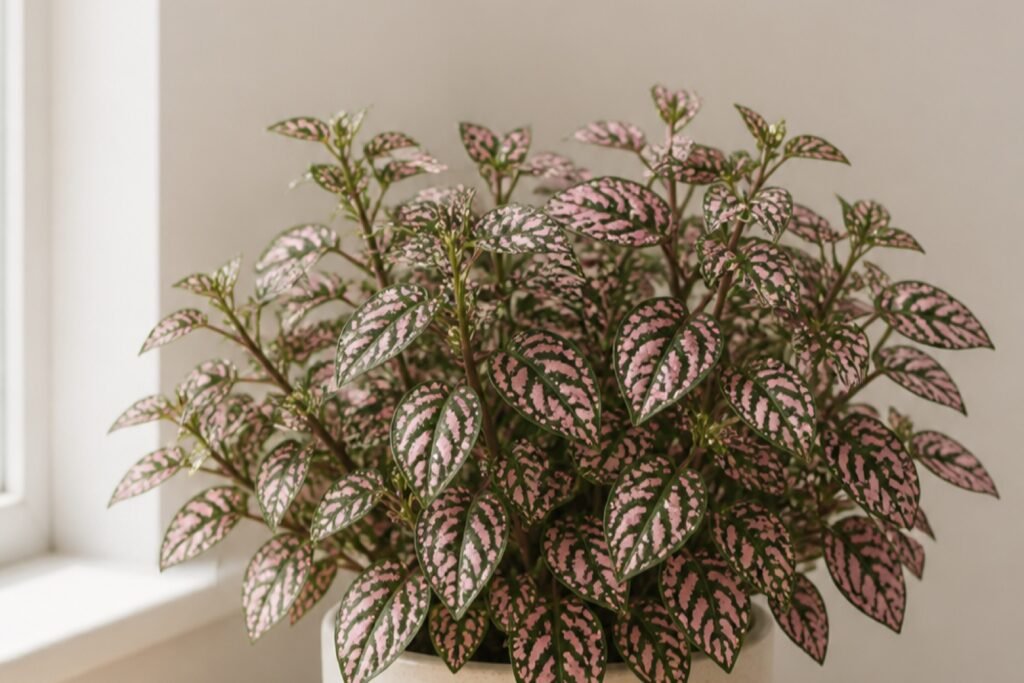
Polka dot plant care is easiest when the plant is allowed to be what it is: a short-lived, fast-growing mound that needs regular pinching. Hypoestes phyllostachya has thin oval leaves splashed with pink, white, or red over green. It is not the tall cane Begonia with silver dots that shops call Polka Dot Begonia.
The color stays strongest with useful filtered light. In a dark room, stems lengthen and new leaves may become greener. In hot direct sun, the thin leaf surface can bleach or crisp.
Polka dot plant care at a glance
| Care point | Practical indoor target |
|---|---|
| Light | Bright indirect light, with gentle morning sun if acclimated |
| Water | Water when the upper inch dries; do not leave the pot saturated |
| Soil | Loose indoor mix that holds some moisture and drains freely |
| Humidity | Average to moderate humidity |
| Temperature | About 60 to 80 F |
| Mature indoor size | Commonly 12 to 24 inches, smaller with pinching |
| Growth rate | Fast during warm active growth |
| Pet safety | ASPCA lists Hypoestes phyllostachya as non-toxic to cats and dogs |
Polka dot plant care needs steady bright light
Place it near an east window or close to a bright north window. A sheer curtain can soften stronger southern or western exposure. Turn the pot every week or two if the stems lean to one side.
Color alone is not a perfect light meter because cultivars differ. Watch spacing between leaf pairs. Wide gaps and thin stems show that the plant is reaching, even when the pink remains vivid. Our guide to why a plant gets leggy explains why cutting without improving light only resets the same problem.
If no window provides enough light, a small measured grow light can work. Keep it far enough away to avoid hot, bleached patches and use a timer. The grow light distance guide offers a better starting point than a fixed number borrowed from another fixture.
Water before a full wilt, not every day
Feel the upper inch of mix and lift the pot. Water when that layer is dry and the container is lighter, then soak the full root ball and drain the saucer. Thin leaves may droop when the plant is dry, but a wet root ball can also produce limp growth. Check first.
A small plant in a large decorative pot is especially easy to overwater. The lower mix can stay damp while the surface looks ready. Use the physical checks in how often to water indoor plants and avoid constant small sips.
Brown tips can follow a missed watering, dry hot air, or fertilizer salts. One damaged leaf will not repair itself. Stabilize the root zone and judge the next leaves.
Pinch early for a compact mound
Remove the tip just above a healthy pair of leaves when a stem begins to race upward. The buds below the cut can branch, giving the plant more growing points. Repeat light pinches across the plant rather than shearing it into a hard geometric shape.
Flower spikes are small and may signal a shift toward seed production. Many indoor growers remove them to keep energy in the foliage and delay decline. The plant may still become sparse with age, so rooting a few tip cuttings is sensible insurance.
Use a short stem cutting with one or two bare nodes. It can root in water or a lightly moist medium. The clean-container steps in propagating houseplants in water reduce the risk of losing a small cutting to cloudy water and soft stems.
Keep the pot proportional to the roots
A general indoor potting mix works when it accepts water evenly and drains. Choose a container only a little wider than the root mass. If the plant dries every day despite a thorough watering, roots may have filled the pot. If it stays wet for a week, the pot or mix may be too heavy.
Repot during active growth when roots circle densely or the old mix has collapsed. The potting soil comparison helps with texture, and the repotting guide explains why one modest size increase is safer than a jump into a floor planter.
Feed lightly while new leaves are expanding. A complete fertilizer used according to its label is enough. Pause after repotting, during severe heat, or when the plant has stopped growing.
Common polka dot plant problems
| Symptom | Likely checks | First sensible move |
|---|---|---|
| Long bare stems | Weak light, missed pinching, or an aging plant | Improve light and pinch above healthy nodes |
| Faded or greener leaves | Cultivar traits or insufficient light | Judge stem spacing and move gradually brighter |
| Crispy leaf edges | Dry root ball, hot air, or salt buildup | Stabilize watering and flush the mix if drainage is good |
| Yellow soft leaves | Wet mix or poor root aeration | Let the surface dry and inspect roots if decline continues |
| White clusters at nodes | Mealybugs | Isolate the plant and inspect every leaf pair |
Fast, leafy growth gives pests many hiding points. If white cottony material returns after wiping, repeat treatment and inspect every nearby leaf joint. Discard badly infested propagation stock rather than spreading it into several new pots.
Pet and household safety
The ASPCA record identifies Hypoestes phyllostachya and lists it as non-toxic to cats and dogs. It should still be treated as an ornamental, not pet forage. Chewed leaves can cause a mild digestive upset simply because plant material is fibrous. Place the pot where repeated grazing is unlikely and call a veterinarian if symptoms develop. The pet-safe indoor plant guide explains why the exact botanical name matters here, especially with Polka Dot Begonia nearby in search results.
Frequently asked questions
Why is my polka dot plant so leggy?
It probably needs brighter filtered light, more regular pinching, or both. Improve the light first, then cut long stems just above healthy leaf pairs.
Should I remove polka dot plant flowers?
You can. The small blooms are not harmful, but removing spikes may keep the plant focused on foliage for a while. Keep tip cuttings because older plants often decline after flowering.
Can a polka dot plant grow in a terrarium?
Yes, compact cultivars suit roomy terrariums. Avoid saturated soil and trapped condensation, provide airflow, and pinch before stems press against the glass.