
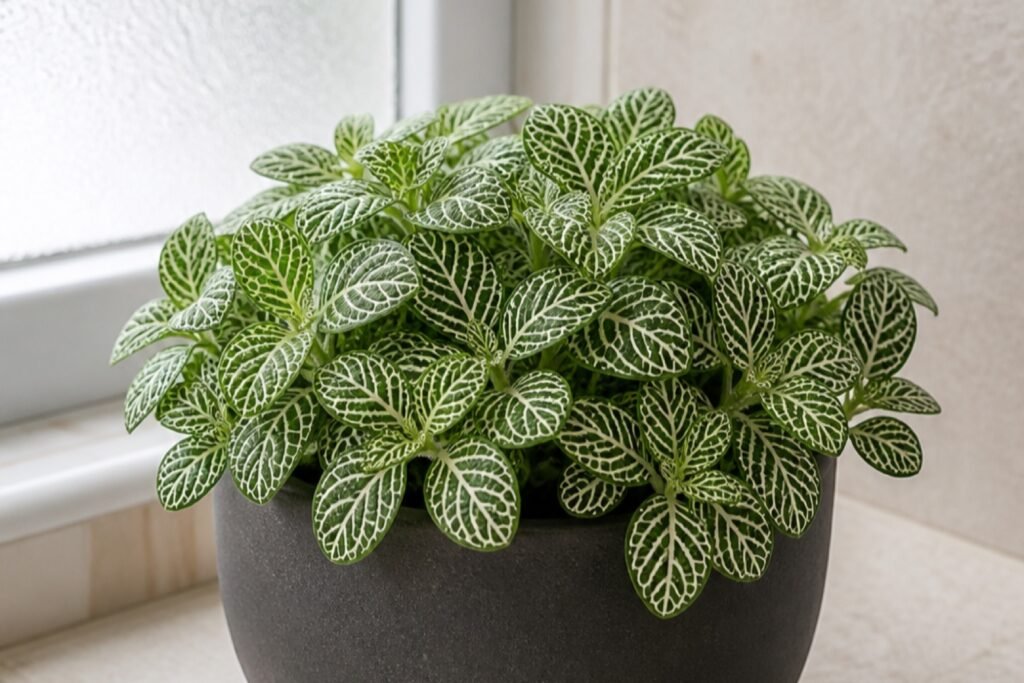
Nerve plant care is less mysterious than the dramatic wilt suggests. Fittonia albivenis is a small tropical groundcover with a fine network of white, pink, or red veins. Its thin leaves lose water quickly, so a dry root ball can flatten the whole plant in a few hours. That performance is useful information, but repeated collapses still damage roots and leaf edges.
The older botanical name Fittonia verschaffeltii remains common in shops and in the ASPCA database. It is a synonym, not a separate care category.
Nerve plant care at a glance
| Care point | Practical indoor target |
|---|---|
| Light | Medium to bright indirect light |
| Water | Water when the surface just begins to dry; keep the root ball lightly moist, never saturated |
| Soil | Fine but airy indoor mix in a small pot with drainage |
| Humidity | High humidity with gentle air movement |
| Temperature | About 65 to 80 F |
| Mature indoor size | Usually 4 to 8 inches tall and 12 to 18 inches wide |
| Growth rate | Moderate to fast when warm and evenly moist |
| Pet safety | ASPCA lists nerve plant as non-toxic to cats and dogs |
Nerve plant care depends on an even root zone
Check this plant sooner than a succulent or dracaena. Press the surface and lift the pot. Water when the top has just begun to dry and the container feels a little lighter, then let the excess leave through the drainage hole. Do not keep the saucer full.
The aim is a damp gradient inside the root ball, not permanent saturation. A small plant in a huge pot can sit wet at the center long after the surface looks dry. A tiny pot in hot window light can dry before evening. The physical checks in how often to water indoor plants adapt to both situations.
If the plant wilts on dry soil, water it thoroughly and give it time. If it wilts while the soil is wet, inspect the roots instead of adding more. Soft dark roots and a sour smell point to lost root function.
Choose filtered light and protect the leaf color
Medium indirect light maintains compact growth. Bright filtered light can strengthen red and pink vein color, but direct hot sun may bleach or crisp the thin leaves. An east window behind a sheer curtain or a bright north window often suits it.
Long stems with wide gaps between leaves mean the plant is reaching. Move it gradually closer to useful daylight and pinch the tips once healthy growth resumes. A fittonia on a dark shelf may stay green for a while but slowly open into a loose mat. The grow light guide can help if the room has no workable window position.
Raise humidity without sealing in disease
Dry moving air from a heater can brown leaf edges even when the soil is reasonable. Grouping plants or using a room humidifier can reduce sharp swings. Our guide to increasing humidity for houseplants explains why pebble trays and occasional misting rarely change the room enough.
A closed terrarium can suit a compact fittonia, but trapped condensation and saturated soil are not the same as healthy humidity. Open the lid when glass stays wet all day, remove decaying leaves, and keep the crown above the mix. Air exchange matters.
Keep the pot small and pinch for a fuller mat
Use a shallow container only a little wider than the roots. A fine indoor mix should hold moisture without turning to mud. If a squeezed handful remains a dense lump, the mix needs more air space. The potting soil comparison gives practical texture checks.
Repot when roots circle tightly, the plant dries much faster than before, or the mix has collapsed. Avoid tearing the root ball into tiny pieces during an ordinary repot. A stressed fittonia loses moisture rapidly through its leaves.
Pinch a stem just above a node when it becomes long. Several modest pinches create a fuller plant more reliably than cutting the entire mat at once. Healthy stem tips root in water or a lightly moist medium. For water rooting, use a short section with lower leaves removed and follow the hygiene steps in propagating houseplants in water.
Feed lightly while new leaves are opening. A small root zone does not need frequent strong fertilizer, and salts can collect quickly. Flush the mix with plain water occasionally if the drainage is sound.
Common nerve plant problems
| Symptom | Likely checks | First sensible move |
|---|---|---|
| Whole plant collapses | Dry root ball or damaged roots in wet soil | Check moisture and root condition before watering |
| Brown crisp edges | Dry air, missed watering, or salt buildup | Stabilize moisture and move away from hot airflow |
| Long sparse stems | Light that is too weak or missed pinching | Improve light, then pinch above healthy nodes |
| Yellow soft leaves | Saturated mix or poor air around the crown | Let the surface breathe and inspect the roots |
| Fine stippling or webbing | Spider mites | Isolate and inspect leaf undersides with magnification |
Because the leaves are small, mite damage can spread before webbing is obvious. The spider mite guide covers repeat treatments and nearby-plant checks. Remove dead leaves from the soil surface so they do not mask new problems.
Pet and household safety
The ASPCA nerve plant record uses the synonym Fittonia verschaffeltii and lists it as non-toxic to cats and dogs. Non-toxic does not mean edible. A pet can still vomit after chewing a large amount of fibrous plant material. Keep the pot where it will not be knocked down, and contact a veterinarian if symptoms develop. Our pet-safe plant guide explains how to verify both the name and the exposure.
Frequently asked questions
Why does my nerve plant keep fainting?
Its thin leaves lose water quickly, usually because the small root ball dried. Repeated wilting means the moisture swings are too wide. Check the pot sooner or move it away from hot airflow.
Can a nerve plant live in a terrarium?
Yes, its small size and humidity preference fit many terrariums. Use drainage, avoid waterlogged soil, and provide enough air exchange that condensation does not cover the glass all day.
How do I make a nerve plant bushier?
Give it medium filtered light and pinch growing tips just above nodes. Root the removed tips if you want to fill empty parts of the same pot.