
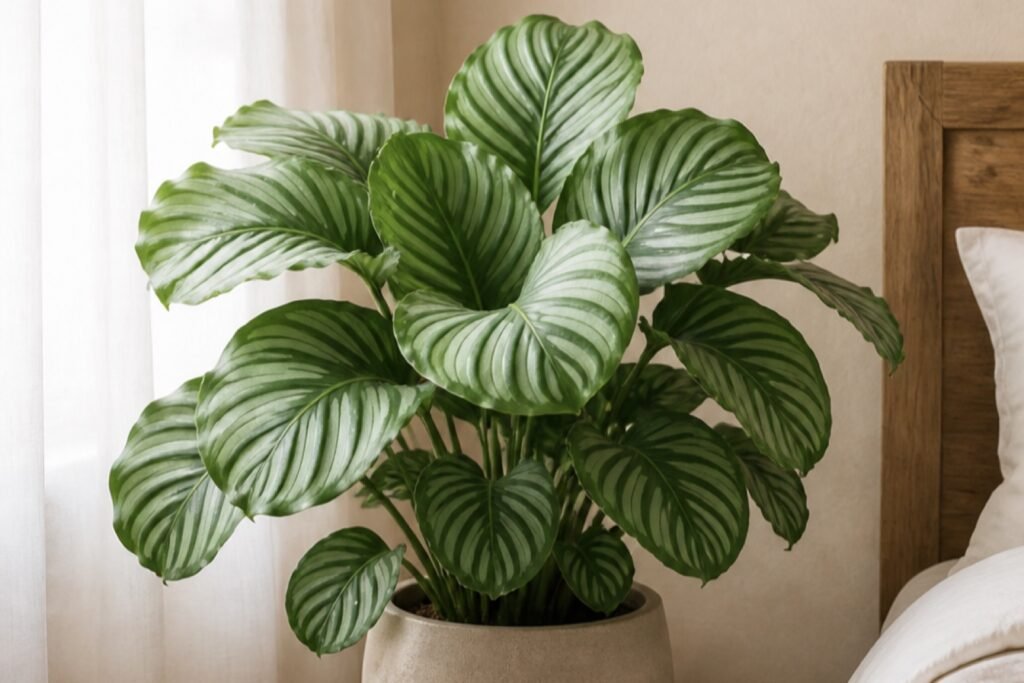
Calathea orbifolia care begins with the name on the label. Botanists now accept Goeppertia orbifolia, while stores and most growers still use Calathea orbifolia. The plant is easy to recognize: broad rounded leaves carry wide silver-green bands from the midrib toward the margin. Those large leaves also show every dry spell, hot draft, and salt buildup.
This is a moisture-sensitive tropical plant, not a plant that wants permanently wet soil. The roots need a lightly moist mix with air still moving through it.
Calathea orbifolia care at a glance
| Care point | Practical indoor target |
|---|---|
| Light | Medium to bright indirect light, with no harsh midday sun |
| Water | Water when the upper inch starts to dry; keep the root ball lightly moist |
| Soil | Airy moisture-holding indoor mix in a draining pot |
| Humidity | High, stable humidity with gentle air movement |
| Temperature | About 65 to 80 F |
| Mature indoor size | Roughly 2 to 3 feet tall and wide |
| Growth rate | Moderate in warm, stable conditions |
| Pet safety | ASPCA lists Calathea species as non-toxic to cats and dogs |
Calathea orbifolia care starts with stable light
An east window behind a sheer curtain or a bright north-facing position usually provides enough light without hot sun on the leaf surface. Strong direct exposure can bleach the silver bands and create crisp tan patches. A dark corner may produce small leaves on long petioles.
Do not keep moving the plant to chase a perfect spot. Pick a stable location away from heating vents, exterior doors, and cold glass. If the petioles lean, rotate the pot gently rather than changing rooms. The grow light guide can help if the available window light is weak for much of the year.
Leaves rise and lower over the day, so a changed angle is not always wilt. Look for loss of firmness, curled edges, and root-zone moisture before reacting.
Keep moisture even without drowning the roots
Press into the upper inch and lift the pot. Water when the surface has started to dry and the container is slightly lighter. Soak the root ball, let excess run out, and empty the saucer. Do not leave a cachepot holding water around the nursery pot.
If the leaf edges curl while the soil is dry, the plant may need water. If they curl on wet soil, inspect temperature, roots, and air movement. The cue-based approach in how often to water indoor plants is safer than a weekly reminder.
Brown tips often get blamed on tap water alone. Mineral salts can contribute, but dry air, uneven watering, fertilizer residue, and damaged roots create similar marks. Filtered or rainwater is worth testing when the routine is otherwise sound. Change one factor, then judge new leaves.
Pair humidity with air movement
Calathea orbifolia responds well to a room humidifier, especially during heating season. Aim for a steady improvement rather than a damp pocket around the leaves. Misting briefly wets the surface but does not hold room humidity for long. The options in how to increase humidity for houseplants explain what changes the air in a measurable way.
Crowding the plant against a wall can slow drying on the back of the leaves. Leave space around the canopy and wipe dust with a soft damp cloth. Support each broad leaf because the petiole can crease. Skip leaf shine.
Repot only when the root zone asks for it
Use a pot with a drainage hole, only a little wider than the roots. A mix should retain some moisture but break apart easily. Heavy soil stays waterlogged at the center; an extremely coarse mix may dry too fast for the thin roots. The potting soil comparison helps find that middle ground.
Repot when roots circle densely, drainage becomes uneven, or the old mix has collapsed. Keep the crown at the same depth and avoid stripping every particle from healthy roots. Follow the measured size increase in the repotting guide.
Feed lightly during active growth, using a complete fertilizer as its label directs. Pause after repotting and flush the mix if salts collect. More fertilizer will not fix a small leaf caused by weak light.
Propagation is by division. Separate a natural clump with several leaves and a healthy share of roots. Tiny single-growth divisions dry quickly and recover slowly, so leave a useful root mass attached.
Common Calathea orbifolia problems
| Symptom | Likely checks | First sensible move |
|---|---|---|
| Brown leaf tips | Dry air, uneven moisture, salt buildup, or root stress | Stabilize humidity and watering, then judge new growth |
| Rolled or curling leaves | Dry root ball, heat, cold, or damaged roots | Check soil and temperature before adding water |
| Pale scorched patches | Direct sun through glass | Move back from the window and acclimate gradually |
| Yellow soft leaves | Saturated mix or poor drainage | Let the surface breathe and inspect the roots |
| Fine stippling and webbing | Spider mites | Isolate and inspect leaf undersides with magnification |
The broad leaves make mite stippling easy to see if they are checked in side light. Confirm the pest before treating; brown edges alone do not prove mites. Our spider mite guide covers repeat treatment and nearby-plant checks.
Pet and household safety
The ASPCA page covers Calathea at genus level and uses the older genus rather than the accepted Goeppertia name. It lists Calathea as non-toxic to cats and dogs. This is not an edible-plant rating, and chewing can still cause digestive upset. Keep loose leaves out of reach and contact a veterinarian if an animal becomes unwell. The pet-safe indoor plant guide explains how synonym changes affect safety searches.
Frequently asked questions
Why are my Calathea orbifolia leaves curling?
Dry soil is common, but heat, cold, saturated roots, and very dry air can look similar. Feel the mix and check the plant's position before watering again.
Should I cut off brown Calathea leaves?
Remove a fully brown leaf at the base with clean shears. A leaf with one dry edge still feeds the plant. Trim only the dead margin if its appearance bothers you.
Can Calathea orbifolia grow in low light?
It may survive in a dim room, but new leaves become smaller and growth slows. Medium filtered light gives a better balance of size and color.