
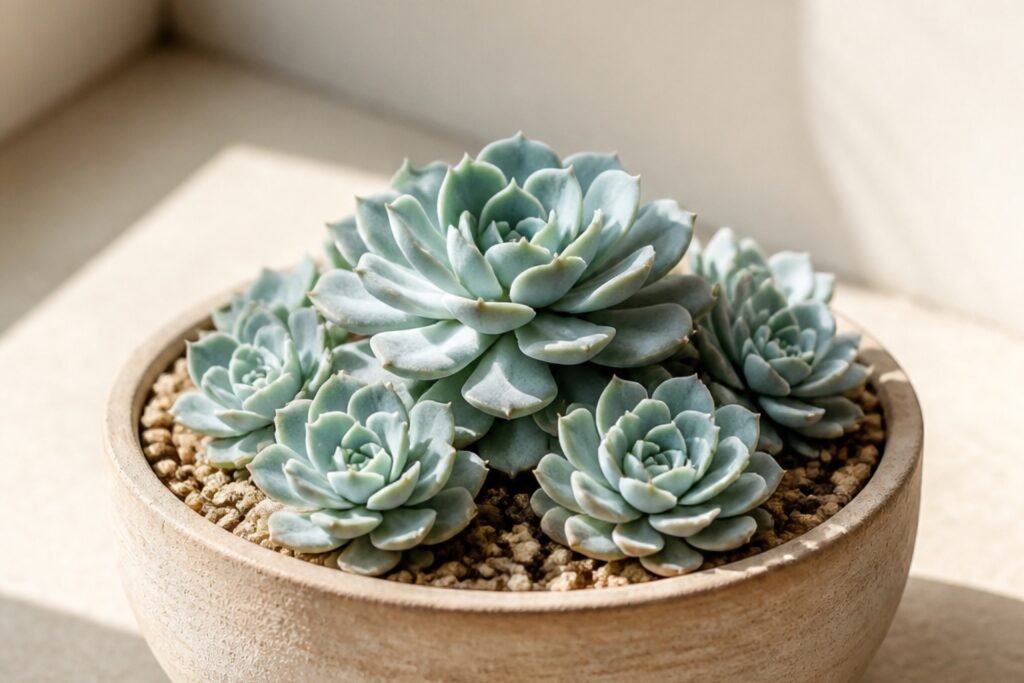
Echeveria elegans care indoors comes down to two things that many rooms cannot provide by accident: very strong light and a root zone that dries fully. Mexican snowball forms pale blue-green rosettes coated with powdery farina. That coating is normal, protective tissue, not dust to polish away.
The species is also sold as Mexican gem or Mexican hens and chicks. The last name causes confusion with Sempervivum, a different succulent group. Keep the botanical label. Echeveria elegans makes offsets around a main rosette and stays low rather than producing a leafy houseplant stem.
Echeveria elegans care indoors at a glance
| Care point | Practical indoor target |
|---|---|
| Light | Several hours of direct sun after gradual acclimation |
| Water | Dry the mix completely, then soak and drain |
| Soil | Coarse mineral-rich succulent mix |
| Humidity | Average to dry household air |
| Temperature | Roughly 55 to 80 F indoors |
| Indoor size | Rosettes about 4 to 8 inches wide, plus offsets |
| Growth rate | Slow to moderate in strong light |
| Pet safety | ASPCA lists the species as non-toxic to cats and dogs |
Find the brightest practical position
An unobstructed south or west window is often the best indoor position. East light can work if it is strong and the plant sits close to the glass. Introduce direct sun over a week or two, especially after purchase or winter. A sudden move from a store shelf to intense midday sun can scar the leaves.
The rosette tells you when light is weak. It opens flat, the center stretches upward, and new leaves sit farther apart. That lost compact shape cannot be squeezed back together, though stronger light can improve future growth. Rotate the pot so the stem does not lean sharply.
A grow light may be necessary in cloudy climates or deep rooms. Use the guide to how far a grow light should be from plants to adjust intensity without guessing from fixture brightness.
Let the entire pot dry
Water only when the mix is dry through the container and the pot feels very light. Soak evenly until water exits the drainage hole, then empty the saucer. Keep water out of the rosette when possible, particularly in a cool room with weak airflow.
Do not mist the leaves. Misting does not solve dry roots and can spot the farina. Healthy lower leaves gradually soften and dry as the plant reuses them. Several translucent or mushy leaves at once, especially over damp soil, point toward excess moisture.
Intervals vary widely with sun, pot size, temperature, and root density. The observations in how often to water indoor plants are more reliable than a succulent schedule printed on a tag.
Keep the crown high in a small pot
Use a coarse succulent mix with plenty of mineral structure and a pot with a drainage hole. The rosette should sit above the soil line. Leaves resting on damp mix are more likely to rot. A shallow terracotta pot can make moisture easier to judge, but it still needs the right size.
Move up only one small size when roots or offsets fill the container, or when old mix no longer drains properly. Hold the plant by the base instead of rubbing the leaves. The succulent soil guide explains why coarse particles need to be distributed through the mix rather than placed as a gravel layer at the bottom.
Feed lightly during active spring and summer growth with a diluted succulent fertilizer used as its label directs. A pale stretched plant needs better light, not more fertilizer.
Protect the farina and manage offsets
Farina gives the leaves their matte blue cast and helps shield them from intense light. Fingerprints stay visible because the coating does not quickly regrow on an old leaf. Handle the pot, not the rosette, and skip leaf-shine products.
Offsets can be separated once each has a small root system. Lift the cluster during repotting, cut the connecting stem with a clean blade if needed, and allow damaged tissue to dry before placing the offset in a small airy mix. A healthy leaf may also form a new plant, but the leaf must detach cleanly with its base intact.
The broader houseplant repotting guide covers root inspection. For this species, wait several days before watering after a major root disturbance so small breaks can dry.
Common Echeveria problems
| Symptom | Likely checks | First sensible move |
|---|---|---|
| Open, stretched rosette | Insufficient light | Increase direct light gradually |
| Translucent soft leaves | Wet mix or crown rot | Stop watering and inspect the stem and roots |
| Dry lower leaves | Normal aging or prolonged drought | Check whether the rest of the rosette remains firm |
| Brown bleached patches | Sun introduced too quickly | Move out of peak sun and acclimate slowly |
| White cottony material | Mealybugs in leaf joints or roots | Isolate and inspect the crown and root ball |
Mealybugs are easy to miss between tightly packed leaves. Root mealybugs can resemble white residue along the pot edge. Follow the repeated checks in the mealybug guide and avoid flooding the crown with untested mixtures.
If the base turns black and soft, remove healthy offsets and sound upper tissue before decay travels farther. The overwatered plant rescue guide helps separate reversible stress from collapsed roots.
Pet safety and identification
ASPCA lists Echeveria elegans as non-toxic to cats and dogs under the name hens and chickens. Any plant material can still cause stomach upset if enough is eaten. Protect the rosette from chewing, and confirm the botanical name because other plants share the hens-and-chicks label.
The pet-safe indoor plant guide explains how to use scientific names when a common name points to several unrelated plants.
Frequently asked questions
Why is my Echeveria elegans growing tall?
The rosette is probably stretching for light. Move it closer to a brighter window or adjust a grow light gradually. Existing stretched growth will remain, but new leaves can form more compactly.
Should I wipe the white powder off Mexican snowball leaves?
No. The powdery farina is a natural wax coating. It protects the leaf surface and does not readily return where fingers or cloth remove it.
How do I know when to water Echeveria elegans?
Wait until the mix is dry all the way through and the pot feels very light. Then soak the root ball and let every bit of excess water drain.