Best Soil Moisture Meters for Houseplants: 3 Types Compared
A soil moisture meter does not measure plant thirst directly. Probe material, potting mix, salinity, insertion depth, and contact with air pockets can all change the reading. We chose three products that work in different ways: the XLUX analog probe, Sustee watering indicator, and Ecowitt WH51 wireless sensor.
The physical test will compare each signal with gravimetric water loss in peat-based mix, coir mix, and chunky aroid mix. We will also check insertion repeatability and whether the device leads a grower to water too early or too late.
Affiliate disclosure: Fern & Shelf may earn a commission from qualifying purchases after retailer links are added. Product inclusion does not determine the test score.
The provisional shortlist
XLUX gives an instant 1–10 dial reading. Sustee stays in the pot and changes from blue to white. Ecowitt logs a 0–100% signal but requires a compatible gateway or console.
| Product | Documented specification | Likely buyer fit before testing |
|---|---|---|
| XLUX single-probe meter | Battery-free analog dial; 1–10 moisture scale; 7.6-inch single probe | Occasional spot checks across several pots |
| Sustee watering checker | Permanent color indicator; white to blue after watering; S, M, and L sizes; replaceable core | One visible watering cue left in a frequently checked pot |
| Ecowitt WH51 | 0–100% displayed range; 1% resolution; about 70-second updates; user low/high calibration; gateway required | Logged monitoring of one or more stable pots or growing beds |
These are manufacturer claims and documented features. The values and ranking below are model-based forecasts, not Fern & Shelf measurements.
What we are testing
We will compare device signals with pot mass and oven-dry subsamples, then test repeatability, mix sensitivity, response after watering, and practical root disturbance.
- Nine identical nursery pots with drainage, three per potting mix
- Peat-based indoor mix, buffered coir mix, and chunky bark-rich aroid mix
- Digital scale with at least 1 g resolution
- Drying oven or food dehydrator reserved for non-food samples, plus heat-safe tins
- Graduated cylinder, labels, ruler, and data logger
- Three healthy cloned pothos plants per mix if the plant phase is included
Run an initial media-only phase before using planted pots. Roots and plant water use add useful realism later, but they make it harder to establish the sensor response curve.
Physical test protocol
1. Create dry and saturated reference masses
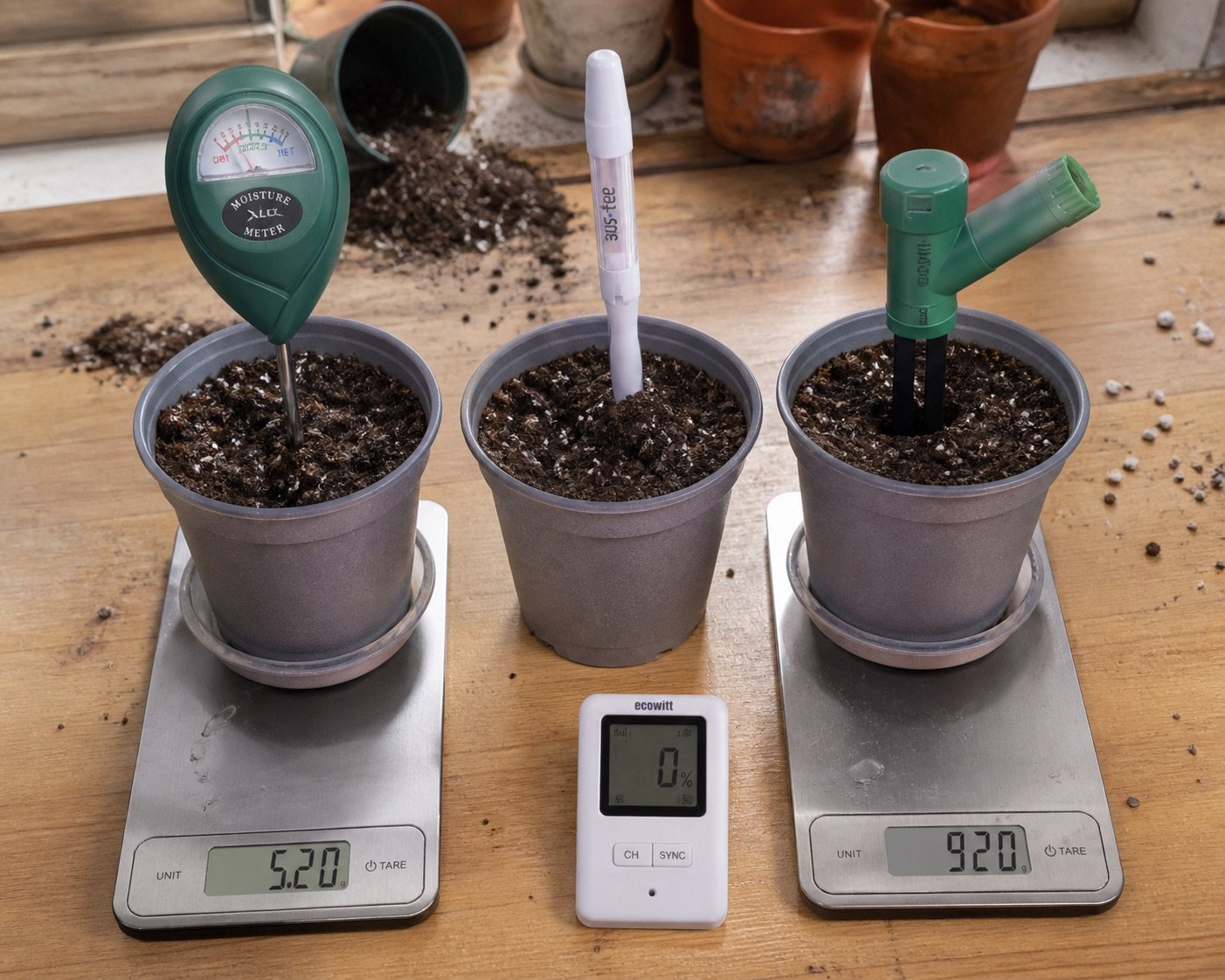
Weigh each empty pot and dry medium. Saturate slowly until drainage begins, allow 30 minutes to drain, and record container capacity mass. Use these endpoints to express later water loss consistently.
2. Install products at fixed positions
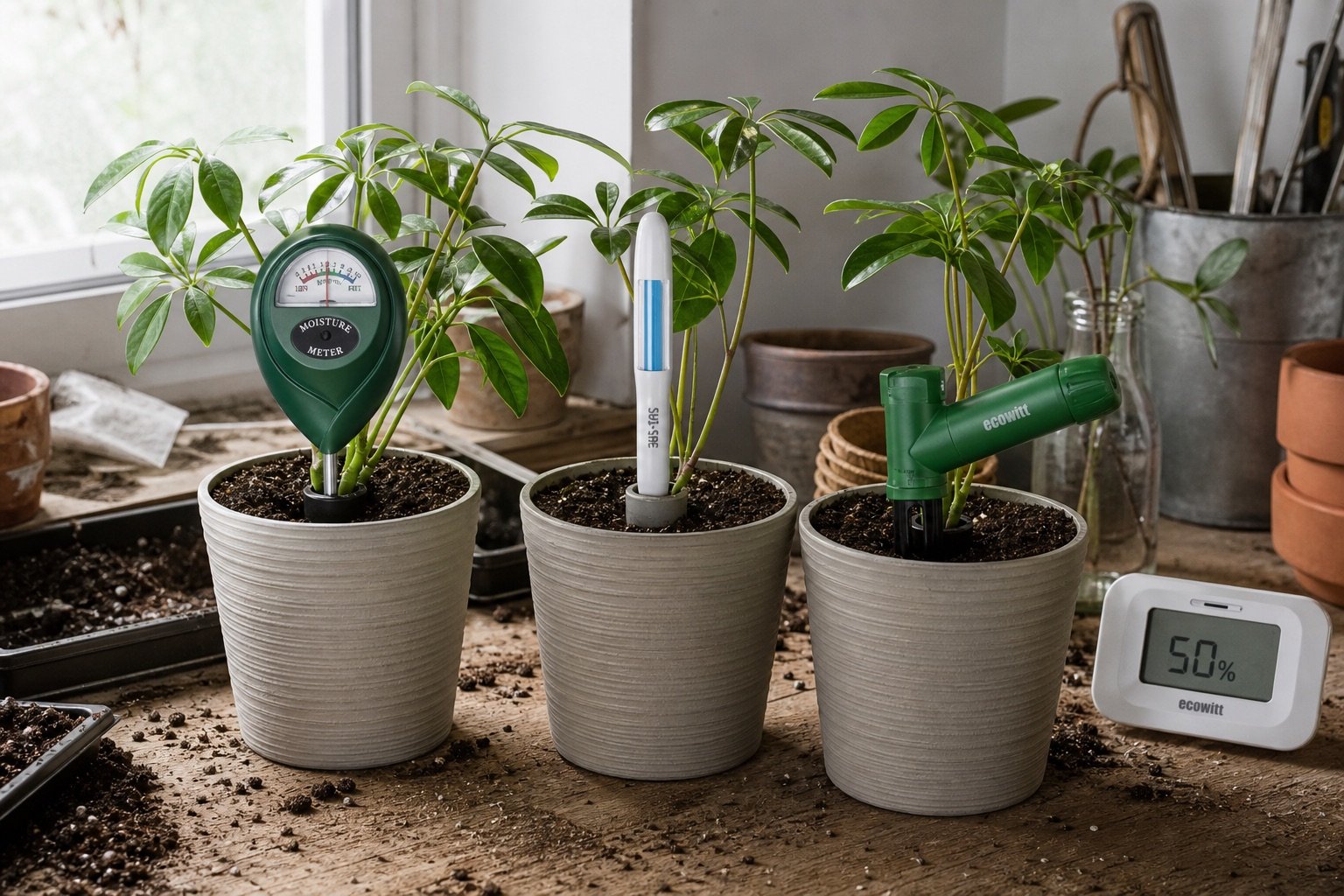
Mark insertion depth and distance from the pot wall. Install Sustee and WH51 according to their manuals. Use a guide for the removable XLUX probe so each reading enters at the same angle and depth.
3. Record the dry-down curve
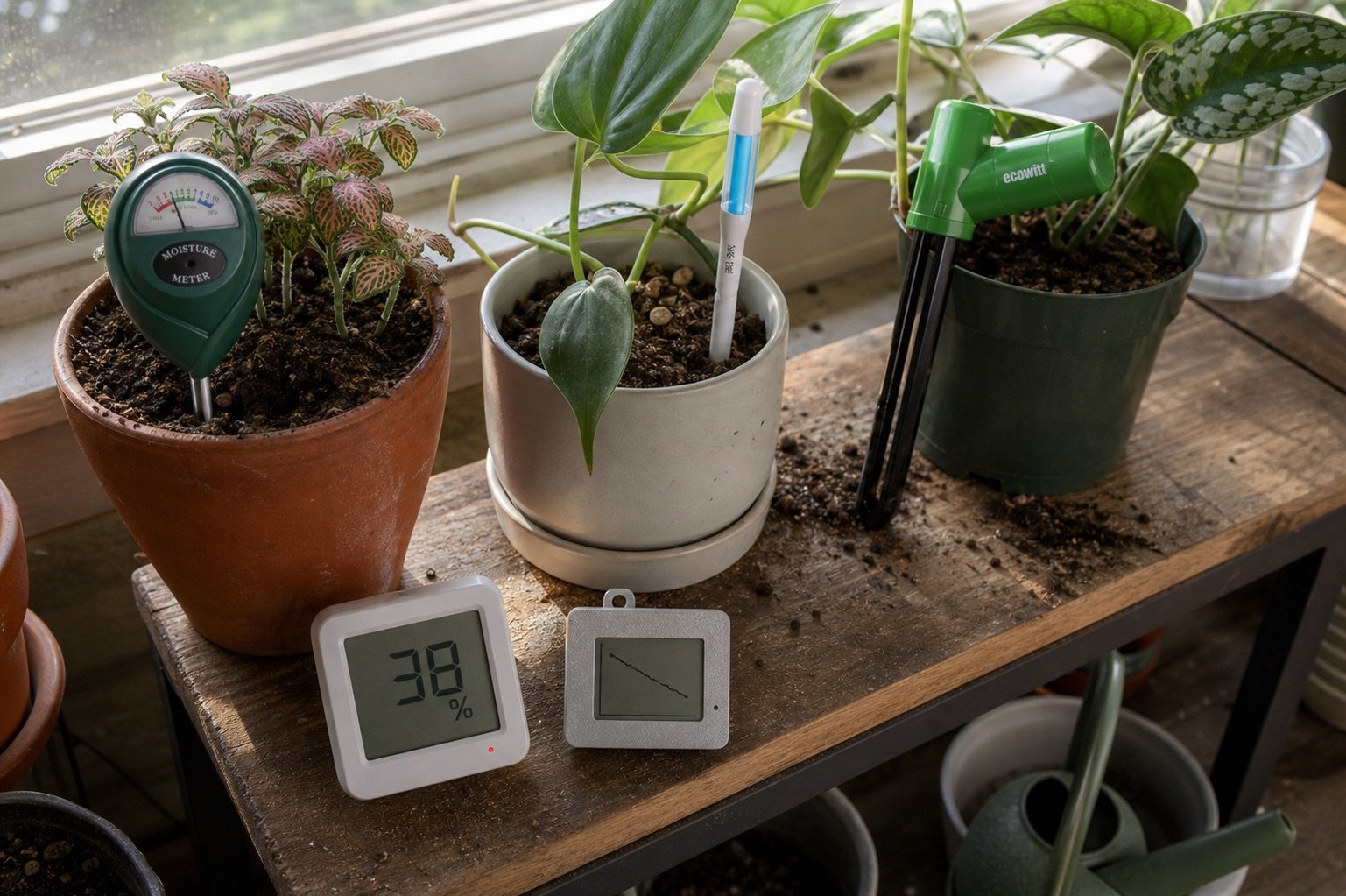
Weigh pots and record device signals twice daily as they dry. Do not water during the curve. Take small sacrificial subsamples from replicate pots for gravimetric moisture checks.
4. Test spatial repeatability
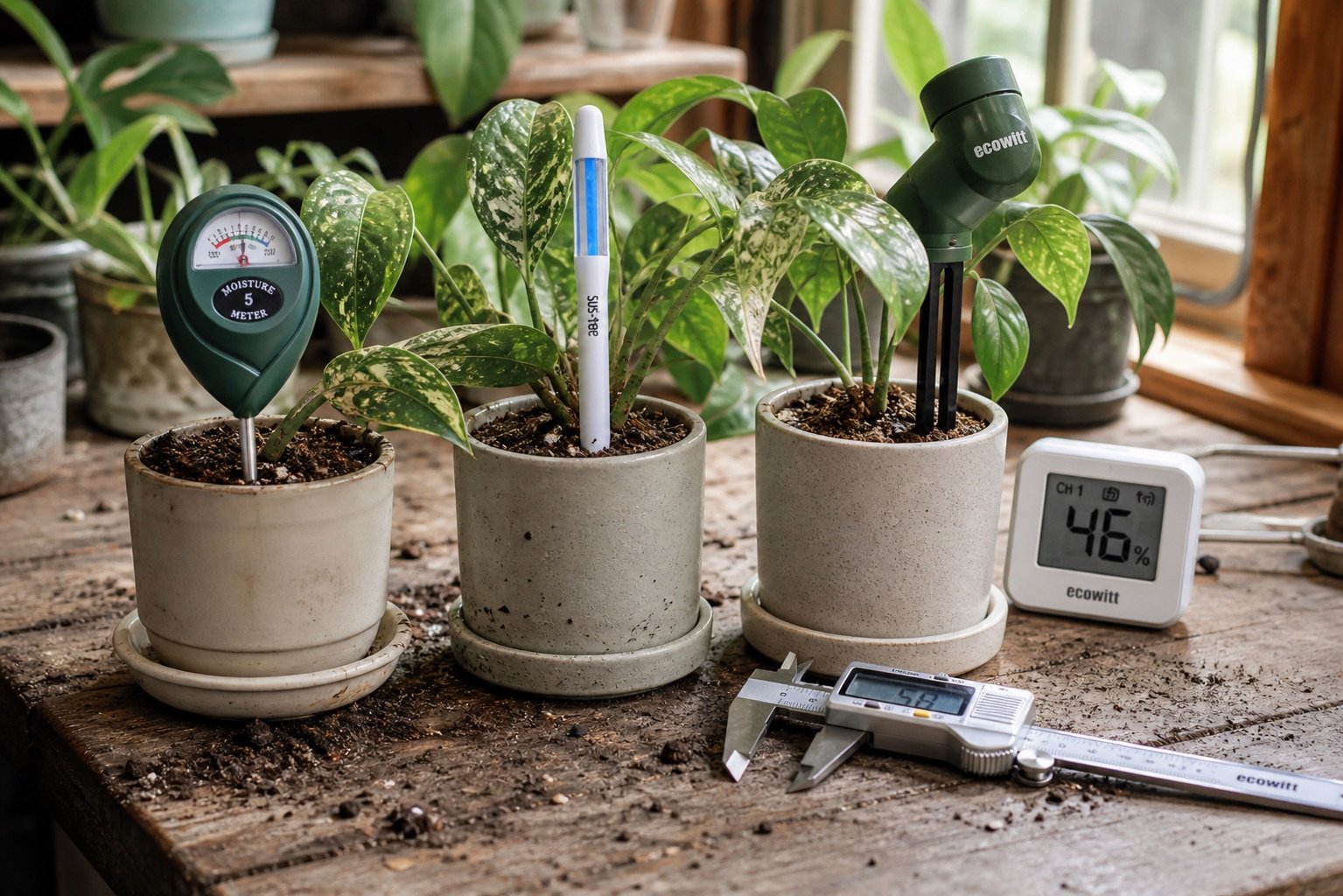
At three moisture stages, take XLUX readings at north, east, south, and west positions. For installed sensors, rotate replicate pots rather than moving the device.
5. Measure response after watering
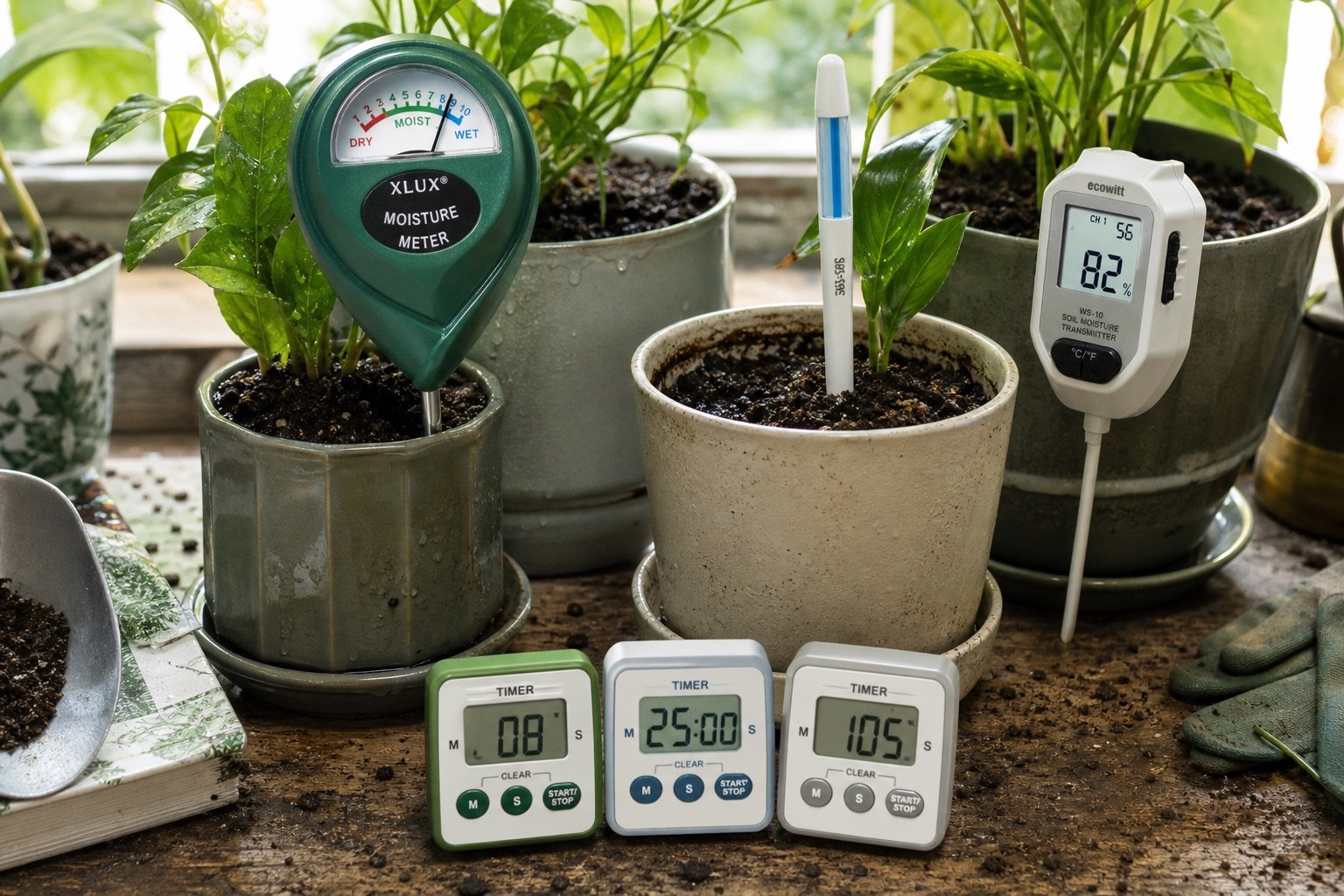
Add the same measured water volume to each pot. Record the time until Sustee turns blue, Ecowitt stabilizes, and the XLUX dial reaches its post-watering plateau.
6. Evaluate the watering decision
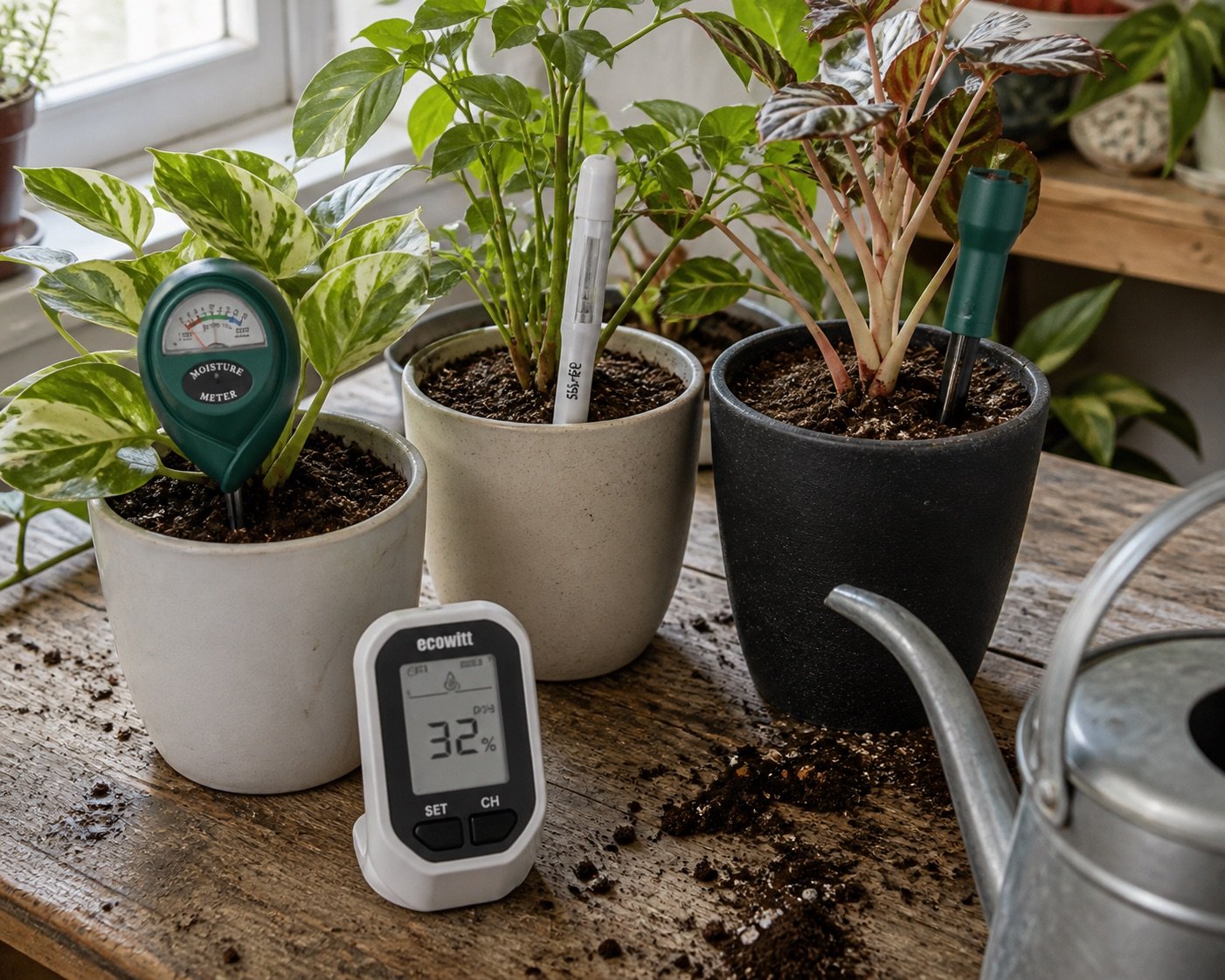
Define an appropriate dry-down threshold for the selected pothos treatment before testing. Record whether each product signals before, near, or after that threshold. The device is useful only if its cue supports the plant and mix in front of it.
Results table
| SIMULATED metric / device reading | XLUX single-probe | Sustee | Ecowitt WH51 |
|---|---|---|---|
| Dry reference | 3/10 | White | 18% |
| Saturated reference | 10/10 | Blue | 92% |
| Repeatability | ±1.2 dial points | 85% cue agreement | ±4 percentage points |
| Response after watering | 08 s | 25 min | 105 s |
| Watering timing difference | +1.5 days | +0.8 day | +0.5 day |
How ranking is scored
We will not crown one technology for every plant. Scores will emphasize whether each product gives a repeatable watering cue within its intended use.
| Category | Weight | What earns a high score |
|---|---|---|
| Decision accuracy | 35% | Signals near the predefined water-loss threshold |
| Repeatability | 20% | Similar results across replicate pots and repeated insertions |
| Mix robustness | 15% | Useful behavior in peat, coir, and chunky media |
| Convenience | 15% | Readable cue with manageable setup and minimal root disturbance |
| Cost over two years | 15% | Includes gateway, batteries, and Sustee replacement cores |
A tie goes to the product with the lower ownership cost only when its core measurement performance stays within the same practical band. A cheap tool that changes the watering, nutrient, or lighting decision in the wrong direction is not good value.
The products in the test
1. XLUX single-probe meter
The XLUX design is simple and inexpensive. It depends on good probe-to-soil contact and offers no user calibration. We will test it at multiple insertion points because one dial reading can hide a dry edge or wet center.
Question for the physical test: How much does the dial vary when the same pot is measured at four points and two depths?
Official source: https://xluxmeter.com/index.html
2. Sustee watering checker
Sustee uses a replaceable absorbent core and a pF-based watering cue rather than a numeric percentage. The maker says it turns blue within 20–30 minutes after watering and returns white when watering is due.
Question for the physical test: At what gravimetric water content does the indicator return to white in each potting mix?
Official source: https://sustee.jp/eng/about-sustee/
3. Ecowitt WH51
The WH51 can send history to Ecowitt’s app and server through a separate gateway. The official manual lists ±5% accuracy and supports custom dry and wet calibration. It is physically larger than a houseplant dial probe.
Question for the physical test: Does a two-point calibration for one mix transfer to peat, coir, and bark-based media?
Official source: https://shop.ecowitt.com/en-gb/products/wh51
Buying guidance before our measurements are complete
Use XLUX when you want one movable spot-check tool, Sustee when a visible per-pot cue suits your routine, and Ecowitt when you need history and are willing to buy the gateway. None should replace drainage, pot weight, and observation of the plant.
A percentage from one sensor is not universal volumetric water content unless the device and medium have been calibrated for that relationship.
Modeled final ranking
- Ecowitt WH51, 89/100. Calibration and logging give it the best projected decision consistency.
- Sustee watering checker, 82/100. The simple visual cue suits one plant per sensor, though replacement cores add cost.
- XLUX single-probe meter, 68/100. It is inexpensive and fast, but readings depend more heavily on insertion and potting mix.
What would change our recommendation
We will change the ranking if a device signals at very different water contents across mixes, damages roots during ordinary use, or responds so slowly that the cue arrives after the watering decision.
Frequently asked questions
Are cheap soil moisture meters accurate?
Some can give a repeatable relative cue in a familiar pot. Accuracy across different mixes is the harder test. Use the reading as one observation and verify it against pot weight.
Can I leave an analog probe in the soil?
Only if the manufacturer says to do so. Many analog probes are intended for short spot checks and may corrode or distort the root zone if left in place.
Does 50% mean the same thing in every potting mix?
No. Peat, coir, bark, mineral particles, and salts change the sensor response and the amount of water available to roots.
Is Sustee reusable?
The body is reusable and the absorbent core is replaceable. The maker lists different typical core lifespans by growing medium.
Sources checked for this draft
Specifications and procedures were checked on August 24, 2026. Prices can change, so the final article should record the purchase price from each receipt rather than copying a later sale price.