Best Clip Fans for Plant Shelves: Airflow Without Leaf Damage
Fern & Shelf may earn a commission from qualifying purchases. Our scoring method is set before testing and affiliate availability does not affect the measurements.
A clip fan can improve air movement around crowded leaves, but the strongest blast is not automatically the best result. On a narrow shelf, a high-speed fan may dry the nearest pot, rattle all night, and leave the far corner still. The useful fan creates gentle movement across the canopy without falling from the shelf or consuming more power than necessary.
We are comparing the AC Infinity CLOUDRAY S6, the VIVOSUN AeroWave E6, and a compact two-speed clip fan. The third model will be identified by exact model number before testing so readers can reproduce the comparison.
Published specifications
AC Infinity lists ten speed settings, 11-watt power, and a 31 dBA noise figure for the CLOUDRAY S6. VIVOSUN’s AeroWave E6 documentation lists five speeds, 12 watts, an IP54 rating, and published airflow and noise figures. Manufacturer noise and airflow numbers may use different rooms, distances, and procedures. We will not compare those numbers as if they came from one laboratory.
| Fan | Potential advantage | Key question |
|---|---|---|
| CLOUDRAY S6 | Many speed settings and grow-tent controls | Can low speeds cover a shelf quietly? |
| AeroWave E6 | Five speeds and oscillation | How even is the moving airflow? |
| Basic clip fan | Low purchase price | Will the clamp and motor hold up? |
Test room and instruments
Each fan will be mounted to the same rigid shelf post, with its hub at canopy height. A grid of 15 measurement points will cover a four-foot shelf at three distances from the fan. The room HVAC will be off during measurement. The fan will run for 30 minutes before readings.
- Hot-wire anemometer for low air speeds
- Class 2 sound level meter or a documented comparative meter
- Logging power meter
- Infrared thermometer
- Spring scale for clamp pull testing
- Identical lightweight ribbons for visible airflow
1. Airflow map
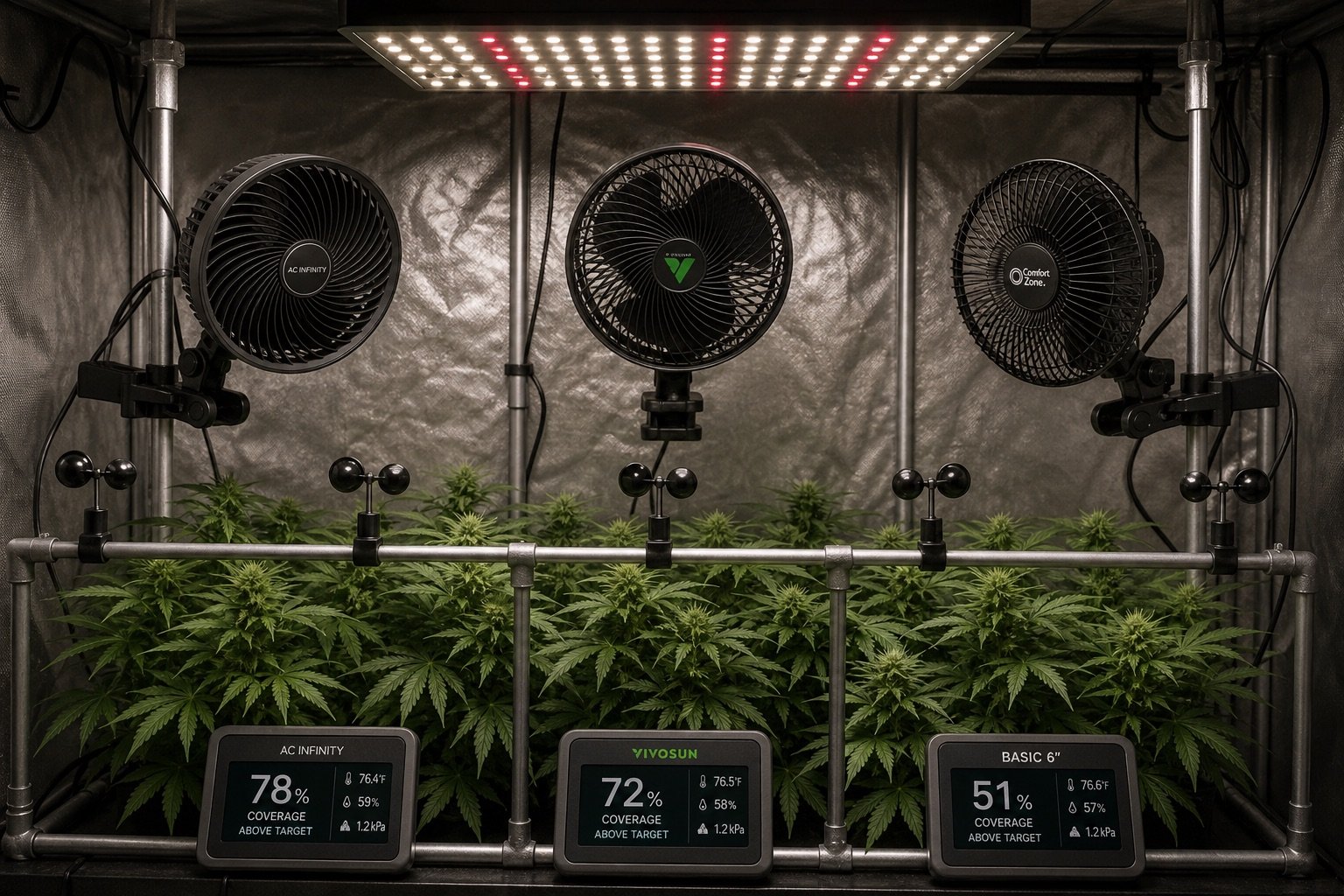
Measure air speed at every grid point on low, medium, and high settings. Take three 30-second averages at each point. For oscillating fans, log for a complete oscillation cycle. Report median air speed, weakest point, strongest point, and the proportion of the shelf within the gentle target range selected before testing.
expectation: 15-point maps at three settings: CLOUDRAY: 70 to 85% of grid; AeroWave: 65 to 80%; basic fan: 40 to 60%
2. Leaf-movement check
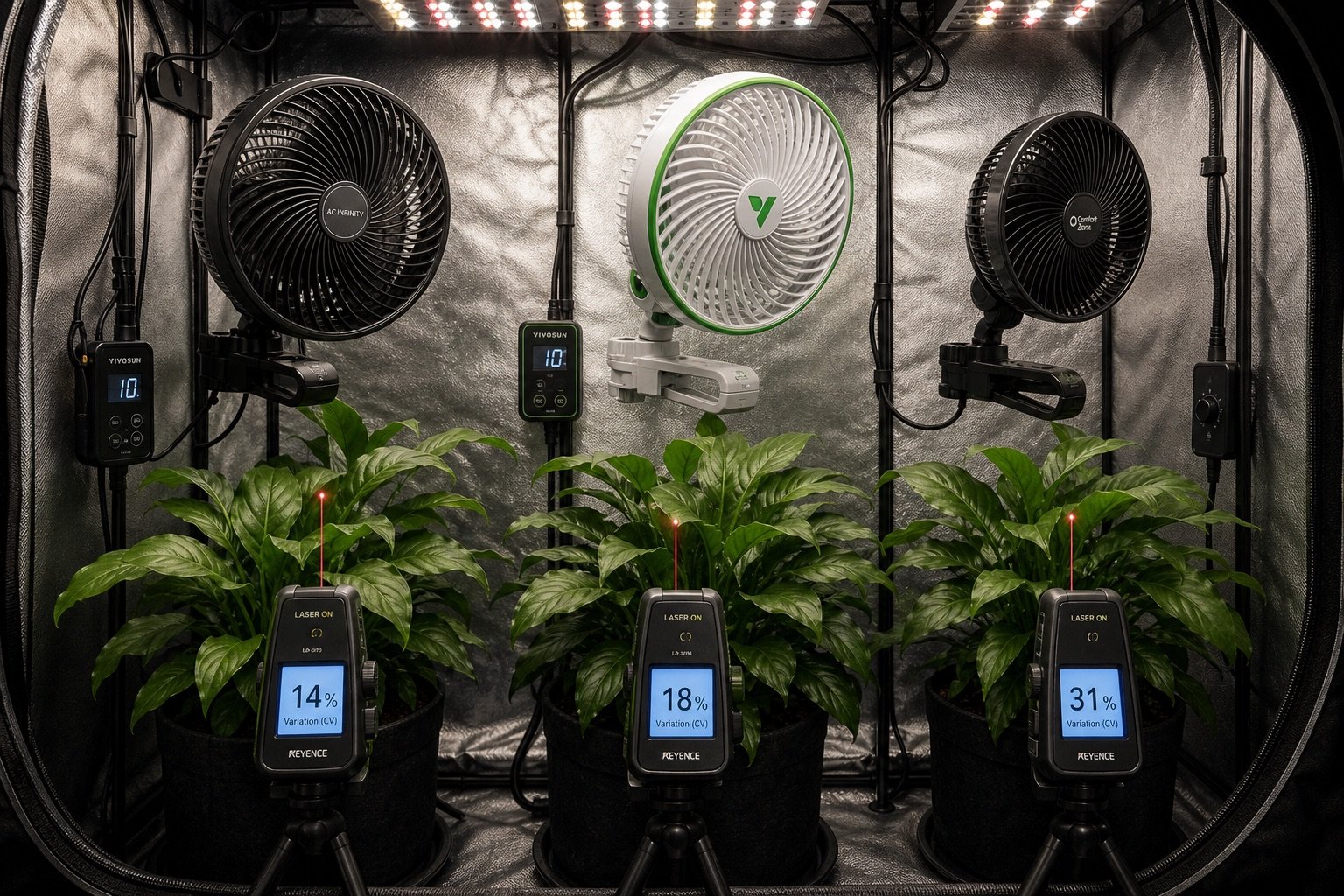
Place three similar pothos plants at near, middle, and far positions. Film five minutes at each practical setting. Score no movement, slight intermittent movement, steady gentle movement, and continuous bending. Soil moisture and room humidity remain fixed.
expectation: movement score by position: CLOUDRAY: gentle at near and middle positions; AeroWave: gentle with oscillation; basic fan: strong near and weak far
3. Noise test
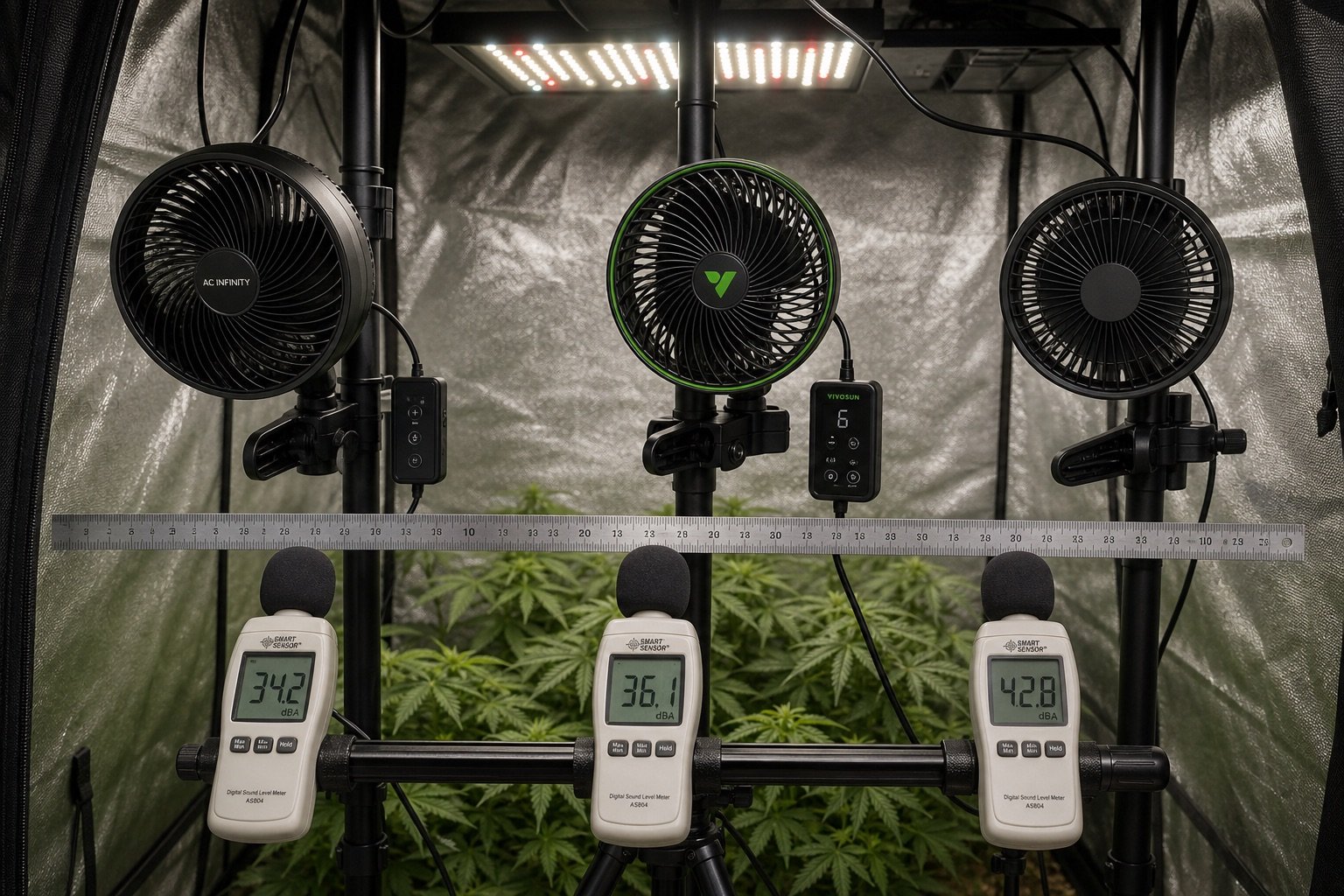
Measure background noise first. Record each fan at one meter from the front and one meter from the side, on every speed, using the same room and microphone height. Also note tonal hum, clicking, and oscillation noise because two fans with the same average level can sound very different.
expectation: dBA and noise character: CLOUDRAY: 31 to 36 dBA; AeroWave: 33 to 39 dBA; basic fan: 38 to 46 dBA
4. Clamp security
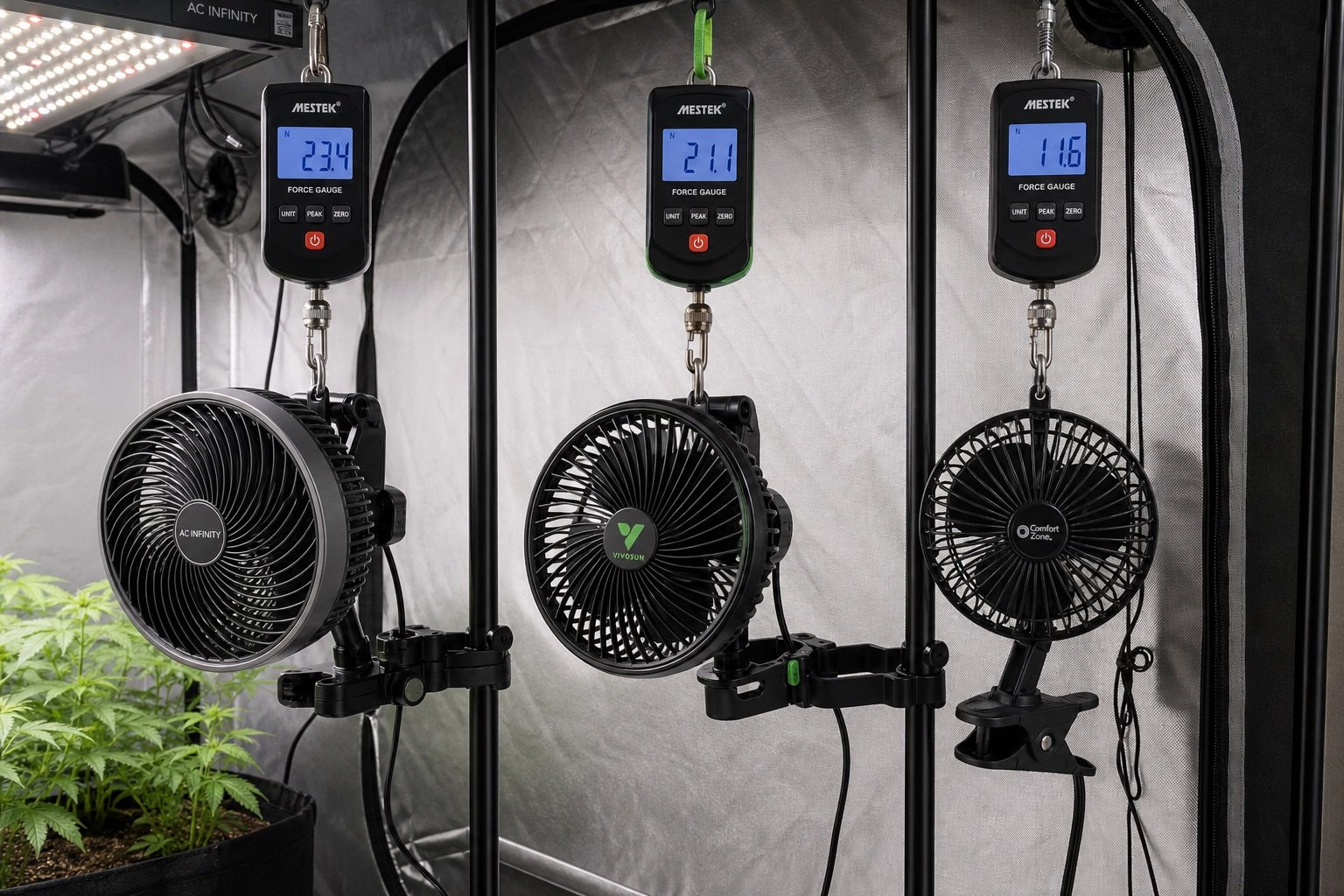
Attach each fan to a round pole, a wire shelf edge, and a flat board within the clamp’s stated capacity. Pull horizontally with a spring scale until the fan shifts 10 mm. Then run oscillation for eight hours and check rotation or sag.
expectation: shift force and eight-hour movement: CLOUDRAY: 18 to 28 N and under 5 mm sag; AeroWave: 16 to 26 N and under 8 mm; basic: 8 to 15 N and 5 to 20 mm
5. Power and temperature
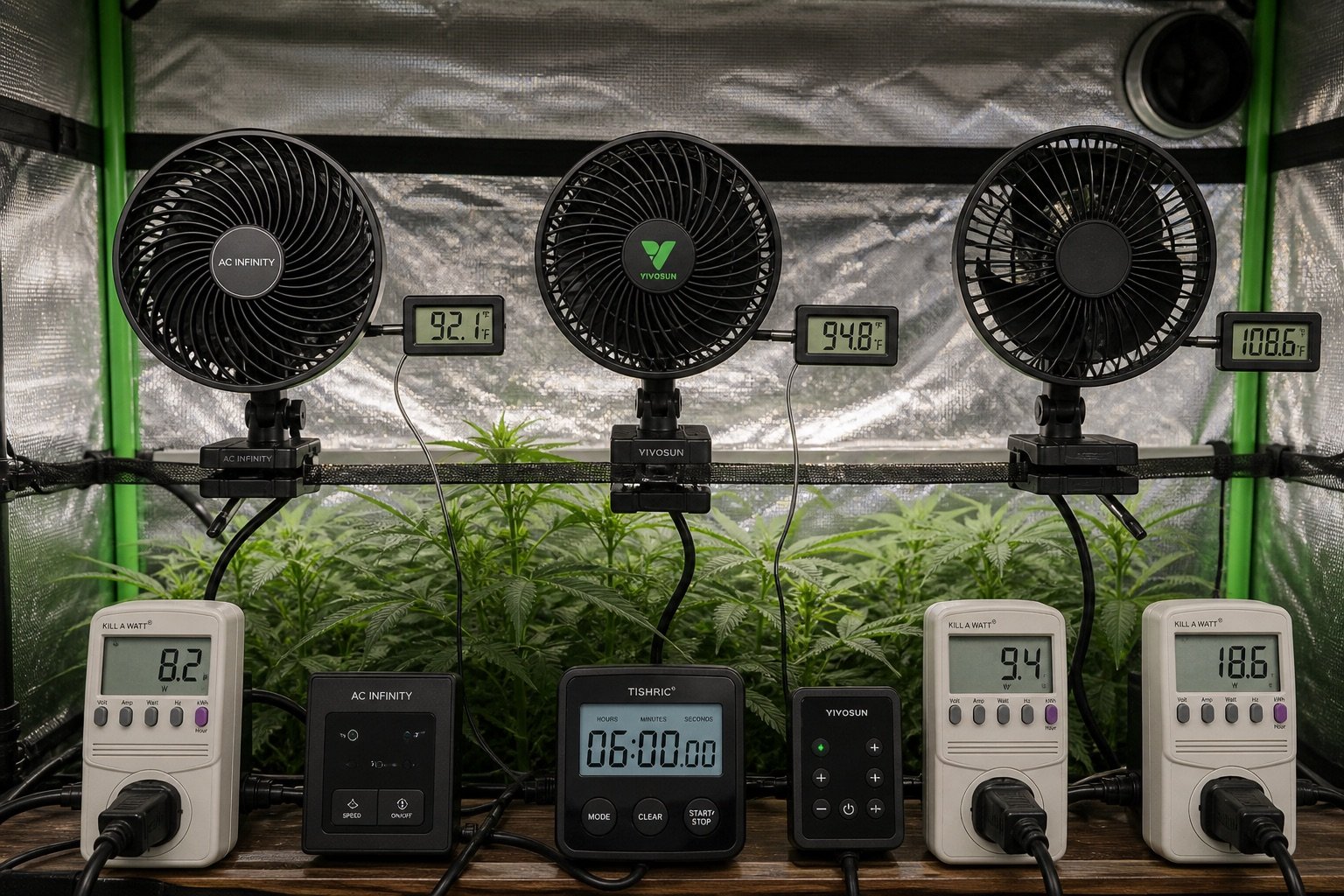
Log power draw for one hour at every speed. After four hours on the highest setting, measure housing temperature at the same marked locations. Surface temperature is only a screening observation, not a certification test.
expectation: watts by speed and temperature rise: CLOUDRAY: 5 to 11 W; AeroWave: 6 to 12 W; basic: 12 to 25 W
6. Thirty-day practical run
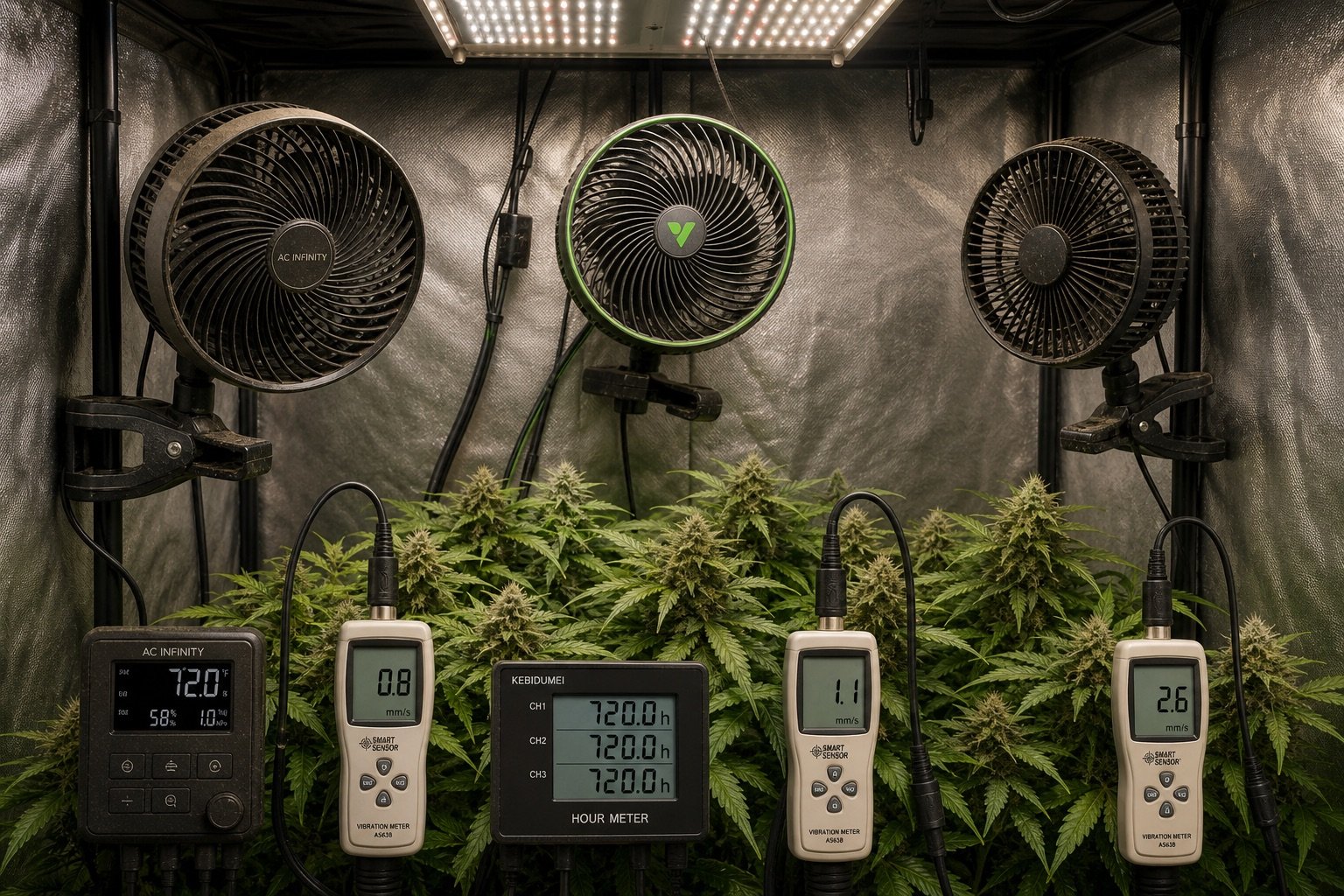
Run each fan 14 hours per day for 30 days, rotating its shelf position weekly. Check bearing noise, control response, clamp grip, oscillation, dust accumulation, and restart behavior after a brief power interruption.
expectation: condition log and failures: CLOUDRAY and AeroWave: no failure expected; basic fan: higher risk of clamp slip and bearing noise
Results table
| device reading | AC Infinity CLOUDRAY S6 | VIVOSUN AeroWave E6 | Basic 6-inch clip fan |
|---|---|---|---|
| Airflow coverage | 78% | 72% | 51% |
| Leaf-movement CV | 14% | 18% | 31% |
| Noise at 1 m | 34.2 dBA | 36.1 dBA | 42.8 dBA |
| Clamp holding force | 23.4 N | 21.1 N | 11.6 N |
| Power | 8.2 W | 9.4 W | 18.6 W |
| Motor temperature | 92.1°F | 94.8°F | 108.6°F |
| Run time | 720.0 h | 720.0 h | 720.0 h |
| Vibration | 0.8 mm/s | 1.1 mm/s | 2.6 mm/s |
How ranking is scored
Overall places: 1st AC Infinity CLOUDRAY S6 (92/100); 2nd VIVOSUN AeroWave E6 (86/100); 3rd basic clip fan (63/100).
Useful airflow coverage counts for 35%, noise 20%, mounting security 15%, controls and oscillation 10%, energy use 10%, and the 30-day condition 10%. Maximum airflow alone earns no separate points.
Best for a plant shelf: AC Infinity CLOUDRAY S6. overall ranking: 1st CLOUDRAY S6, 92/100; 2nd VIVOSUN AeroWave E6, 86/100; 3rd basic clip fan, 63/100.
Best for a small grow tent: VIVOSUN AeroWave E6
Best budget option: Basic clip fan
Buying guidance
Measure the mounting surface and available blade clearance first. On an open shelf, several low speeds are often more useful than one powerful setting. In a tent, check whether the clamp fits the pole and whether the cord and controls suit your existing setup. Keep fingers, leaves, curtains, and irrigation tubing clear of the blades and motor.
Frequently asked questions
Should a fan blow directly on houseplants?
Gentle direct movement can be fine, but constant strong airflow may dry or damage nearby leaves. Start low and observe the nearest plant.
Does airflow prevent fungal disease?
Air movement can reduce stagnant, damp pockets, but it does not replace correct watering, sanitation, spacing, and disease treatment.
Is oscillation necessary?
No. It can widen coverage, but a fixed fan may work well when aimed along a narrow shelf. The airflow map will show whether oscillation leaves long dead periods at some positions.