GreenStalk vs Garden Tower 2: Which Vertical Planter Should You Actually Buy?
Last updated: July 22, 2026.
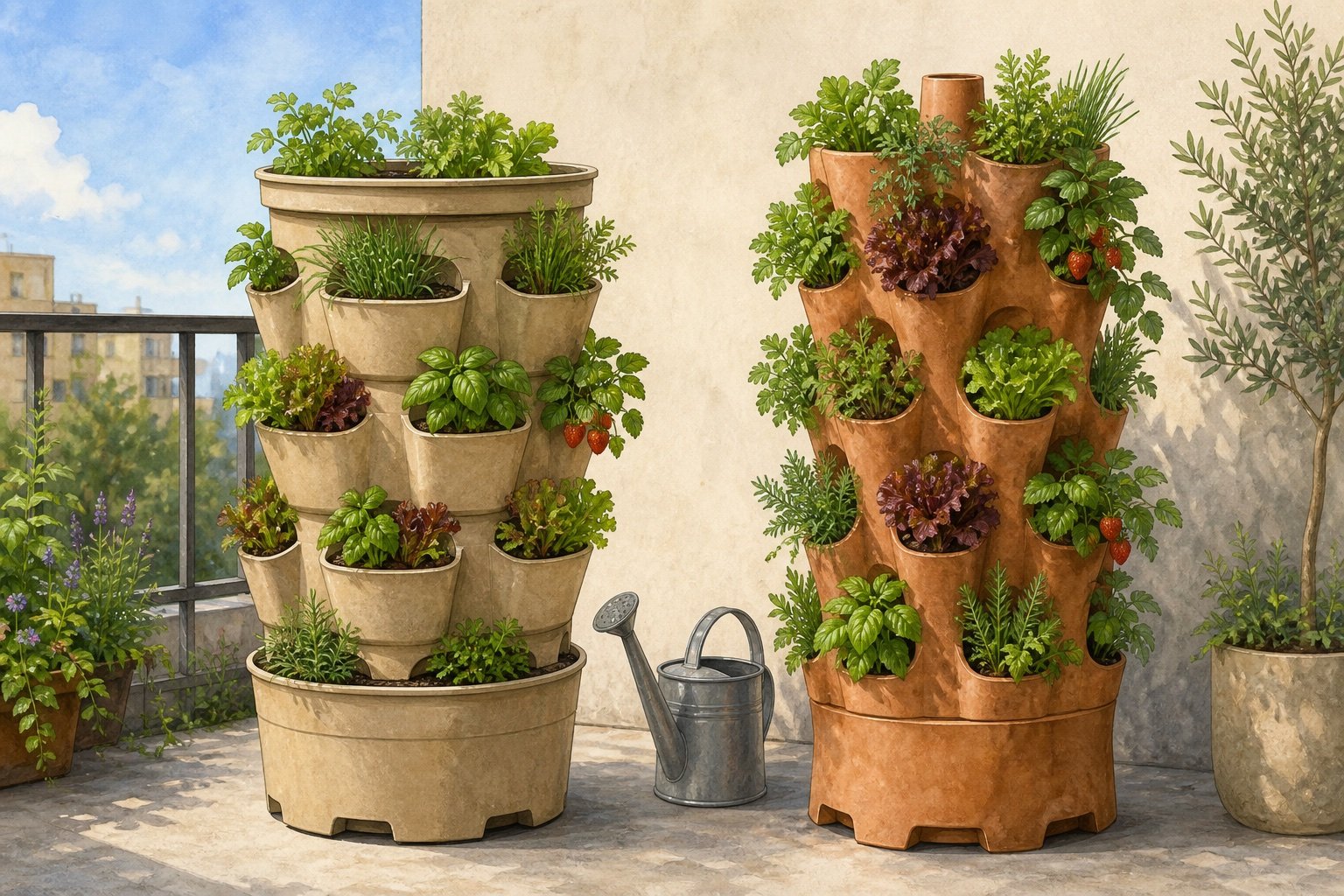
GreenStalk vs Garden Tower is the comparison that keeps appearing once you decide to squeeze a soil-filled vegetable garden onto a balcony. The two systems grow a lot of plants in a small footprint, but they do it with different structures, watering routines, and priorities.
Start here: For a complete overview, see our 7 Best Hydroponic Systems for Beginners in 2026.
I have spent real time with both. My short answer has not changed: most people should buy the GreenStalk. A five-tier GreenStalk Original currently gives you 30 pockets for $149, while Garden Tower 2 gives you 50 pockets, rotation, and a compost core for $399 on sale. The extra $250 is worthwhile only when those specific Garden Tower features solve a problem you actually have.
Prices and specifications in this GreenStalk vs Garden Tower comparison were checked against the manufacturers’ US pages on July 22, 2026.
Official specification sources: GreenStalk’s 5-Tier Original product page and 7-Tier Basic collection, plus Garden Tower Project’s Garden Tower 2 product page. These citations support current product facts and are not affiliate links.
GreenStalk vs Garden Tower 2: quick comparison
| Feature | GreenStalk Original, 5 tier | Garden Tower 2 |
|---|---|---|
| Current base price | $149 | $399 sale price |
| Planting pockets | 30 | 50 side pockets plus top |
| Dimensions | 19 inches wide by 55 inches high | 24.5 inches wide by 43 inches high |
| Soil capacity | 40 gallons | 5.5 to 6 cubic feet, about 41 to 45 gallons |
| Watering design | Top reservoir and watering disks for each tier | Water from top through soil mass |
| Built-in compost core | No | Yes |
| Rotation | Requires turning the unit or an optional base accessory | 360-degree rotating base included |
| Estimated filled weight | Not stated by manufacturer | About 220 pounds with moist soil |
| Warranty | 5 years | 5 years |
Best value: GreenStalk.
Best maximum-capacity composting tower: Garden Tower 2.
The two planters in plain English
GreenStalk Original
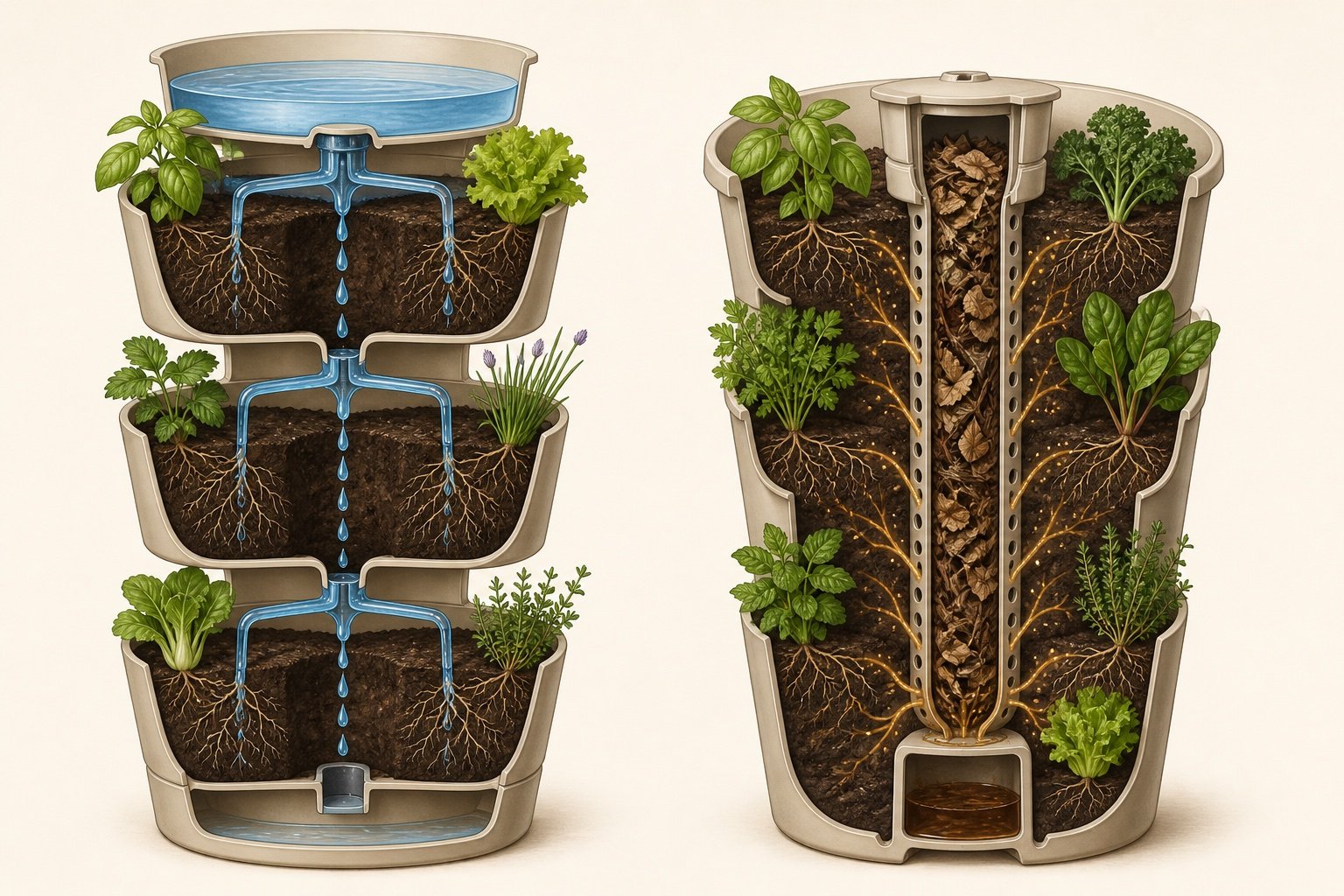
GreenStalk is a stack of round planters. Each Original tier has six pockets, and a reservoir at the top sends water into disks that distribute it through the levels. The current Basic line starts with an 18-pocket, three-tier unit at $109. The five-tier version has 30 pockets for $149. A seven-tier Leaf model has 42 shallower pockets and starts at $169 in the Basic texture.
The five-tier Original is the fair comparison for most buyers. It stands 55 inches high, measures 19 inches across, and holds 40 gallons of potting mix. The tiers can be separated, which helps with initial setup and end-of-season storage, but a planted tier full of wet soil is still heavy. This is easier to break down than Garden Tower 2, not a lightweight planter to carry around every afternoon.
Garden Tower 2
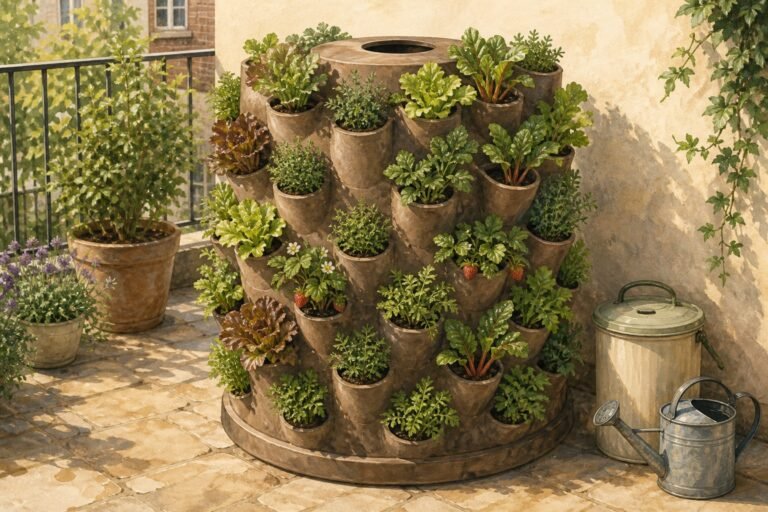
Garden Tower 2 is one broad soil body with 50 pockets spiraling around it and a planting area on top. A perforated central tube accepts suitable kitchen scraps and composting worms. The base rotates 360 degrees, which helps share one-directional sun around the tower.
The current price was $399 on sale, reduced from $519, when checked. The tower is 43 inches tall and 24.5 inches wide, holds 5.5 to 6 cubic feet of mix, and weighs 36 pounds empty. The manufacturer estimates roughly 220 pounds when the soil is moist. My full Garden Tower 2 review covers the season-long experience in more detail.
Where GreenStalk wins
1. Price
This is the decisive difference. At current base prices, the five-tier GreenStalk Original is $250 less than Garden Tower 2. It costs less than half as much while providing 30 planting pockets and a similar total volume of soil.
Accessories can narrow the gap. A GreenStalk spinner or mover, covers, supports, and extra tiers all raise the total. Garden Tower 2 also needs a large quantity of potting mix and may need composting worms. Compare the full setup you plan to use, not a base planter on one site with a loaded cart on the other.
2. A clearer watering routine
GreenStalk’s top reservoir and watering disks made the routine feel easier in my use. I could add water at the top and let each tier’s disk distribute it to that level. Garden Tower 2 asks water to move through one much larger soil body, so I paid closer attention to the pockets and adjusted when one area behaved differently.
That is a hands-on observation, not a guarantee that GreenStalk cannot be watered badly. Small pockets, mature plants, heat, wind, clogged passages, and an out-of-level base can still create trouble. Whichever tower you choose, learn its moisture pattern before trusting a fixed calendar. Our guide to watering indoor plants explains why the plant and root zone matter more than the day of the week.
3. Modular tiers
GreenStalk is easier to configure around a smaller crop. You can buy three or five Original tiers, or choose the shallower seven-tier Leaf version for greens and herbs. The sections also separate for empty storage. Garden Tower 2 arrives as a 50-pocket commitment.
Do not confuse modular with easy to move while planted. Forty gallons of moist mix, plus plants and water, still creates a very heavy five-tier garden. If mobility is important, plan the base and route before filling it.
4. Deep Original pockets
GreenStalk lists its Original pockets at 10 inches deep. That makes the Original line appealing for crops that want more root depth, including compact carrots and other smaller root vegetables. The seven-tier Leaf line uses 7-inch pockets and is better matched to herbs, greens, and flowers.
Where Garden Tower 2 wins
1. More pockets in one integrated planter
Garden Tower 2 gives you 50 side pockets in a 24.5-inch-wide body. The five-tier GreenStalk gives you 30 in a 19-inch-wide body. If the goal is the largest number of compact herbs, greens, or strawberries in one permanent tower, the Garden Tower capacity is meaningful.
Plant count is not the same as harvest. Fifty large fruiting plants will compete for light and root space. The capacity is most useful when matched with crops that suit the pocket size and the light available at each level.
2. The composting core
GreenStalk has no equivalent to Garden Tower 2’s central vermicompost tube. During my season, that core changed the tower from a dense planter into a small compost-and-growing loop. Suitable scraps went into the center, worms processed them, and finished material stayed close to the root zone.
It does not make every fertilizer or soil question disappear, and it only adds value if you maintain it properly. Still, if vermicomposting is part of the reason you want a tower, this is the feature that can justify the premium. GreenStalk cannot be accessorized into the same thing.
3. Rotation is included
The Garden Tower base rotates 360 degrees as part of the design. That was genuinely useful with directional balcony sun. GreenStalk can be turned, and the company sells separate spinner and mover options, but the base planter price does not include the same built-in rotating platform.
What is a tie
Durability and warranty
Both manufacturers currently offer five-year warranties. Both make their planters in the United States and present them as long-term outdoor products. I have heard encouraging long-use reports from owners, but the written warranty is the cleanest comparison. I would not award either product an invented decade-long guarantee.
They need a permanent light plan
Neither base planter includes grow lights. On a balcony, track direct sun across the whole day and remember that a railing or wall can shade lower pockets. Indoors, the height and circumference make even lighting much harder than hanging one bulb over a normal pot. Read our guide to using garden towers indoors before assuming either one belongs in a living room.
Which should you buy?
Buy GreenStalk if:
- You want the best capacity for the initial price.
- This is your first soil tower.
- You want a choice of three, five, or seven tiers.
- Deep pockets for some root crops matter to you.
- You prefer a top-reservoir watering system for separate tiers.
- You want sections that can be broken down for empty storage.
Buy Garden Tower 2 if:
- You want 50 pockets in one integrated planter.
- You will use the central composting tube with worms.
- Built-in 360-degree rotation solves a real sun problem.
- You have a permanent place that can safely support about 220 pounds.
- The $399 sale price plus soil fits comfortably in the budget.
If you are really looking for pumps, nutrient solution, and integrated lights, neither product is the right category. Start with our indoor vertical garden systems comparison instead. For either soil tower, choose crops that suit the pockets and use a draining container mix rather than ground soil. These guides to vertical-garden plants and potting mix will help.
Frequently asked questions
Is GreenStalk cheaper than Garden Tower 2?
Yes. On July 22, 2026, the five-tier GreenStalk Original was $149 and Garden Tower 2 was $399 on sale. Accessories, potting mix, plants, shipping, and taxes can change the final difference.
Which one holds more plants?
Garden Tower 2 has 50 side pockets plus the top. The five-tier GreenStalk Original has 30 pockets. GreenStalk’s seven-tier Leaf model has 42 smaller pockets.
Which one is easier to move?
GreenStalk is modular and easier to take apart when empty. Neither filled planter should be called portable without qualification. GreenStalk does not publish a filled weight for the five-tier unit, while Garden Tower Project estimates about 220 pounds for its tower with moist soil.
Which one is better for beginners?
GreenStalk. The $149 five-tier version costs much less, and its tiered reservoir system was easier for me to understand in daily use. Garden Tower 2 makes more sense when the buyer already knows that capacity, rotation, and vermicomposting are worth paying for.
Final verdict
GreenStalk remains the recommendation for most balcony gardeners. The five-tier Original gives you 30 deep pockets, 40 gallons of soil, and a good watering design for $149. That is a strong first tower without a premium feature you may never use.
Garden Tower 2 is the more interesting machine. Its 50 pockets, rotating base, and compost tube create a denser, more integrated system. I enjoyed those features during a real season with it. I would pay the extra $250 only if the compost loop and greater capacity were central to the plan, not because the more expensive tower must automatically grow better plants.
You can search for GreenStalk on Amazon or Garden Tower 2 on Amazon. These are untagged search links, not confirmed Fern & Shelf affiliate links.