Garden Tower 2 Review: Is the 50-Plant Composting Planter Worth It?
Last updated: September 5, 2026.
The Garden Tower 2 is worth considering if you want a soil-based vertical planter and will use its compost core. It costs $399 before potting mix or worms on the check date. Its advertised four-square-foot footprint does not include all the room you need to reach the pockets, manage drainage and let foliage spread.
Short verdict: It makes sense for someone with a permanent sunny spot who wants many planting positions in a small footprint and will actually use the compost core. It makes much less sense for a renter who expects to move it, a gardener with a questionable balcony load limit, or anyone who only wants a few herbs.
Start here: For a complete overview, see our Garden Tower Alternatives.
A gardener known personally to the publisher shared the season-long experience described below. He found the planting density useful and made the compost tube part of his routine. His observations help explain daily use; they do not establish a guaranteed harvest or payback period.
The article’s author did not conduct this growing trial. We have attributed the gardener’s observations below and kept them separate from manufacturer specifications and budget examples. Prices and product details were checked on September 5, 2026.
Official specification source: Garden Tower Project’s Garden Tower 2 product page. It supports the current price, capacity, dimensions, soil volume, weight, material, rotation, compost-core, and warranty details used below. This citation is not an affiliate link.
Garden Tower 2 review at a glance
| Current price | $399 sale price, reduced from $519 when checked |
|---|---|
| Planting capacity | 50 side pockets plus the top |
| Stated footprint | 4 square feet |
| Dimensions | 43 inches tall by 24.5 inches wide |
| Empty weight | 36 pounds |
| Estimated moist weight | About 220 pounds |
| Soil volume | 5.5 to 6 cubic feet |
| Material | Food-grade, UV-protected HDPE |
| Core feature | Central compost and vermicompost tube |
| Warranty | 5 years |
Garden Tower 2 vs Tower Garden
Garden Tower 2 is the soil-filled planter discussed here. The similarly named Tower Garden is a different, soil-free growing system. Their equipment and maintenance instructions are not interchangeable. Check the brand and model on a listing before comparing prices.
What the Garden Tower 2 is
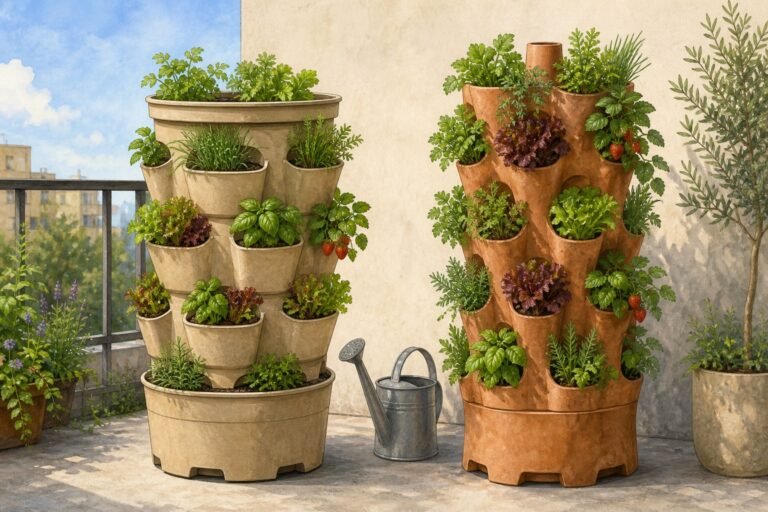
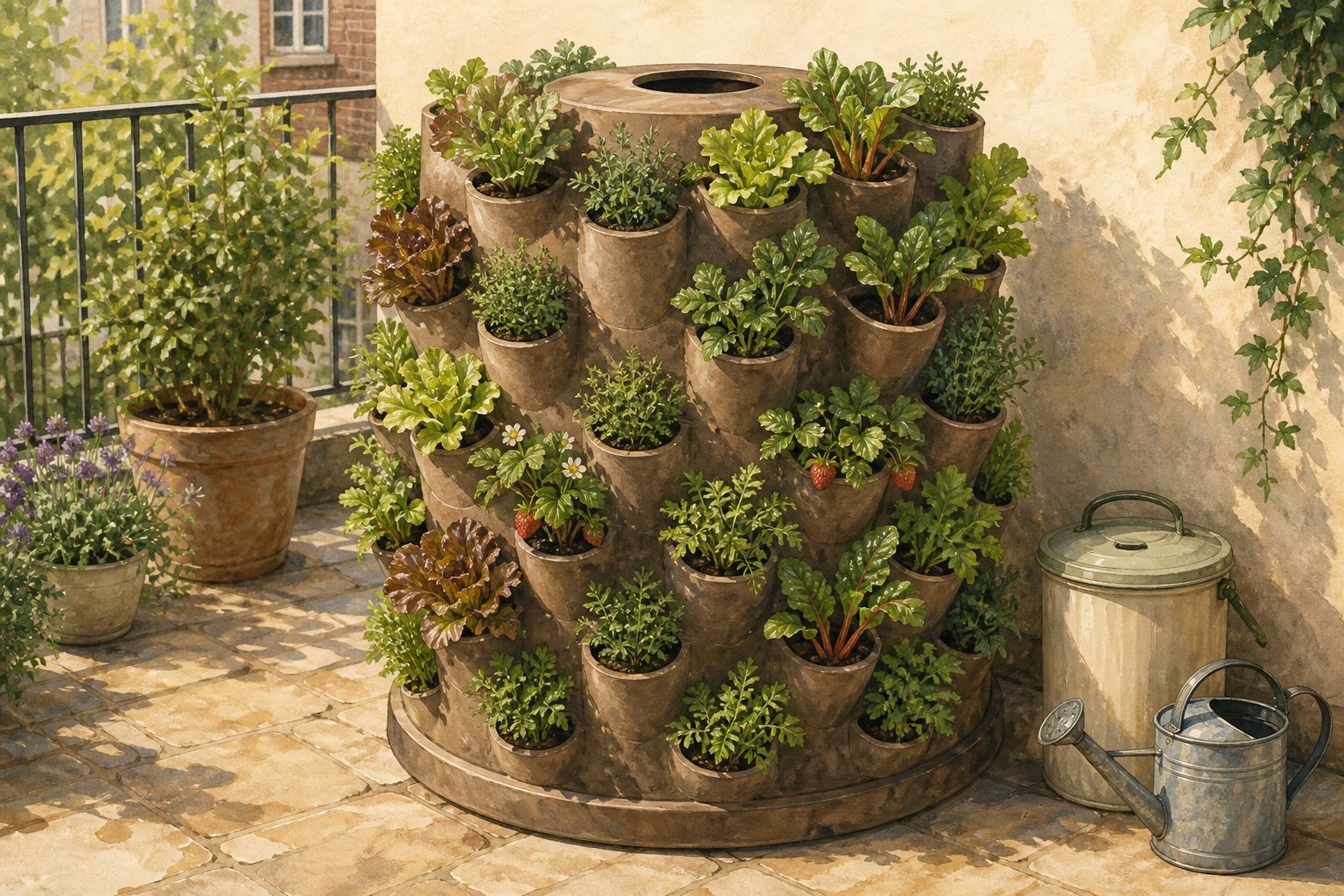
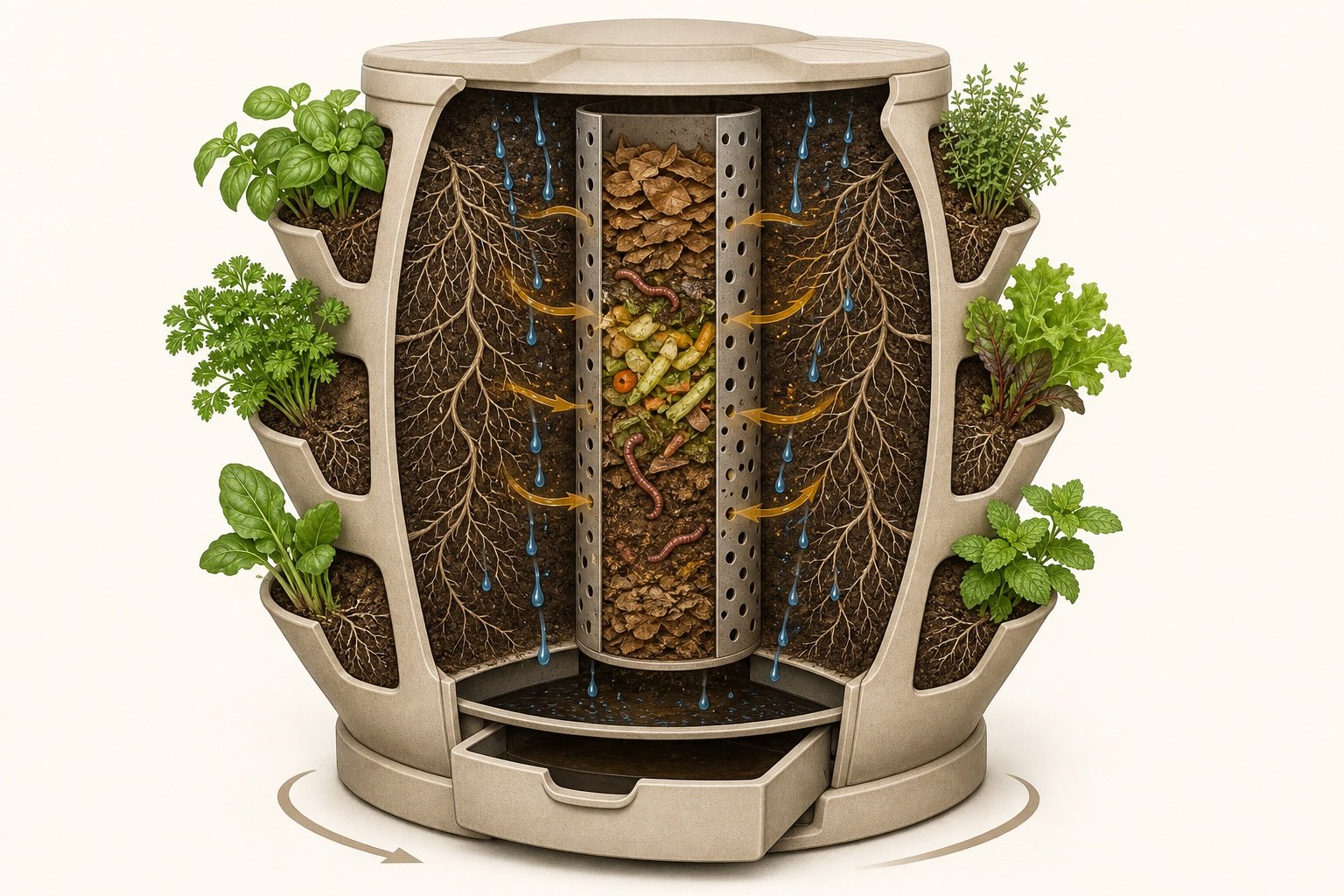
Picture a broad barrel with ten curved sections and 50 pockets spiraling around the outside. A perforated tube runs through the center. Kitchen scraps can go into that tube with composting worms, while water and worm-processed nutrients move into the surrounding soil. A drawer at the bottom gives access to finished material and drainage.
The planter rotates 360 degrees on its base. The gardener reported turning it to share directional sun between the pockets. He still had to watch individual plants: rotation helped with uneven exposure but did not increase the amount of sunlight reaching the site.
The current tower is listed at 43 inches high and 24.5 inches wide. It weighs 36 pounds empty and takes 5.5 to 6 cubic feet of potting mix. Garden Tower Project estimates roughly 220 pounds when the tower is filled with moist soil. This is not a planter you casually slide across a balcony after dinner.
A grower’s observations after one season
Planting density and access
Fifty pockets are usable, especially for lettuces, parsley, thyme, strawberries, spinach, kale, chard, and other crops that do not need a huge root zone in every opening. That does not mean 50 mature tomato plants belong in it. Crop choice and placement still matter. Larger or hungrier plants need more soil and light, so he reserved the top for plants that wanted more room.
He found the tower useful for mixing quick greens with slower herbs rather than waiting for one large harvest. He also noticed differences between pockets. A crowded pocket can be shaded by the plant above it, and a plant on the dry or bright side may need attention before its neighbors do.
The compost core earns its space
The gardener said the compost tube became part of his routine: he added suitable kitchen scraps to the center and used red wigglers. This is his account of managing the core, not a measurement of nutrient delivery or fertilizer savings.
That does not establish a permanent, complete fertilizer supply. Worms need the right food and moisture, the tower still begins with quality potting mix, and plant nutrition is not reduced to throwing every kitchen scrap into a tube. The benefit is a compact soil-and-compost loop that works in the same footprint as the planter. For a gardener who already wants to vermicompost, it combines two gardening tasks in one footprint. For someone who dislikes worms or will never feed the core, much of the premium loses its point.
Rotation and optional casters
The gardener rotated the tower in place to share directional sun among the pockets. The standard rotating base is not a wheeled base. Once the planter contains nearly six cubic feet of moist mix, plants, and water, its roughly 220-pound working weight makes the original position important.
Measure the space, confirm water drainage, and check the load rating of any balcony before filling. If you are unsure about structural capacity, ask the building owner, manager, or a qualified local professional. A general gardening review cannot approve a specific balcony.
The manufacturer sells an optional Garden Tower 2 caster wheel kit. It changes the moving options, but you still need a suitable surface and room to roll the tower. Choose and install accessories according to the maker’s instructions before filling.
The costs the $399 price does not include
The current sale price is only the first line of the budget. You also need 5.5 to 6 cubic feet of suitable potting mix, plants or seeds, and possibly red wiggler worms if you plan to run the core as a vermicomposting system. Soil prices vary too much by region and shipping method for an honest universal total. Six cubic feet bought in small delivered bags can cost much more than local bulk or large-bag mix.
| Budget line | What to include |
|---|---|
| Planter | Price for your selected color and bundle at checkout |
| Potting mix | For a 6 cu ft planning allowance, three 2 cu ft bags; multiply by your local bag price |
| Plants and composting worms | Your first planting and worms if you plan to vermicompost |
| Optional equipment | Casters, supports, floor protection or indoor lights as needed |
| Shipping and tax | Check the planter and soil orders separately |
Worked budget example: a $399 planter plus three 2 cu ft bags at an assumed $20 each totals $459 before plants, worms, delivery, tax and optional equipment. The $20 bag price is an illustrative input, not a retailer quote. Replace it with your local price.
Our potting soil guide explains why garden soil is not a safe substitute in a container. Whatever mix you choose must drain while still holding enough moisture for a tall mass of plants.
Does the Garden Tower 2 pay for itself?
Maybe, but a two-or-three-season payback should not be treated as a product specification. Homegrown produce does not have one fixed retail value, and a pocket left empty saves nothing. Sun, climate, crop selection, pest pressure, and the gardener’s consistency affect the result.
A more useful way to think about price is annual use. If a $399 tower serves for ten growing seasons, the tower itself works out to $39.90 per season before soil, seed, water, and replacements. That is a scenario, not a lifespan guarantee. The current written warranty is five years.
I would buy it for space efficiency, the rotating soil system, and the compost core. I would not buy it on the promise that a particular dollar value of greens will appear by a particular date.
Who should buy it
- You have a sunny balcony, patio, rooftop, or yard with a permanent four-square-foot location.
- You want many herbs, greens, or strawberries rather than a few decorative plants.
- You like the idea of vermicomposting kitchen scraps in the planter itself.
- You value waist-high access and a rotating design.
- The filled weight is safe for the surface beneath it.
Who should skip it
- You need to carry the planter between locations or move it over unsuitable surfaces.
- You have weak light and do not want to build a serious indoor lighting setup.
- You only need a small herb garden.
- You will not use the compost core.
- The $399 tower plus soil would strain the gardening budget.
The GreenStalk comparison is worth reading if price and portability are the main objections. If you are considering this tower inside a home, read our separate guide to using a garden tower indoors. A DIY project can cost less, but it comes with its own drainage, stability, and material choices. Our DIY vertical garden guide covers that route.
Frequently asked questions
How much is the Garden Tower 2 now?
It was $399 on the manufacturer’s US site on September 5, 2026, shown as a sale from $519. Check the final price and shipping before ordering.
Does it really hold 50 plants?
It has 50 side planting pockets plus the top. Whether all 50 should be occupied at once depends on what you grow. Compact greens and herbs fit the design better than filling every opening with a large fruiting plant.
Do I need worms?
You need composting worms if you want the central tube to operate as a vermicomposting system. Red wigglers are the usual choice. Do not substitute ordinary garden earthworms without checking the system instructions and the needs of the species.
Can it be moved when full?
The standard base rotates in place. Garden Tower Project also offers a separate caster kit; check its installation and surface requirements before planning to move a filled planter. Don’t assume it can cross steps or uneven ground. Moist soil weight is an estimate, not a safe lifting limit.
Final verdict
The gardener’s season of use supports a practical case for the tower: he used the planting pockets, rotated the planter for directional light and kept the compost core in use. Those observations are most relevant if you expect to garden in a similar way.
It is still a $399 planter that becomes roughly 220 pounds when filled. Those are not minor objections. Buy it because the dense soil system and compost core match how you want to garden, not because an optimistic payback claim made the decision feel automatic.
If you decide it fits, you can search for the Garden Tower 2 on Amazon and red wiggler composting worms. These are untagged search links, not confirmed Fern & Shelf affiliate links. Our list of plants for a vertical garden can help with the next decision.