The 6 Best Self-Watering Planters for People Who Travel (Tested for 2 Weeks Away)
Last updated: 24.05.2026.
Affiliate disclosure: As an Amazon Associate I earn from qualifying purchases. Links marked “paid link” may earn Fern & Shelf a commission at no extra cost to you. Read our full Affiliate Disclosure.
Start here: For a complete overview, see our Indoor Gardening for Absolute Beginners.
If you’ve ever come home from a 10-day trip to find every plant in your apartment dead, this guide is for you. Self-watering planters solve the single most common reason indoor plants die: inconsistent watering. A good one will keep a plant happy for 2–6 weeks without you touching it.
The category is full of cheap junk and a few genuinely well-designed products. We tested six of the most-recommended self-watering planters by going on real two-week trips and seeing what survived. Here’s what’s actually worth your money.
How self-watering planters actually work
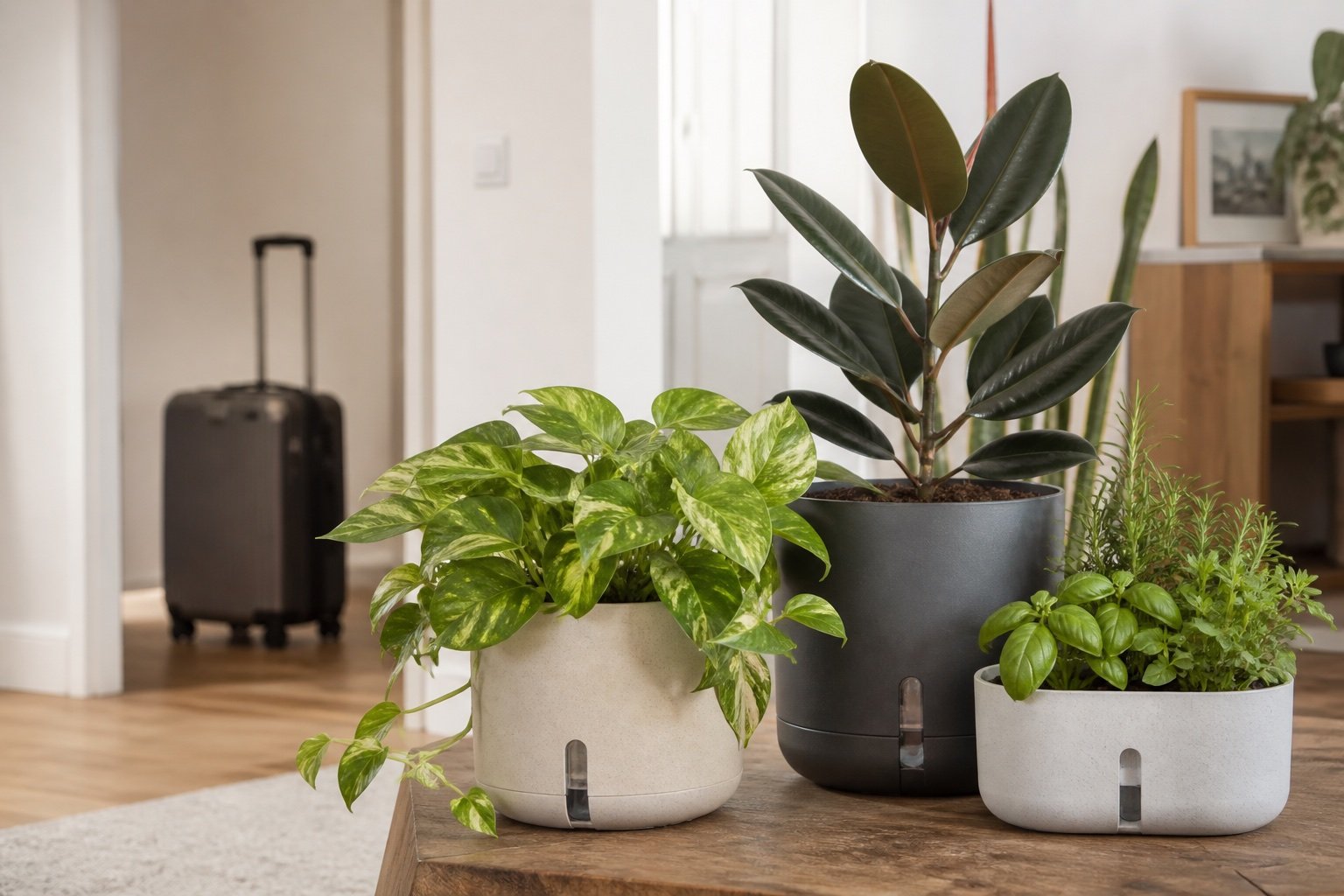
There’s no magic. A self-watering planter has two parts: a soil chamber where the plant lives, and a water reservoir underneath. A wick or capillary action pulls water from the reservoir into the soil only as the plant needs it. The result is consistent soil moisture without the daily watering.
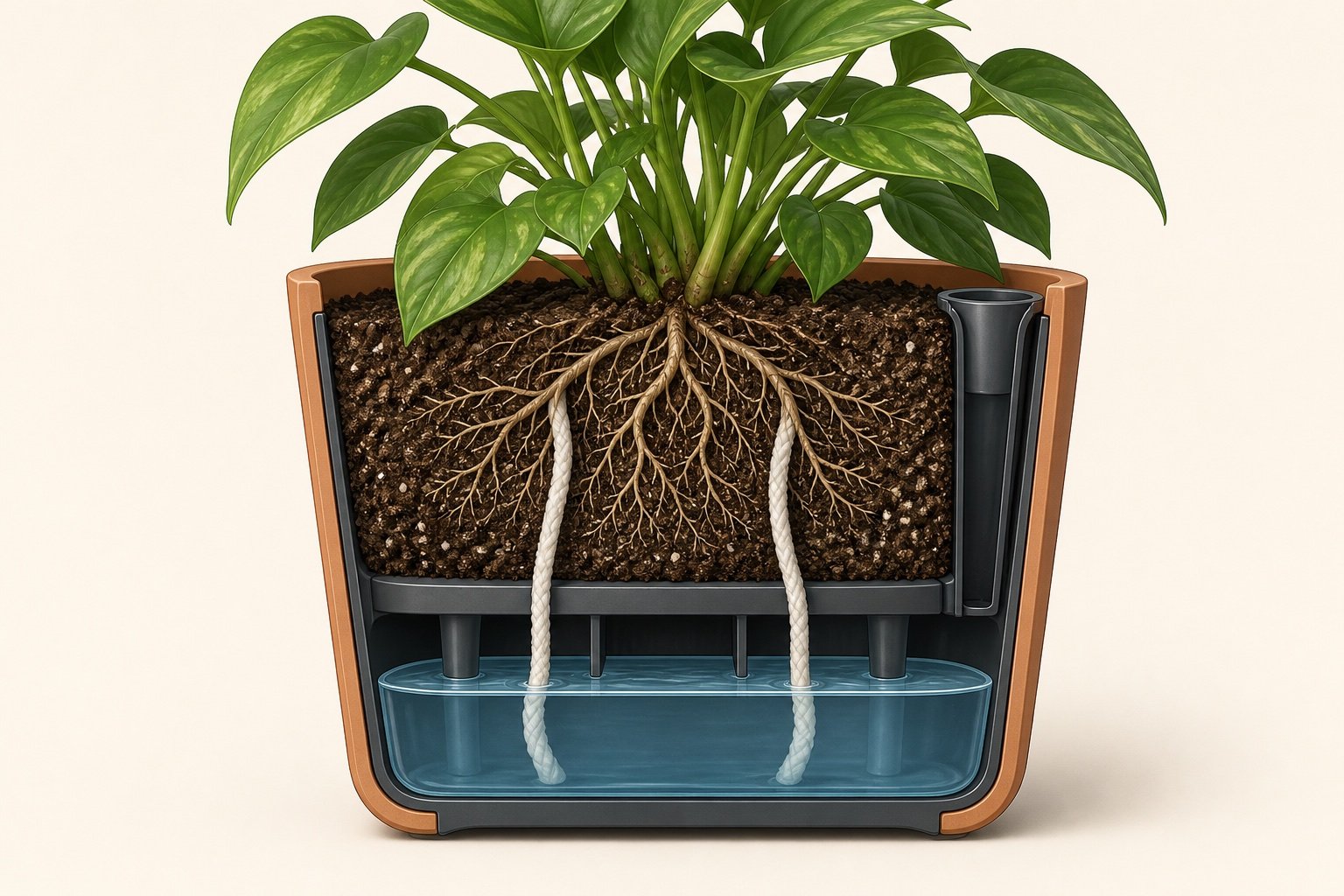
Two things to look for:
- Reservoir size: Bigger reservoirs mean longer between refills. A 2-liter reservoir typically lasts 3–4 weeks for a medium plant; a small 250 ml reservoir might only last a week.
- Water level indicator: A small float or window that shows how much water is left. Without one, you’re guessing — and people who travel hate guessing.
How we tested
We planted identical pothos cuttings in each planter, left them for 14 days, and tracked: plant condition on return, water remaining, root health (we checked at the end), and how easy each was to clean and refill.
1. Lechuza Cubico — Best Overall
Best for: Medium to large floor plants in living rooms, hallways, or any prominent spot.
Price range: $90–$220 (depending on size)
The Lechuza Cubico is what self-watering planters look like when a German design company spends 20 years iterating on them. Matte finish, multiple color options, a real water level indicator on the side, and a reservoir that holds enough water for a medium-sized plant for 8–12 weeks. Yes — weeks.
We put a 3-foot rubber tree in one and left for 14 days. Came back to a plant that looked exactly like when we left. The reservoir was still half full.
Pros
- Holds 8–12 weeks of water depending on plant
- Tasteful, modern design
- Multiple sizes (9″ up to 16″)
- Visible water level indicator
Cons
- Expensive
- The proprietary soil-substrate granules they suggest are optional but pricey
[BUY ON AMAZON — Lechuza Cubico (paid link)]
2. Lechuza Classico LS — Best Medium-Plant Choice
Best for: Medium tabletop plants and shelf plants.
Price range: $60–$130
Same brand, smaller form factor, lower price. The Classico LS sits on a tabletop or shelf instead of the floor, and is a beautiful round design suitable for ZZ plants, pothos, peace lilies, or any 1–2 foot plant.
Reservoir holds 4–8 weeks of water depending on plant. We took a 2-foot snake plant on a 17-day trip — came back to a thriving plant and a reservoir at 25%.
Pros
- Same build quality as the Cubico in a smaller package
- Beautiful round form
- Works for almost any tabletop plant
- Multiple sizes and colors
Cons
- Smaller reservoir than the Cubico
- Premium pricing
[BUY ON AMAZON — Lechuza Classico LS (paid link)]
3. Bloem Ariana Self-Watering Planter — Best Budget Pick
Best for: People who want self-watering without the premium price tag.
Price range: $20–$45
Bloem’s Ariana is a solid plastic planter at a third of Lechuza’s price. The reservoir is smaller (about 2 weeks for most plants) and the build is plastic rather than premium composite, but the actual self-watering mechanism works correctly. The water level indicator pops up and down to show fullness.
This is the planter to buy if you have five plants you want to convert to self-watering and don’t want to spend $600 doing it.
Pros
- Cheap
- Multiple sizes and colors
- Genuinely functional reservoir
- Lightweight (easy to move when full)
Cons
- 2-week reservoir max (vs Lechuza’s 8+)
- Plastic looks plastic
- Indicator is functional but less elegant
[BUY ON AMAZON — Bloem Ariana Self-Watering Planter (paid link)]
4. Glowpear Urban Garden — Best for Herbs and Edibles
Best for: Indoor herb gardens, balcony edibles, anyone growing food.
Price range: $60–$110
The Glowpear is a rectangular self-watering planter sized for an indoor herb garden or balcony edible patch. Reservoir holds about 2–3 weeks for herbs. The shape is purpose-built for growing several different things in one container — basil on one end, parsley in the middle, mint on the other side.
We left ours with basil, parsley, and chives for 12 days. All thriving on return. The single 2-liter reservoir handled all three.
Pros
- Purpose-designed for herb gardens
- Holds 2–3 weeks of water
- Clean white design suits kitchen counters
- Works indoors or on a balcony
Cons
- Larger footprint than single-plant pots
- Limited color choice
[BUY ON AMAZON — Glowpear Urban Garden (paid link)]
5. T4U Self-Watering Pots (Multi-Pack) — Best for Small Plants in Bulk
Best for: People with multiple small plants on a windowsill or shelf.
Price range: $25–$45 for a 4-pack
A four-pack of 6-inch self-watering pots for the price of a single Lechuza. The reservoir on each is small (about 1 week for most small plants), so these aren’t for serious travel — but they’re an easy upgrade if you have a row of succulents, small herbs, or small pothos on a sunny shelf and want to stop forgetting to water any of them.
Pros
- Cheapest credible self-watering option
- Multi-pack value
- Decent build for the price
- Available in multiple colors
Cons
- Small reservoir (1 week max)
- Not for trips longer than a week
- Plastic finish
[BUY ON AMAZON — T4U Self-Watering Pots 4-Pack (paid link)]
6. Modern Sprout Smart Growhouse — Best Smart Option
Best for: Tech-comfortable users who want both self-watering and grow light in one piece.
Price range: $150–$200
Modern Sprout’s Smart Growhouse combines a self-watering reservoir with a built-in LED grow light and an app. It’s marketed for herbs but works for any small plant. The reservoir holds about 3 weeks of water; the grow light runs on a timer and lets you grow in spots that don’t get natural light.
This sits in an awkward middle between “self-watering pot” and “hydroponic system” — but it’s the right answer for one specific use case: a small herb garden in a dim apartment, set-and-forget for trips.
Pros
- Self-watering + grow light in one unit
- App control
- Works in dim spaces
- 3-week reservoir
Cons
- More expensive than a basic self-watering pot
- More expensive than a basic countertop hydroponic
- Smaller capacity than dedicated hydroponic systems
[BUY ON AMAZON — Modern Sprout Smart Growhouse (paid link)]
Quick comparison
| Planter | Reservoir lifespan | Plant size | Price | Best for |
|---|---|---|---|---|
| Lechuza Cubico | 8–12 weeks | Large floor plants | $90–220 | Long trips, statement plants |
| Lechuza Classico LS | 4–8 weeks | Medium tabletop | $60–130 | Most living-room plants |
| Bloem Ariana | ~2 weeks | Medium | $20–45 | Budget self-watering at scale |
| Glowpear Urban Garden | 2–3 weeks | Herbs / edibles | $60–110 | Indoor herb garden |
| T4U 4-Pack | ~1 week | Small | $25–45 | Multiple small plants |
| Modern Sprout Smart Growhouse | 3 weeks + grow light | Small herbs | $150–200 | Dim corner herb garden |
Frequently asked questions
Will any plant work in a self-watering planter?
Most plants — yes. Exceptions: succulents and cacti specifically prefer dry-out cycles and can rot in a constantly moist reservoir system. For everything else (tropicals, herbs, leafy plants), self-watering is a real upgrade.
Can I make my own self-watering planter?
Yes — DIY versions using two stacked containers and a cotton wick work. They look like DIY, but they function. We’d only do this if budget is the absolute primary concern.
How do I refill the reservoir?
Most planters have a fill spout at the top. You pour water in until the indicator shows full. The plant continues drinking on its own from there.
What about root rot?
Quality self-watering planters separate the soil from standing water — the plant only draws water as needed via wicking. Root rot is rare. It happens mostly with cheap planters where soil sits directly in water, or when you continue top-watering the plant (drowning the soil).
Will self-watering planters work for my fiddle-leaf fig?
Yes, and they’re a great match — fiddle leafs hate inconsistent watering, which is exactly what self-watering planters fix. The Lechuza Cubico is the right size and reservoir for a typical FLF.
The bottom line
For travelers and forgetters: Lechuza Cubico if you have one or two important plants you want to genuinely protect. Bloem Ariana if you want to convert multiple plants to self-watering without spending hundreds. Glowpear if you grow herbs.
The bigger lesson from testing: self-watering planters work. Two-week trips become non-events. The plant you brought home is the plant you’ll come back to.