Can Plants Get Too Much Grow Light? 7 Warning Signs
Last updated: July 26, 2026.
Affiliate disclosure: As an Amazon Associate I earn from qualifying purchases. Links marked "paid link" may earn Fern & Shelf a commission at no extra cost to you. Read our full Affiliate Disclosure.
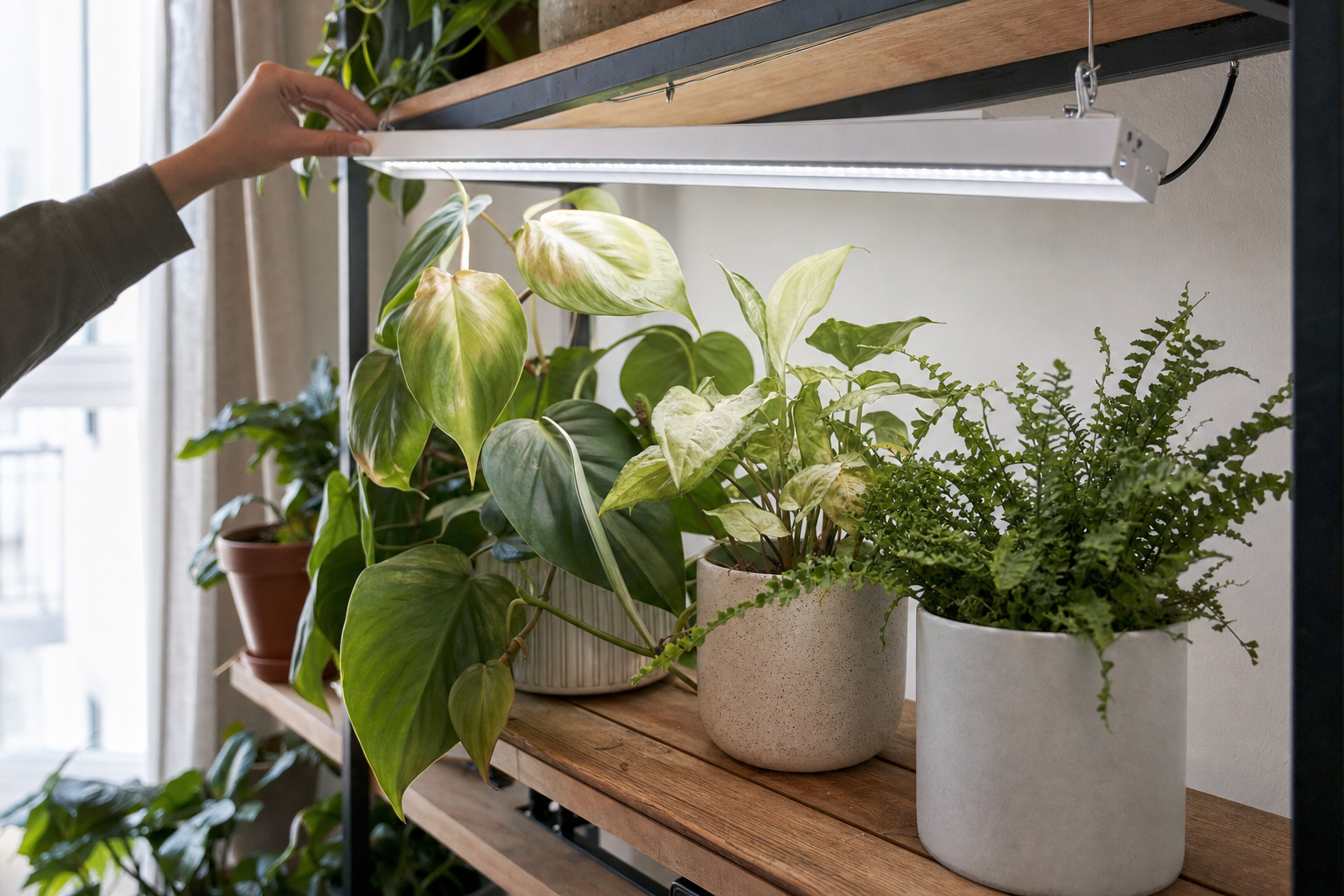
Can plants get too much grow light? Yes. A fixture can deliver more light than a plant can use, especially when it sits close to the leaves, runs at full output, or stays on for a long day. The first clues often appear on the uppermost, most exposed foliage.
One bleached spot does not prove the lamp is responsible. Dry roots, heat, fertilizer salts, pests, and ordinary leaf aging can produce similar damage. A better diagnosis comes from the pattern: where the symptoms occur, what changed in the setup, and whether the shaded leaves look different.
Can plants get too much grow light? The short answer
Plants use light for photosynthesis, but their capacity is not unlimited. University of Maryland Extension describes pale, bleached, faded, and eventually brown or brittle tissue as common symptoms of excess light. Damage can be worse when the potting mix is dry.
Three parts of the setup matter:
- Intensity: how much usable light reaches the leaves at one moment.
- Duration: how many hours the plant receives that light each day, including daylight from a window.
- Quality: the wavelengths supplied by the fixture.
Distance changes intensity quickly. A lamp that was gentle 18 inches away may be stressful after it is lowered to 6 inches, even though the wattage has not changed. Duration matters too. Maryland Extension advises against giving indoor plants more than 16 total hours of light in a day because plants also need darkness.
There is no universal safe distance or brightness setting for every plant and LED. Fixture optics, dimmer level, species, window exposure, and canopy shape all change the result. Treat the manufacturer's chart as a starting point, then read the whole plant.
Seven warning signs of excess grow light
The most useful signs form a consistent pattern. Several clues together are much stronger than one damaged tip.
1. The upper leaves turn pale or bleached
Look first at the leaves closest to the diodes. Excess light can fade green tissue toward pale green, cream, or nearly white. The change may be broad rather than sharply bordered.
Compare exposed leaves with foliage lower in the canopy. If the top layer is washed out while shaded leaves keep their normal color, the fixture deserves attention. Pale growth throughout the plant may instead point to root trouble, nutrient availability, or another care problem.
2. Dry brown patches form on the exposed side
Bleached tissue can become tan, brown, dry, and brittle. The marks often face the lamp or sit directly beneath its brightest zone. They may resemble sunscald on a plant moved abruptly into strong outdoor sun.
Do not confuse this with a leaf tip that browned after inconsistent watering. Light stress usually follows the exposure pattern. Random spots deep in the plant call for a wider investigation.
3. Leaf edges curl or cup away from the fixture
Some leaves respond by curling, cupping, or changing their angle. This is a supporting clue, not a diagnosis. Low humidity, heat, pests, and root stress can also distort foliage.
Check the leaf undersides and stem joints for insects. Feel the mix. Then note whether the curling is strongest at the top of the canopy. The location matters more than the shape alone.
4. Leaves near the lamp feel warmer and the pot dries faster
LED fixtures release less radiant heat than many older lamp types, but they are not heat free. Drivers, diodes, trapped air, and a small gap above the canopy can raise leaf temperature. Heat and excess light may arrive together.
Compare the air and leaves directly under the fixture with a shaded part of the same shelf. If the top leaves feel noticeably warm, improve airflow and check the distance in the manual. A dry root ball makes exposed tissue less resilient, so review watering without automatically soaking the pot.
5. Damage maps the fixture's brightest area
A good lighting diagnosis is partly a map. The palest or crispiest leaves often sit beneath the center of a narrow fixture or another high-output area. Plants at the edge may look normal.
Coverage can be uneven even when the shelf looks bright to your eyes. Human vision adapts too well to judge plant light by sight. Measure several points across the canopy if you have a suitable meter, or move identical plants around briefly and record their response.
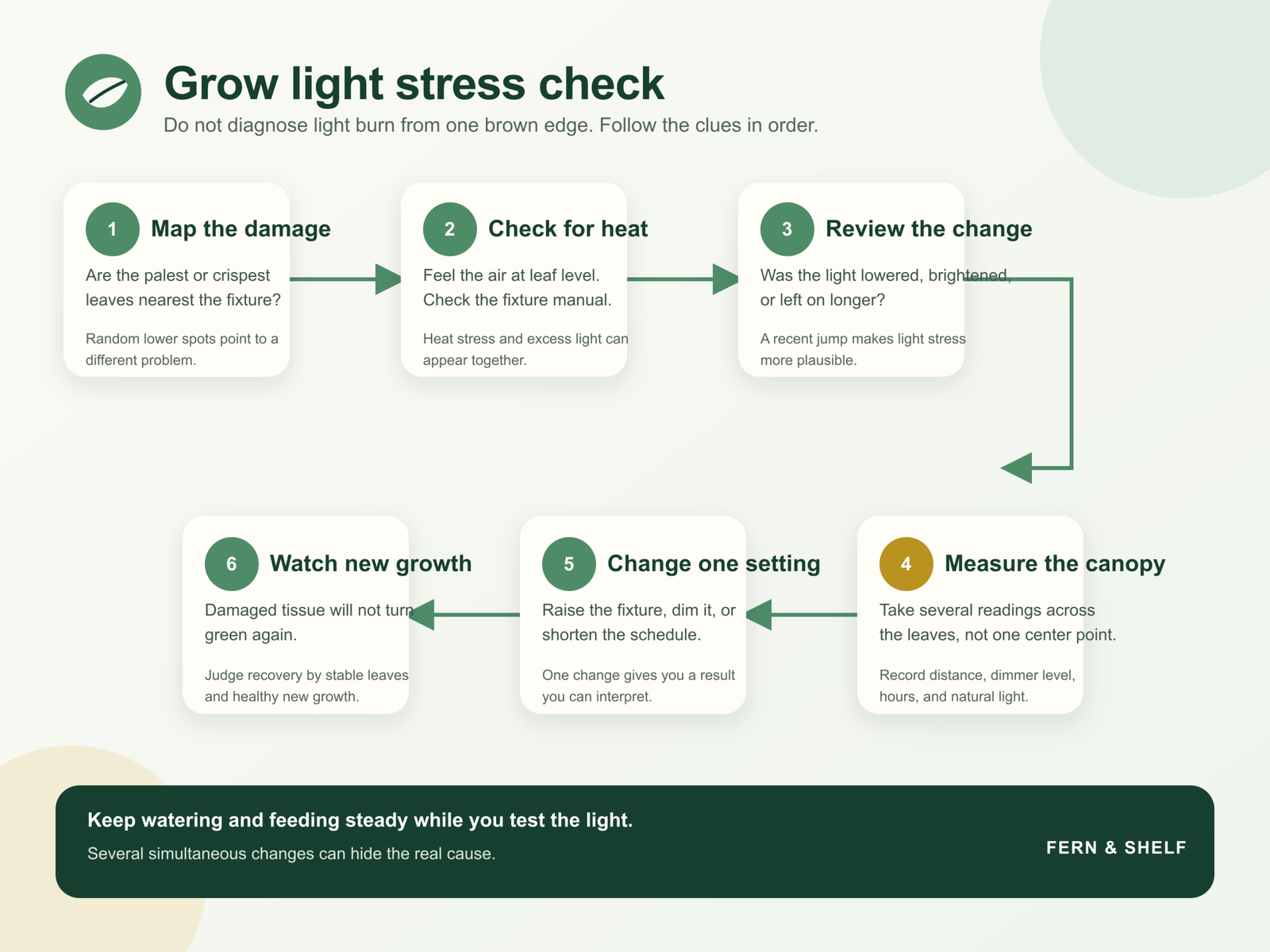
6. Symptoms followed a clear lighting change
Ask what happened before the damage appeared. Was the fixture lowered? Did you increase the dimmer? Was a timer changed from 12 hours to 16? Did longer summer daylight begin reaching the same shelf?
A recent jump makes light stress more plausible. It also gives you a sensible variable to reverse. If nothing about the light changed, inspect watering, roots, pests, fertilizer, and temperature before blaming the lamp.
7. New growth stalls while the exposed leaves keep deteriorating
Growth may slow when a plant is using its resources to cope with stress. Still, stalled growth is a weak clue on its own. Short winter days, a crowded root ball, cool temperatures, or a pest problem can do the same thing.
Use this sign only after the exposure pattern and recent setup history point in the same direction. If the plant is simply long, thin, and leaning, it may have the opposite problem. The guide to why a plant gets leggy covers insufficient light and other causes of stretching.
Light stress, heat, drought, or fertilizer?
The question "can plants get too much grow light" becomes easier when you compare lookalikes instead of naming the first brown mark.
| Clue | Excess light is more plausible when | Check before changing the lamp |
|---|---|---|
| Pale or bleached tissue | Upper exposed leaves fade first | Root health, nutrient pattern, normal variegation |
| Crisp brown areas | Damage faces the fixture or matches a bright zone | Dry mix, hot glass, cold injury, salt buildup |
| Curling leaves | The highest leaves cup away from the source | Mites, thrips, low humidity, root stress |
| Fast drying | Leaves and air are warmer beneath the lamp | Pot size, airflow, season, porous mix |
| Slow growth | It follows a large increase in light | Temperature, roots, pests, dormancy |
Normal variegation follows the plant's genetic pattern and does not become brittle simply because it is pale. Pest damage often comes with stippling, webbing, residue, insects, or distorted young growth. Fertilizer burn commonly starts at tips and margins and may coincide with a crust on the mix or pot.
If the plant is both dry and brightly lit, correct the root moisture carefully and reduce the light stress. Do not leave a saturated pot standing in a saucer. Changing every care variable at once makes the result hard to read.
How to correct too much grow light safely
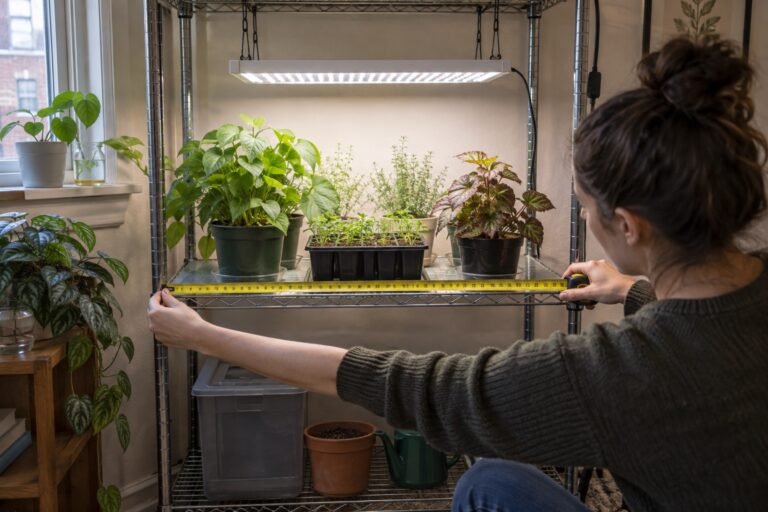
Start by recording the current setup. Measure the gap from the fixture to the tallest leaf, note the dimmer setting, list the timer hours, and include window light. A phone photo taken from the same angle will help you compare new growth later.
Then change one lighting variable:
- Raise the fixture. This is often the simplest move. Use the manufacturer's safe hanging method and the grow light distance guide for a more detailed placement check.
- Reduce the dimmer setting. Keep distance and hours steady while you test the lower output.
- Shorten the schedule. Count both the lamp and meaningful daylight. The grow light timing guide explains how to build a day with a dark period.
Search Amazon for a plug-in light timer (paid link)
Search Amazon for an adjustable LED grow light (paid link)
Search Amazon for a plant light meter (paid link)
Iowa State University Extension explains why PPFD is more useful to plants than consumer watts or lumens. It also defines daily light integral, or DLI, as the total photosynthetic light delivered across the day. If you want to measure rather than estimate, use our PPFD and DLI guide. A basic lux reading can show relative bright and dim zones, but it is not a universal conversion to PPFD.
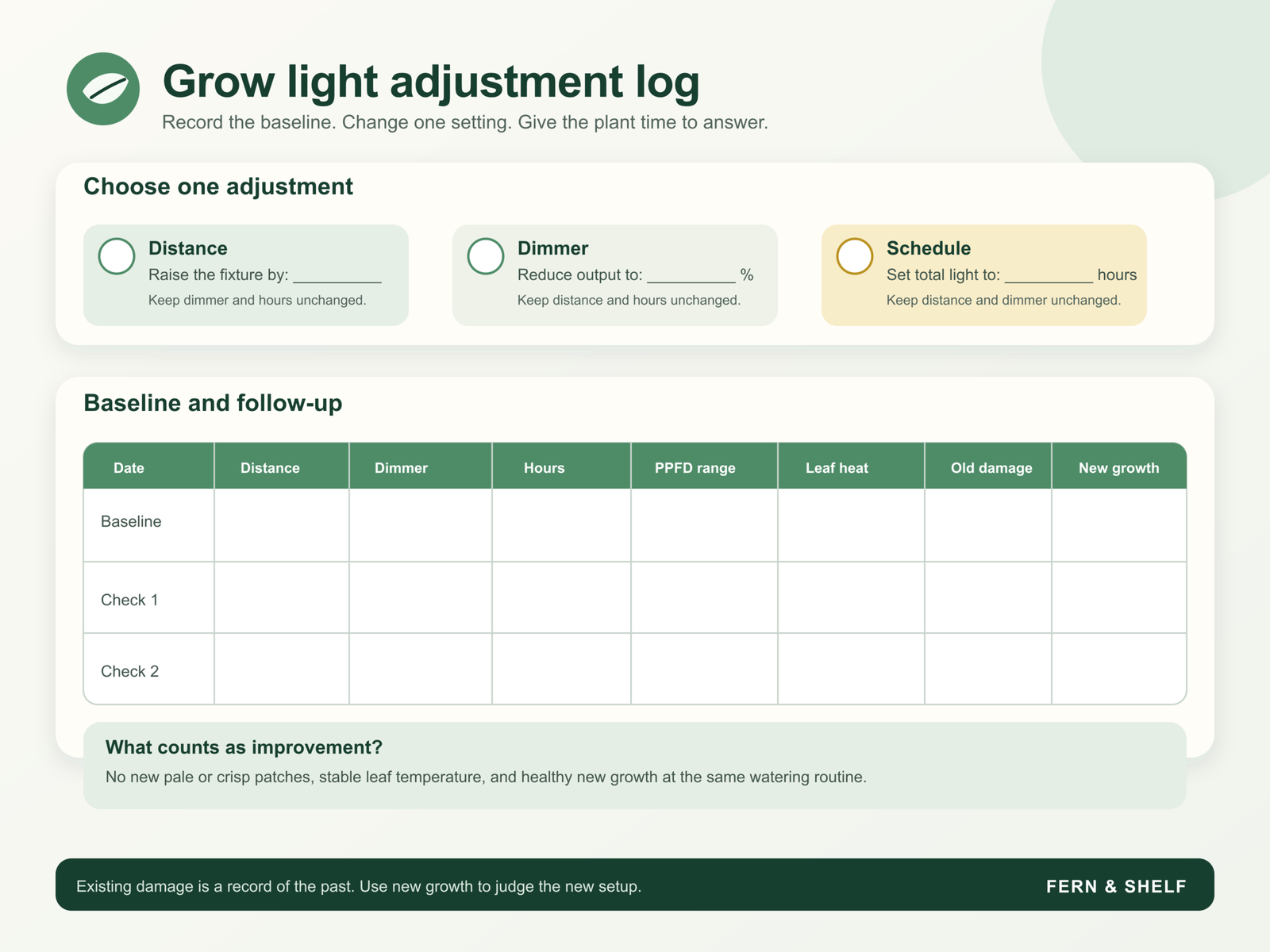
Keep watering and feeding steady while testing the change unless either practice is clearly unsafe. Check the plant over the following days and weeks. Existing bleached or crisp tissue will not turn green again. Improvement means the damage stops spreading and healthy new leaves appear.
Preventing the problem on a crowded shelf
Can plants get too much grow light when only one pot looks damaged? Absolutely. A tall plant can enter a hot spot while shorter neighbors remain comfortable. Raise small pots on stable platforms instead of lowering the fixture toward the entire shelf, or group plants with similar light needs.
Recheck the gap after pruning, repotting, and growth spurts. A timer prevents accidental all-night operation. If you are still deciding whether the shelf needs a lamp at all, see do you need a grow light. For equipment comparisons, the apartment window grow light guide and plant shelves with grow lights keep the buying decision separate from this diagnosis.
Frequently asked questions
Can plants get too much grow light from an LED?
Yes. LEDs can deliver high light intensity even when they do not feel as hot as an older lamp. Distance, output, daily duration, optics, and species all matter. Check the fixture instructions and the plant's exposure pattern.
How many hours should a grow light stay on?
There is no single schedule for every plant. University of Minnesota Extension gives crop-specific examples and stresses that placement matters. Maryland Extension recommends no more than 16 total hours for indoor plants. Count natural light too, and preserve a dark period.
Will bleached leaves become green again?
No. Once tissue has been bleached or turned crisp, judge the new setup by undamaged leaves and new growth. Remove an old leaf only when the plant can spare it or the tissue is clearly dead.
Should I water more if the lamp is too bright?
Not automatically. Dry roots can make light damage worse, but extra water in an already wet pot creates a second problem. Check the mix and pot weight, water thoroughly only when appropriate, and let excess drain.
Can a cheap light meter diagnose excess light?
It can help map relative bright and dim areas, but a lux meter does not directly report plant-usable PPFD without limitations. A PAR meter is more relevant for PPFD. Either tool still needs species guidance, a fixture map, and observation of the plant.
Make one change and watch the next leaves
When you ask can plants get too much grow light, the answer is useful only if it leads to a careful test. Map the damage, review recent changes, rule out heat and root trouble, then raise, dim, or shorten the lamp. Healthy new growth is the clearest sign that the new setting fits.
Sources and further reading
- University of Maryland Extension: Excess Light on Indoor Plants
- University of Maryland Extension: Lighting for Indoor Plants
- University of Minnesota Extension: Lighting for Indoor Plants and Starting Seeds
- Iowa State University Extension: Important Considerations for Supplemental Light
- Iowa State University Extension: How to Set Up Supplemental Lights