Hydroponic Nutrients for Beginners: 7 Costly Mistakes
Last updated: August 5 2026.
Affiliate disclosure: As an Amazon Associate I earn from qualifying purchases. Links marked “paid link” may earn Fern & Shelf a commission at no extra cost to you. Read our full Affiliate Disclosure.
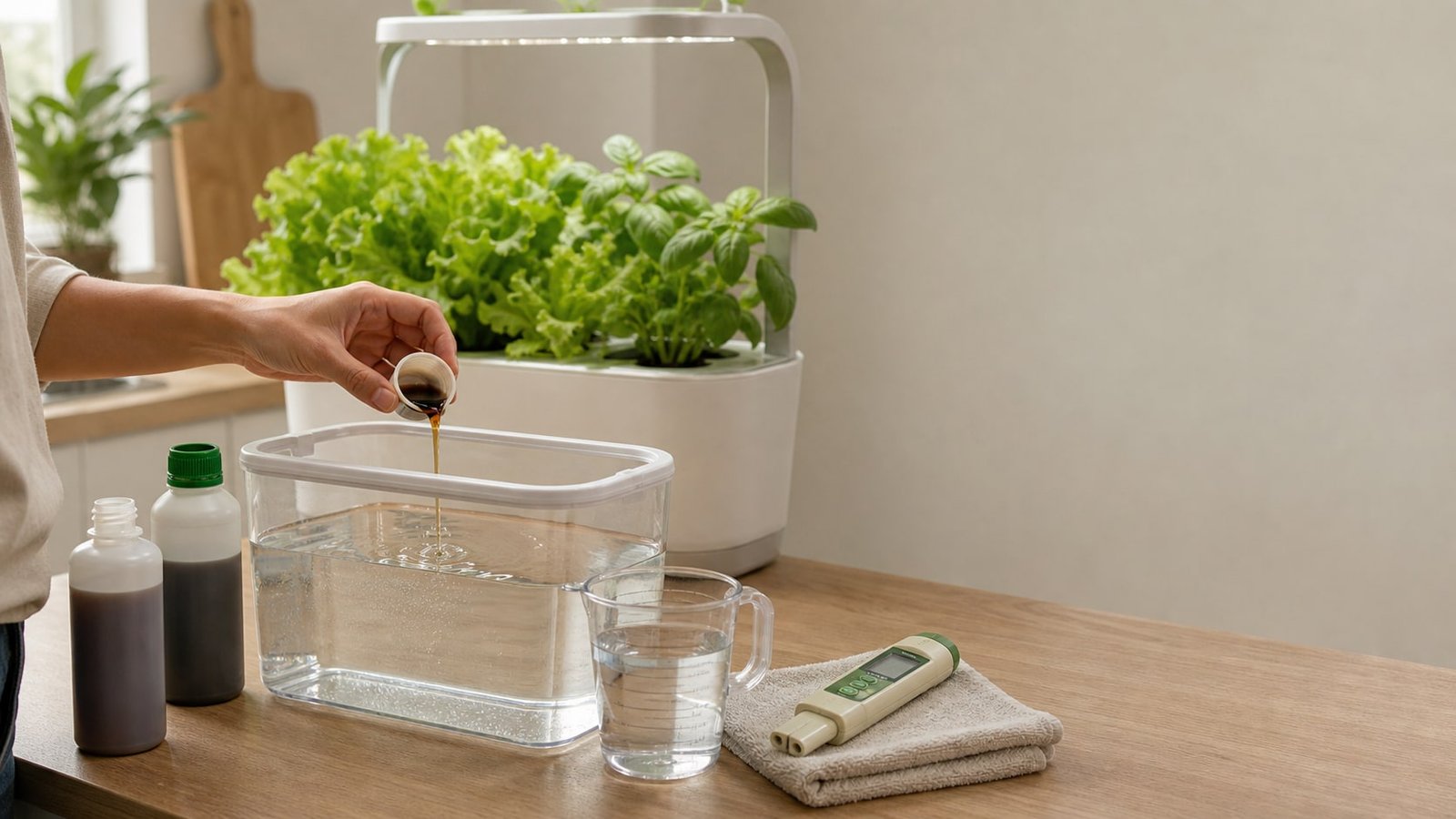
Hydroponic nutrients for beginners are easier to manage when you stop treating the reservoir like a soup recipe. Forget the hunt for one magic dose. Follow the product label, understand your starting water, mix in the right order, and keep a short record of what the system does.
That approach matters because the same bottle can behave differently in two homes. Crop, growth stage, reservoir size, source water, temperature, and water use all change the picture. A number copied from a forum may be perfectly reasonable for someone else’s lettuce and still be wrong for your basil.
These seven mistakes can waste nutrient solution, replacement parts, time, or a crop. The article does not provide a universal pH target, EC target, replacement schedule, or acid and base recipe. Those choices must match the crop, system, water, and instructions supplied with the nutrient product.
The simple framework
| Question | What answers it |
|---|---|
| What should I add? | A complete hydroponic nutrient label written for your crop or system |
| How much should I add? | The label dose for the actual volume of water |
| Did the solution mix as expected? | A stable EC reading compared with your source water and product guidance |
| Can roots access the nutrients? | Crop-appropriate pH, healthy roots, oxygen, flow, and temperature |
| Is the reservoir still balanced? | Trends, top-up history, plant response, and periodic replacement based on the system |
If the equipment itself is still undecided, begin with our guide to the best hydroponic systems for beginners. A small, understandable reservoir is a better classroom than a complicated system with several hidden variables.
For hydroponic nutrients for beginners, this framework is enough to make the first batch carefully and understand what to check next.
Hydroponic nutrients for beginners: the label-first method
A beginner does not need to formulate fertilizer from individual salts. A complete product designed for hydroponics removes much of that calculation. The label should identify the intended use, list the supplied elements, explain whether the product has one or more parts, and give directions for your reservoir volume.
University of Minnesota Extension recommends choosing a hydroponic fertilizer for the crop being grown and following its per-gallon directions. It also notes that crops with different nutrient requirements may be easier to manage in separate containers.
Use this order of authority:
- The nutrient label and the system manual.
- Crop-specific guidance from a university Extension source.
- Your source-water reading and a calibrated trend log.
- General advice from other growers.
The fourth item can offer clues, but it should not overrule the first three.
Mistake 1: Using a fertilizer that is not complete for hydroponics
Plants need more than the three large numbers printed on a typical garden fertilizer. A hydroponic root zone has no soil reserve to help fill in missing elements. The nutrient program must supply the necessary macro and micronutrients in soluble forms that fit the system.
Do not assume that a general houseplant fertilizer, compost tea, or bottle labeled “natural” is a direct substitute. Check whether the product is intended for hydroponics and edible crops, if you are growing food. Then check whether it is complete by itself or requires a companion part.
Missouri Extension advises reading the label for water solubility, the number of parts, the listed elements, and the expected EC information when provided. That is much more useful than choosing by bottle color or online popularity.
When choosing hydroponic nutrients for beginners, a clearly labeled one-part or two-part product is usually easier to audit than a homemade formula.
Search Amazon for complete two-part hydroponic nutrients (paid link)
Before buying, read the current listing and manufacturer label. Confirm the crop, number of parts, measuring units, shelf-life instructions, and whether anything else must be supplied.
Mistake 2: Skipping the source-water baseline
The reservoir does not begin at zero. Tap and well water may already contain dissolved salts and alkalinity. Those affect the first EC reading, how readily pH moves, and how the final solution behaves.
Oklahoma State University Extension identifies pH, EC, alkalinity, and nutrient ratios as central parts of soilless nutrient management. It recommends water analysis because source water can carry sodium, calcium, magnesium, bicarbonates, chlorides, and sulfates.
For a modest home system, start with a repeatable baseline:
- Fill a clean container with the water you normally use.
- Measure its EC and pH with calibrated equipment.
- Record the water source, date, and readings.
- If scaling, deposits, or unstable pH keep appearing, ask a local Extension office or accredited lab about alkalinity and mineral testing.
This baseline keeps you from blaming the fertilizer for a reading that was already present in the water. It also gives useful context if you later change from tap water to filtered water.
Do not “correct” the source water from a generic internet recipe. First make the complete nutrient solution according to its label, because fertilizer itself can change both EC and pH.
Mistake 3: Mixing concentrates together
Two-part nutrients are separated for a chemical reason. At high concentration, calcium can react with phosphates or sulfates and form a solid precipitate. Once that material falls out of solution, it is no longer available to roots in the intended way.
Penn State Extension explains that concentrated calcium should be kept apart from concentrated phosphates and sulfates. New Mexico State University likewise advises keeping A and B concentrates separate and following the product’s mixing directions.
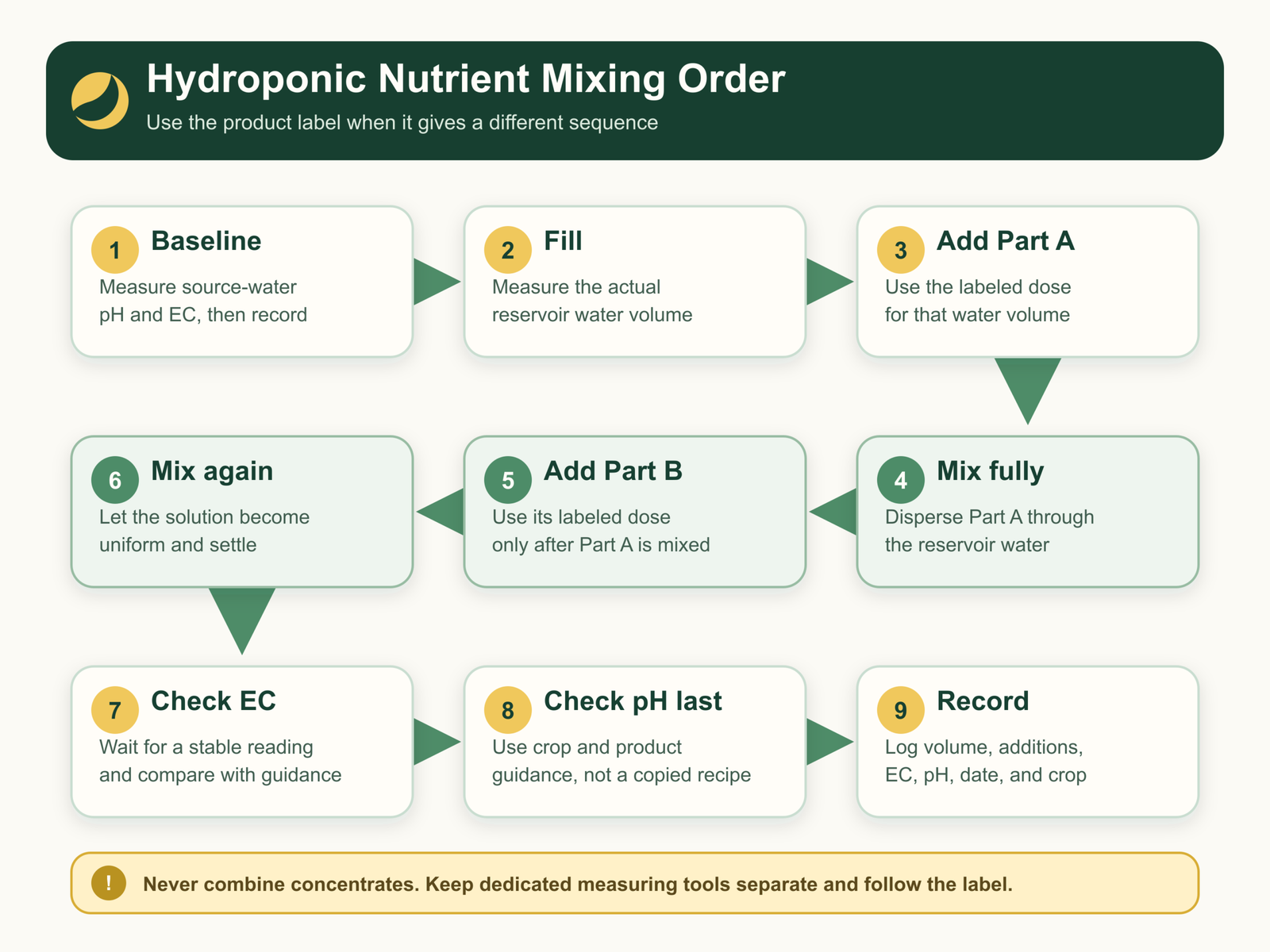
Use this sequence unless the label gives a different one:
- Measure the actual reservoir water.
- Add Part A at the labeled dose.
- Mix it fully into the water.
- Add Part B at the labeled dose.
- Mix again and allow the solution to settle.
- Check EC.
- Check pH last.
Never pour Part A into Part B in a measuring cup. Never use one wet dropper for both bottles. If the label calls for more than two components, add each separately and mix between additions.
A dedicated measuring tool for each concentrate reduces accidental cross-contamination. Rinse tools as the manufacturer directs and store the bottles closed, upright, and away from children and pets.
Mistake 4: Treating pH and EC as the same measurement
These numbers answer different questions.
The pH and EC side of hydroponic nutrients for beginners becomes much clearer once each reading has one job.
EC reflects how well the solution conducts electricity. Dissolved fertilizer salts contribute ions, so EC can help estimate the solution’s overall ionic concentration. It cannot tell you how much calcium, nitrogen, or iron is present, and it cannot prove that those elements remain in the right proportion.
pH describes how acidic or basic the solution is at that moment. It affects nutrient availability at the roots. A reservoir can have an expected EC and an unsuitable pH, or the reverse.
The practical order is nutrients first, EC next, and pH last. Oklahoma State’s guide uses that order because adding fertilizer changes the solution. Measure only after thorough mixing and after the meter reading has stabilized.
Search Amazon for a hydroponic pH and EC meter (paid link)
Match any target to the crop and product guidance. Lettuce, basil, and fruiting crops do not automatically share one ideal value. If you grow several crops in one reservoir, their overlapping needs matter more than a popular screenshot.
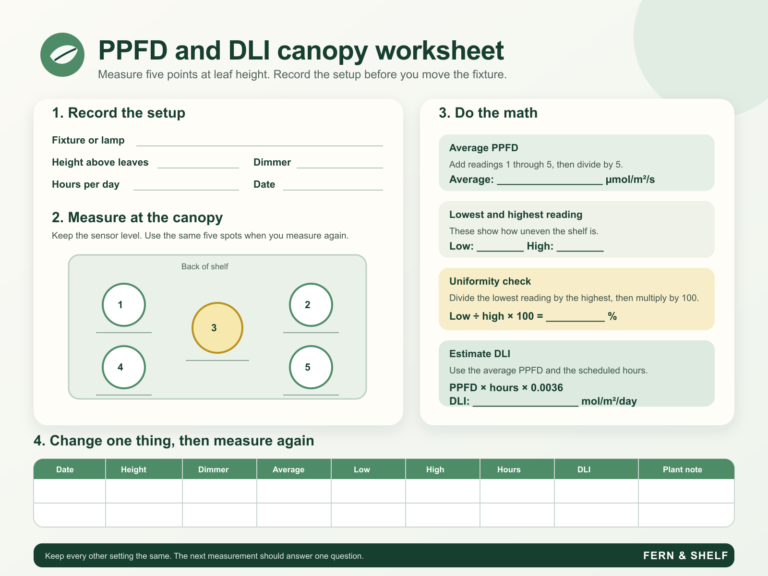
Light also changes how quickly plants use water and nutrients. Our PPFD and DLI guide for indoor plants explains the lighting side without pretending that fertilizer can compensate for a dim canopy.
Mistake 5: Chasing every reading
A meter is only helpful if it is clean, calibrated, stored correctly, and given time to stabilize. One odd reading is a reason to verify, not a command to pour something into the reservoir.
Start by rinsing and checking the probe according to its manual. Recalibrate on the schedule and with the solutions specified by the manufacturer. Then measure again at a consistent time and in a well-mixed reservoir.
Search Amazon for pH and EC meter calibration solutions (paid link)
A short log makes the readings useful. Note:
- date and time;
- source water;
- reservoir volume;
- product and labeled dose;
- EC and pH after mixing;
- water or nutrient added later;
- root appearance and a brief plant note.
Trends are more informative than constant correction. If a reading changes unexpectedly, confirm the meter, water level, and recent additions before making another adjustment. Do not alternate acid and base in pursuit of a perfect decimal. Use only a product intended for the crop and system, follow its safety label, and make the smallest supported correction.
Mistake 6: Topping off forever
Plants and evaporation remove water, but plants do not take every nutrient at the same rate. A top-up can restore volume without restoring the original balance. EC still cannot reveal which individual ions accumulated and which were depleted.
This is why “always add plain water” and “always add nutrient solution” are both too simple. The right top-up depends on the observed EC trend, source water, crop stage, reservoir size, and the instructions for the system.
University of New Hampshire Extension explains that nutrient ratios shift over time and that change frequency is difficult to predict across systems. University of Minnesota makes the same point: a fast leafy crop and a long-running tomato crop do not create the same maintenance schedule.
Use these boundaries:
- Replace water lost from the reservoir before roots are left without the intended water contact.
- Follow the system and nutrient instructions for whether a top-up uses water or premixed solution.
- Record every top-up, because repeated small additions are easy to forget.
- Replace the complete solution when the label, crop cycle, persistent drift, contamination, or system condition calls for it.
- Clean the reservoir and wetted parts between crops.
The hydroponic system cleaning guide covers the physical cleaning sequence. Do not automatically pour old nutrient solution down a drain. Follow local disposal rules. Where local guidance allows, Extension sources suggest using it responsibly on garden soil or established landscape plants rather than sending nitrogen and phosphorus into wastewater.
Mistake 7: Diagnosing a leaf before checking the system
Yellowing, brown edges, and slow growth do not name a missing nutrient by themselves. Similar symptoms can follow weak light, damaged roots, poor oxygenation, heat, disease, incorrect pH, high salt concentration, or a faulty meter.
Before adding fertilizer, work through the reservoir:
- Confirm the meter with its calibration procedure.
- Check water level, circulation, aeration, and unusual temperature changes.
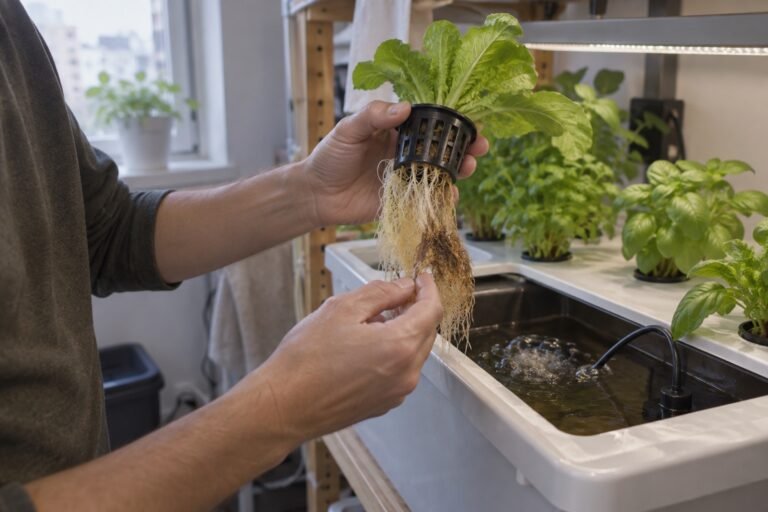
- Look for roots that are brown or mushy, then check whether aeration, flow, or reservoir temperature changed.
- Look for algae, residue, blocked tubing, and failed pumps.
- Review the pH and EC trend rather than one reading.
- Review the label dose and every recent top-up.
- Check whether the light schedule or canopy distance changed.
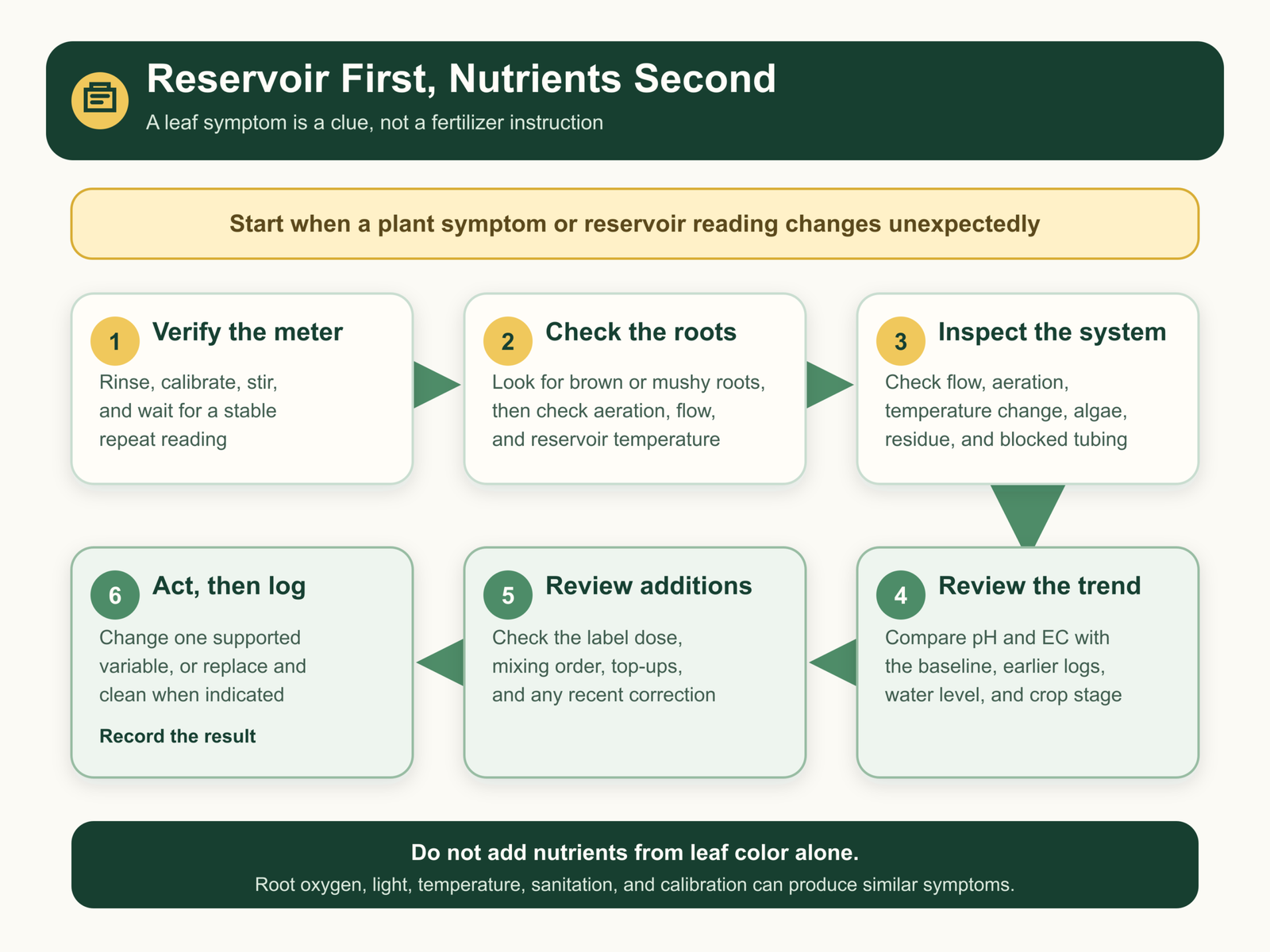
UNH Extension advises examining roots and oxygenation when plants look stunted or unhealthy. That pause matters. Adding more nutrients to roots that cannot breathe can make the diagnosis harder.
Our guide to why houseplant leaves turn yellow explains why leaf color is a symptom rather than a single diagnosis. For a countertop unit, the maintenance limits in are smart indoor gardens worth it and the options in best AeroGarden alternatives can also help set realistic expectations.
A repeatable reservoir routine
Keep the routine boring. That is a compliment.
On mixing day, note the source-water baseline, actual volume, label dose, final EC, and final pH. During the crop, check water level and equipment function, then measure on a consistent schedule that fits the system manual and plant demand. Log additions. Look at roots before assuming a leaf symptom is nutritional.
Change one supported variable at a time. If several things change together, even a recovery will not tell you what helped.
Frequently asked questions
Can I use regular houseplant fertilizer in hydroponics?
A general soluble fertilizer may work only if it supplies a complete nutrient program for the crop and system, but that is harder for a beginner to verify. Soil and potting mixes can buffer or supply elements that a water-only root zone cannot. A clearly labeled hydroponic formula is the simpler beginner choice.
Do beginners need both pH and EC meters?
They answer different questions, so both can be useful in a refillable system. A sealed countertop kit may rely more heavily on its own nutrient and maintenance instructions. If you buy meters, calibration and proper storage matter as much as the display.
Should I adjust pH before or after adding nutrients?
Check the source-water baseline, add and fully mix nutrients according to the label, check EC, and check pH last. Do not copy an acid or base dose from another reservoir. Use the product label and crop-specific guidance.
Can I mix Part A and Part B together?
Not as concentrates. Add each part separately to the reservoir water and mix thoroughly between additions, unless the manufacturer gives another explicit sequence.
How often should I replace hydroponic nutrient solution?
There is no honest universal interval. Crop duration, reservoir size, temperature, water quality, top-up history, sanitation, and system design all matter. Follow the manual and nutrient label, watch trends, and replace the solution when the crop or reservoir condition calls for it.
Does yellowing mean the plants need more nutrients?
Not necessarily. Check roots, oxygen, flow, light, temperature changes, meter calibration, pH, EC, and recent additions first. A symptom can narrow the search, but it does not identify one missing element on sight.
What matters most when learning hydroponic nutrients for beginners?
Use a complete product, follow its label, start with known water, keep concentrates separate, and record what changes. A repeatable process is more useful than memorizing a target from another crop or reservoir.
A better first goal than perfect numbers
A motionless meter reading is the wrong goal for hydroponic nutrients for beginners. Aim for a repeatable process: label first, known water, separate mixing, calibrated measurements, documented top-ups, and a clean reservoir.
Once those basics are steady, pH and EC become useful clues instead of numbers to chase.
Related guides and tools
Sources and further reading
- University of Missouri Extension: Hydroponic Nutrient Solutions
- Oklahoma State University Extension: Electrical Conductivity and pH Guide for Hydroponics
- Penn State Extension: Hydroponics Systems, Nutrient Solution Programs and Recipes
- University of Minnesota Extension: Small-scale Hydroponics
- University of New Hampshire Extension: Hydroponics at Home
- New Mexico State University: Hydroponics, Water-saving Farming for New Mexico’s Arid Environment